

Close Menu
  • Home
  • United States
  • World
  • Politics
  • Business
  • Lifestyle
  • Entertainment
  • Health
  • Science
  • Tech
  • Sports
  • More
    • Web Stories
    • Editor’s Picks
    • Press Release

Subscribe to Updates

Get the latest USA news and updates directly to your inbox.

What's On
Who Is Controversial Influencer Clavicular? Meet Braden Peters and Get Details on ‘Looksmaxxing’

Who Is Controversial Influencer Clavicular? Meet Braden Peters and Get Details on ‘Looksmaxxing’

April 15, 2026
Ex-MLB pitcher convicted of murder breaks silence from prison: ‘I got crucified’

Ex-MLB pitcher convicted of murder breaks silence from prison: ‘I got crucified’

April 15, 2026
‘Something’s missing’: Most thorough-ever study of the cosmos proves we still can’t explain how the universe is expanding

‘Something’s missing’: Most thorough-ever study of the cosmos proves we still can’t explain how the universe is expanding

April 15, 2026
Facebook X (Twitter) Instagram
Trending
  • Who Is Controversial Influencer Clavicular? Meet Braden Peters and Get Details on ‘Looksmaxxing’
  • Ex-MLB pitcher convicted of murder breaks silence from prison: ‘I got crucified’
  • ‘Something’s missing’: Most thorough-ever study of the cosmos proves we still can’t explain how the universe is expanding
  • Men may be doubling their partner’s risk of miscarriage with a single controversial habit
  • Booking.com hackers use hotel messaging to send fake requests to customers — is your vacation reservation protected?
  • Following nude-deepfake outcry, Apple nearly kicked Grok off App Store: report
  • Leavitt: ‘We feel good about the prospects’ of Iran deal
  • Hasan Piker tells Yale students the American Empire will inevitably fall
  • Privacy
  • Terms
  • Advertise
  • Contact Us
Join Us
USA TimesUSA Times
Newsletter Login
  • Home
  • United States
  • World
  • Politics
  • Business
  • Lifestyle
  • Entertainment
  • Health
  • Science
  • Tech
  • Sports
  • More
    • Web Stories
    • Editor’s Picks
    • Press Release
USA TimesUSA Times
Home » ‘Interstellar messenger’ 3I/ATLAS could be nearly as old as the universe itself, James Webb telescope observations reveal
‘Interstellar messenger’ 3I/ATLAS could be nearly as old as the universe itself, James Webb telescope observations reveal
Science

‘Interstellar messenger’ 3I/ATLAS could be nearly as old as the universe itself, James Webb telescope observations reveal

News RoomBy News RoomMarch 12, 20261 ViewsNo Comments

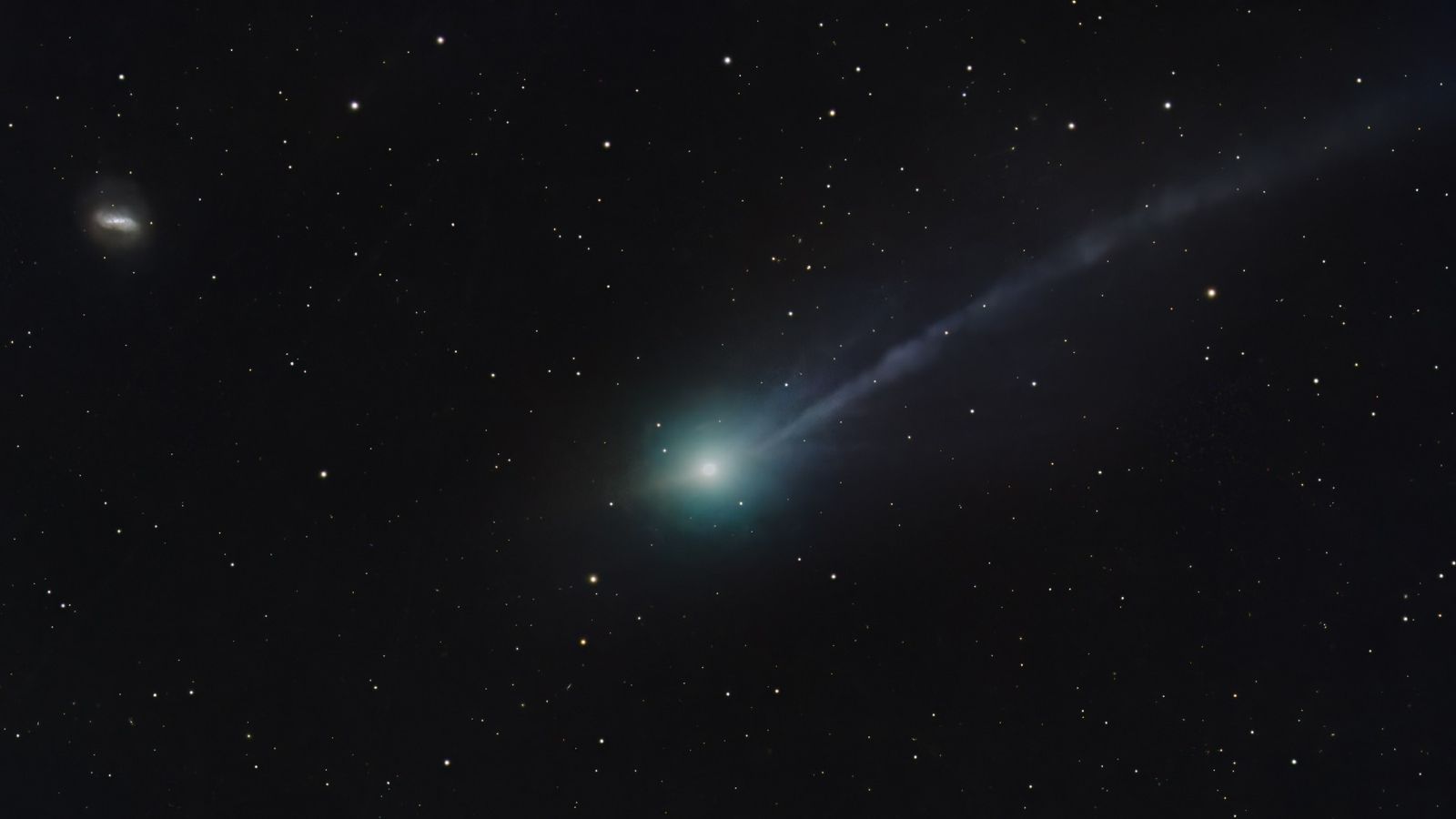
Interstellar comet 3I/ATLAS is up to 12 billion years old and unlike anything found in our solar system, new James Webb Space Telescope (JWST) observations suggest.

Comet 3I/ATLAS became a celestial celebrity last year after the interstellar visitor was discovered hurtling through our cosmic neighborhood. Not long after, online speculation suggested that the space rock could be an alien spacecraft. However, most astronomers are confident that 3I/ATLAS is a comet from an unknown star system.

Now, new preliminary findings from a study posted to the preprint server Research Square, which are still under peer review, suggest the comet formed in a cold and distant region of the Milky Way around 10 billion to 12 billion years ago. That would make comet 3I/ATLAS more than twice as old as Earth (4.5 billion years old) and our solar system (4.6 billion years old), and at its upper range, not far off the ages of our Milky Way galaxy and the universe itself (about 13.6 and 13.8 billion years old).

Article continues below


You may like

Researchers already knew from the comet’s speed and trajectory that it was potentially the oldest comet ever seen. Previous estimates put the comet’s age at somewhere between 3 billion and 11 billion years old. The new findings further narrowed down the comet’s age and origin by looking at isotope measurements taken by JWST when the comet flew past Earth in December 2025.

“They show that 3I/ATLAS isotopic composition is very different from solar system comets and suggest that it likely formed 10-12 billion years ago,” Romain Maggiolo, a research scientist at the Royal Belgian Institute for Space Aeronomy who was not involved in the study, told Live Science in an email. “In other words, 3I/ATLAS formed in a stellar environment different from ours, not only somewhere else in space, but also at a much earlier time in the history of the Milky Way.”

Comet 3I/ATLAS is only the third interstellar object ever recorded in our solar system. The space rock, which Hubble Space Telescope observations suggest is somewhere between 1,400 feet (440 meters) and 3.5 miles (5.6 kilometers) wide, zoomed into our solar system at around 137,000 mph(221,000 km/h) last year before slingshotting around the sun.

After reaching its closest point to our star, known as perihelion, on Oct. 29, 2025, the comet then made its closest approach to Earth on Dec. 19, when it came within about 168 million miles (270 million km) of our planet. JWST made the observations that have been analyzed in the new study a few days later on Dec. 22.

Get the world’s most fascinating discoveries delivered straight to your inbox.

A relic from the ancient universe

Comets heat up as they fly closer to stars, which causes ice on their surfaces to sublimate into gas. By studying the composition of this gas, researchers can start to figure out what they’re made of and the conditions in which they formed.

The authors of the new preprint looked at the ratio of isotopes, or versions of elements, in material outgassed by 3I/ATLAS. They found that the comet’s water is more enriched in deuterium, a heavier hydrogen isotope, than any previously studied comet, while its ratio of carbon isotopes also exceeded levels normally seen in our solar system.

The results offer clues to what conditions may have been like in whatever ancient planetary systems forged the comet in the early years of the Milky Way.


What to read next

“If 3I/ATLAS is indeed as old as this study suggests, the large amounts of volatile molecules it contains indicate that rich prebiotic chemistry may already have been occurring in star-forming regions very early in the history of our Galaxy,” Maggiolo said.

The results also indicate that the comet formed in a cold environment that was around 30 kelvins (minus 406 degrees Fahrenheit, or minus 243 degrees Celsius), likely in a dense and well-shielded protoplanetary disk, according to the study.

While the study is still in the preprint stage, Maggiolo, who has studied comet 3I/ATLAS as part of his own research, didn’t have any major concerns about it. The new measurements help researchers “better understand this interstellar messenger,” he said.

3I/ATLAS likely originated somewhere within the Milky Way’s thick disk (red lines) before crossing paths with our sun along its orbit around the galaxy (yellow lines). (Image credit: M. Hopkins/Ōtautahi-Oxford team. Base map: ESA/Gaia/DPAC, Stefan Payne-Wardenaar, CC-BY-SA 4.0)

Josep Trigo-Rodríguez, the research principal investigator of the Asteroids, Comets and Meteorites research group at the Institute of Space Sciences (CSIC/IEEC) in Spain who has previously identified erupting “ice volcanoes” on comet 3I/ATLAS, described the new findings as a good compilation of scientific results, using different techniques from well-recognized experts.

“This manuscript exemplifies that interstellar comets are unique bodies that are able to sample remote regions of our Milky Way galaxy,” Trigo-Rodríguez told Live Science in an email.

There’s a good chance that researchers will never know which star system birthed comet 3I/ATLAS. The comet has likely been traveling through space for billions of years and has come a very long way in that time. Maggiolo’s own research has found evidence that the object is extremely irradiated, with all that time in space exposing it to cosmic rays that could have fundamentally altered its chemical composition, making its origins more difficult to decipher.

“The isotopic composition of the material outgassed by 3I/ATLAS provides a crucial new piece of the puzzle,” Maggiolo said. “But the puzzle is far from being complete!”

Finding those puzzle pieces is a race against time for astronomers, as comet 3I/ATLAS is now hurtling out of the solar system. It’s currently passing Jupiter, where it is expected to make its closest approach on Sunday (March 15). The comet will come within about 33 million miles (54 million km) of the gas giant — much closer than it got to Earth.

The interstellar traveller will then continue its journey away from us, crossing Saturn’s orbit in July, Uranus’ orbit in April 2027 and Neptune’s orbit in March 2028. You can track the comet using NASA’s Eyes on the Solar System simulation of the comet’s trajectory.


Share. Facebook Twitter LinkedIn Telegram WhatsApp Email

Keep Reading

‘Something’s missing’: Most thorough-ever study of the cosmos proves we still can’t explain how the universe is expanding

‘Something’s missing’: Most thorough-ever study of the cosmos proves we still can’t explain how the universe is expanding

Artemis II quiz: Is your knowledge of NASA’s historic moon mission out of this world?

Artemis II quiz: Is your knowledge of NASA’s historic moon mission out of this world?

Strange mammal ancestor laid huge, leathery eggs —‬ and it was key to surviving the world’s worst mass extinction

Strange mammal ancestor laid huge, leathery eggs —‬ and it was key to surviving the world’s worst mass extinction

73 moon landings? NASA’s ‘Moon Base User’s Guide’ reveals the agency’s ‘most ambitious space project’ will be fraught with challenges

73 moon landings? NASA’s ‘Moon Base User’s Guide’ reveals the agency’s ‘most ambitious space project’ will be fraught with challenges

Diagnostic dilemma: A woman heard voices telling her she had a brain tumor ‪—‬ and scans confirmed she did

Diagnostic dilemma: A woman heard voices telling her she had a brain tumor ‪—‬ and scans confirmed she did

Triassic croc relative from Ghost Ranch, New Mexico finally identified after nearly 80 years in museum basement

Triassic croc relative from Ghost Ranch, New Mexico finally identified after nearly 80 years in museum basement

There were ‘audible screams of delight:’ Why Artemis II sightings of meteor flashes on the moon have scientists giddy

There were ‘audible screams of delight:’ Why Artemis II sightings of meteor flashes on the moon have scientists giddy

Physicists just witnessed pinpricks of darkness moving faster than the speed of light ‪—‬ without breaking the laws of relativity

Physicists just witnessed pinpricks of darkness moving faster than the speed of light ‪—‬ without breaking the laws of relativity

Mini lake meets snowy rim of Canada’s oldest ice mass — Earth from space

Mini lake meets snowy rim of Canada’s oldest ice mass — Earth from space

Add A Comment
Leave A Reply Cancel Reply

Editors Picks

Ex-MLB pitcher convicted of murder breaks silence from prison: ‘I got crucified’

Ex-MLB pitcher convicted of murder breaks silence from prison: ‘I got crucified’

April 15, 2026
‘Something’s missing’: Most thorough-ever study of the cosmos proves we still can’t explain how the universe is expanding

‘Something’s missing’: Most thorough-ever study of the cosmos proves we still can’t explain how the universe is expanding

April 15, 2026
Men may be doubling their partner’s risk of miscarriage with a single controversial habit

Men may be doubling their partner’s risk of miscarriage with a single controversial habit

April 15, 2026
Booking.com hackers use hotel messaging to send fake requests to customers — is your vacation reservation protected?

Booking.com hackers use hotel messaging to send fake requests to customers — is your vacation reservation protected?

April 15, 2026

Subscribe to News

Get the latest USA news and updates directly to your inbox.

Latest News
Following nude-deepfake outcry, Apple nearly kicked Grok off App Store: report

Following nude-deepfake outcry, Apple nearly kicked Grok off App Store: report

April 15, 2026
Leavitt: ‘We feel good about the prospects’ of Iran deal

Leavitt: ‘We feel good about the prospects’ of Iran deal

April 15, 2026
Hasan Piker tells Yale students the American Empire will inevitably fall

Hasan Piker tells Yale students the American Empire will inevitably fall

April 15, 2026
Facebook X (Twitter) Pinterest WhatsApp TikTok Instagram
© 2026 USA Times. All Rights Reserved.
  • Privacy Policy
  • Terms
  • Advertise
  • Contact

Type above and press Enter to search. Press Esc to cancel.