In a first-of-its-kind discovery, astronomers claim they have directly measured the magnetic fields of multiple planets beyond our solar system — potentially providing a crucial new tool in the search for habitable planets and alien life.
Magnetic fields exert a vital influence on planetary atmospheres and, therefore, their ultimate fate and prospects for habitability. We know, for example, that Earth’s magnetic field has long protected our planet from harmful radiation, allowing our world to become a flourishing blue-green planet while inert Mars has grown barren and ostensibly dead.
The importance of a guardian magnetosphere is clearly evident. Yet magnetic fields on exoplanets, or alien worlds that orbit stars beyond our solar system, have remained poorly constrained, until now.
In a study published Tuesday (June 2) in the journal Nature Astronomy, a massive, multinational team of astronomers observed seven sizzling planets and found that their winds were slower than expected, suggesting that magnetic fields were slowing them down.
“This breakthrough opens a completely new window on exoplanet research,” study co-author Julia Seidel, an astronomer at the Lagrange Laboratory in Nice, France, said in a statement. “It’s the first time we can compare the magnetic environments of other worlds — a key step toward ultimately understanding which planets can stay alive, keep their water, and perhaps even, one day, host life as we know it.”
Unexpected astronomy
The researchers were not specifically seeking exoplanetary magnetic fields. Instead, they sought to determine whether winds throughout the cosmos behave similarly on hot planets.
So they focused on seven “ultra-hot Jupiters,” or sizzling gas giants swirling so close to their stellar parents that they’re tidally locked, with one side always facing their star and the other side perpetually drenched in darkness.
Get the world’s most fascinating discoveries delivered straight to your inbox.
Under such intense stellar irradiation, these seven planets attain estimated equilibrium temperatures of approximately 2,600 Kelvin (over 4,200 degrees Fahrenheit), whipping up unimaginable winds ranging from nearly 4,500 miles (7,200 kilometers) per hour to almost 16,000 mph (25,000 kmh). For comparison, our own not-so-hot Jupiter only manages to power winds to a relatively tame 900 mph (1,500 kmh).
The researchers clocked these otherworldly wind speeds using the ESPRESSO instrument on the European Southern Observatory’s Very Large Telescope in Chile and the MAROON-X instrument on the Gemini North telescope in Hawaii.
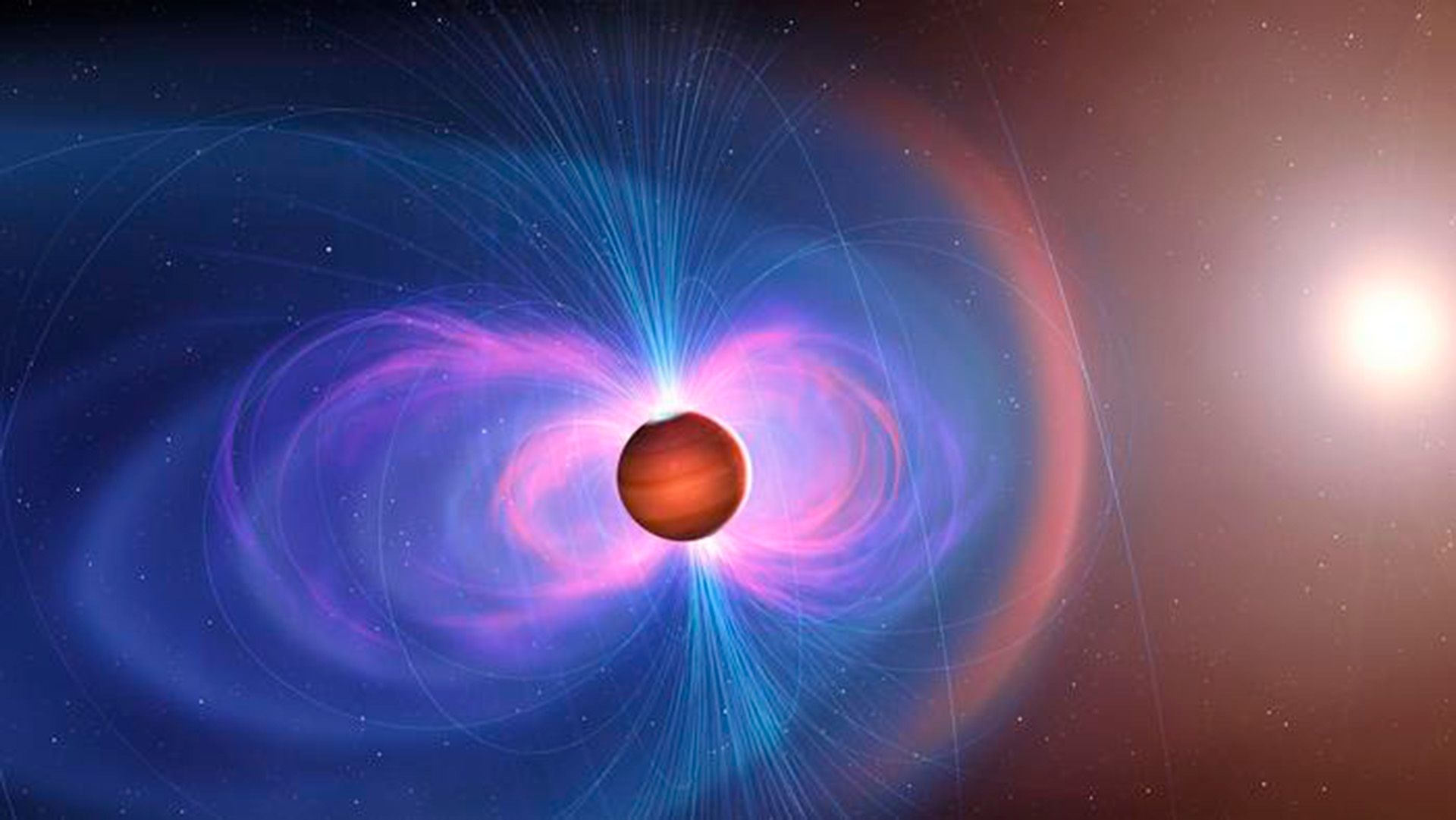
Illustration showing a hot Jupiter exoplanet that’s in tight proximity and tidally locked to its parents. Its magnetic field, depicted in blue, slows down the otherwise speedy winds that blow from its dayside to its nightside.
(Image credit: ESO/M. Kornmesser/L. Calçada))
These are both spectrographs, which are tools that split a celestial object’s light into its constituent wavelengths to reveal its atmospheric composition. Accordingly, these observations allowed the astronomers to measure wind speeds by tracing the movement of iron through the atmospheres of these exoplanets.
A counterintuitive discovery
In doing so, they revealed several surprises. First, wind speeds on these hot, gassy planets actually declined with temperature — the hotter the planet, the lower the wind speed.
“This is totally counterintuitive because, all things being equal, hot planets have more energy to accelerate the winds,” study co-author Vivien Parmentier, an astronomer and professor at Lagrange Laboratory, explained in a separate statement. “Something must happen that slows down the wind speeds for hotter objects.”
The researchers concluded that the magnetic fields may be responsible for putting the “brakes” on these winds, by slowing the movement of charged particles in the atmospheres of these exoplanets.
Perhaps unexpectedly, the research suggests that these magnetic fields are only several gauss in strength — rather than hundreds of gauss, as predicted by some models. Such values are on par with the much colder gas giants in our solar system. This finding may therefore also help to reconcile predictive models for planetary magnetic fields.
Overall, this breakthrough study may set the standard for detecting magnetic fields around planets beyond our own. Applying this technique elsewhere could guide future searches for potentially habitable worlds, an ever-appealing prospect as next-generation facilities begin aiming their electric eyes toward other possible Earths throughout the universe.