
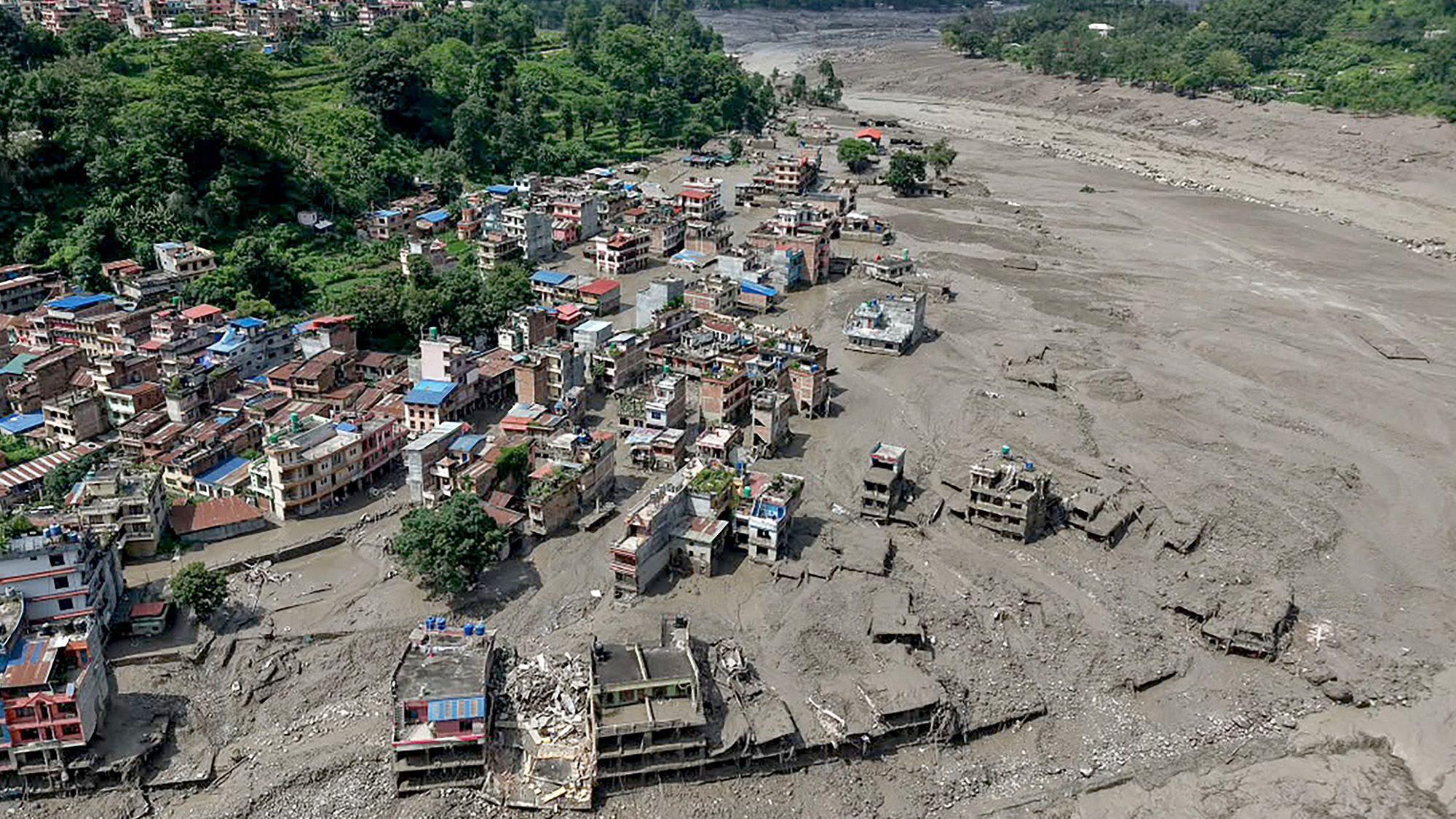



The massive Nepal-Tibet flood on Aug. 26 showed just how devastating glacier-related disasters can be. As of Sept. 16, the event killed at least 1,400 people, with more than 6,000 people still missing.
The Himalayas, with their steep slopes studded with rapidly melting glaciers, are high risk, but areas across much of the world carry the risk of glacier-related disasters, including one tropical region that is at particular risk, experts told Live Science.
“Slope failure from glacier shrinkage is occurring everywhere,” Mark Carey, a professor of environmental studies and geography and director of The Glacier Lab at the University of Oregon, told Live Science in an email.
Nepal-Tibet flood
The recent Nepal-Tibet disaster unfolded when a large mass of bedrock and glacial ice detached from the mountainside. The ice and rock accelerated rapidly, reaching speeds of 500 feet per second (150 meters per second) as it dropped 6,500 feet (2,000 meters) directly into the Lhende River in Tibet, according to the Stimson Center think tank in Washington, D.C.
Glaciers in Nepal have been shrinking, potentially weakening the mountain slopes.
(Image credit: NICHOLAS SHEARMAN via Getty Images)
The rock, ice and water that then raced rapidly downstream eroded the riverbanks and collected debris and water along the way.
Carey noted that this disaster was exacerbated by a combination of factors.
“This particular event in Nepal-China was so profound because of the scale of the landslide, the quantity of water in the flood, the speed of the flood, and the number of people, communities, public works/infrastructure in the flood path,” he said. “There was also little warning.”
Risks in the High Mountains Asia
The Himalayas and the wider High Mountains Asia — an area that includes parts of China, Afghanistan, Nepal, India, Pakistan, Bhutan, Kazakhstan, Uzbekistan, Kyrgyzstan, and Tajikistan — are among the major epicenters for future glacier-related disasters, experts said. More than 9 million people in this region are at risk from glacial outbursts — when a lake bursts through or overtops its dam and drains rapidly — a 2023 Nature study found.
The region is nicknamed the “third pole” because it has the third-highest amount of ice in the world, after the Arctic and Antarctica.
Compounding this, any water, ice or debris can be channeled down the steep slopes into narrow valleys, meaning water and material can move quickly and travel huge distances, potentially inundating the downstream valleys where many people live.
For instance, in the recent Nepal glacial collapse, the resulting flood caused damage more than 60 miles (100 kilometers) away. The 2025 collapse of Birch glacier in Switzerland, by comparison — in which rock and ice also detached from a slope and destroyed the village of Blatten — traveled just 2.6 miles (4.2 km).
The Himalayas are also among the most seismically active places on Earth, and glaciers are frequently weakened by tremors, which can trigger avalanches, glacial lake outburst floods or glacial collapse.
The Himalayas are also warming twice as fast as the global average, reducing ice cover and increasing meltwater. “Permafrost and glacier cover help stabilize mountain slopes,” Carey said. “They hold the rock in place.” So as glaciers melt, the mountain slopes become more prone to avalanches.
Glacial meltwater can also act as a lubricant as it seeps into the bed of the glacier, which, in turn, can facilitate sliding, Bethan Davies, a professor of glaciology at Newcastle University in the U.K., told Live Science in an email.
The region’s large population makes the geographic hazards there riskier, she added.
And with some of the biggest dams in the world going up in seismically active regions of the Himalayas and the Tibetan Plateau, new hazards are being introduced, Live Science previously reported.
A planet-wide risk
But another region on the other side of the world is also at very high risk of glacier-related disasters. Peru has 68% of the planet’s tropical glaciers and has experienced disasters for decades, experts told Live Science.
“In Peru in 1970, 6,000 people died when an earthquake shook loose part of the glacier and rock on Mount Huascarán,” Carey said. “The same slope had failed in 1962, causing a massive rock-ice landslide that buried the community of Ranrahirca, killing about 2,000 people in an event similar to the one recently in Nepal-China.”

Lake Palcacocha, in Peru, is drained to reduce the risk of a glacial lake outburst flood.
(Image credit: LUKA GONZALES via Getty Images)
The Cordillera Blanca portion of the Andes in Peru is considered a particular hazard as a result of glacial lakes that are rapidly expanding due to glacial melt, fueled by increased temperatures driven by climate change. One such lake, called Lake Palococha, sits above the town of Huaraz, which is home to about 130,000 people. All told, experts have identified 528 lakes in Peru that are at risk of overflowing, with 58 considered “very high risk” due to their proximity to populations.
This threat spans the Andes. A 2023 study in the journal Nature noted that the number of glacial lakes in the Andes has risen by 93% in the past two decades — much more than the 37% increase in the High Mountains Asia.
In Europe, the Alps and cold regions like Scandinavia are potential hotspots for glacier-related disasters. Europe is warming faster than the global average.
In North America, meanwhile, Alaska is at risk for landslides and lake outbursts as glaciers collapse and retreat. Although many of the at-risk glaciers aren’t in highly populated areas, there’s a risk that glacial lakes could burst their banks and inundate the state’s Suicide Basin, which frequently drains into and floods Juneau, Carey noted.
Glaciers or glacier-related landslides can also crash into the sea. “All areas with glaciers and all coastal areas where tsunami-like waves from a glacier collapse could inundate them,” are at risk, Carey said.
How to reduce the risks
Better monitoring of glaciers and their lakes in at-risk regions can help mitigate the risks in the short and medium term, experts told Live Science.
The impact of good monitoring was evident last year in Blatten.
“The Birch Glacier was well monitored, and when it started to show signs of movement, the village below was evacuated,” Davies said. Just one person — a 64-year-old shepherd who was outside the evacuation zone — died.

Glaciers across the planet are losing ice rapidly due to climate change.
(Image credit: C3S/ECMWF/WGMS)
However, the Himalayas are a vast region with many potential hazards, and local authorities do not have the resources to establish and run giant monitoring networks, experts said. Nor do local authorities typically have access to expensive rescue equipment, like helicopters that can quickly evacuate people who would otherwise be trapped, Carey said.
Carey noted that when a potential hazard is identified, authorities can take other steps, such as draining a swollen lake to try reducing the risk.
In Peru, over 70 years, for example, authorities “drained 34 glacial lakes over those decades, no doubt saving tens of thousands of lives,” he said.
But disasters can still occur even with monitoring, draining and scientific assessment.
“Everyone, including me, had thought that engineering works to stabilize and contain Lake 513 [in Peru] back in the 1990s had secured it,” Carey said.”We were all wrong.”
Despite all that work, in 2010, a giant avalanche generated a 82-foot-tall (25 m) tsunami that overtopped the lake’s dam and flooded homes and nearby farmland.
In the long term, slowing global warming is the most sweeping way to reduce the risk of glacial collapse.
“Stronger climate action may prevent a worsening and increasing destabilisation of these high mountain environments,” Davies said.
Help us improve Live Science Pro: We’re always trying to make our content better. Leave us feedback about Pro here.