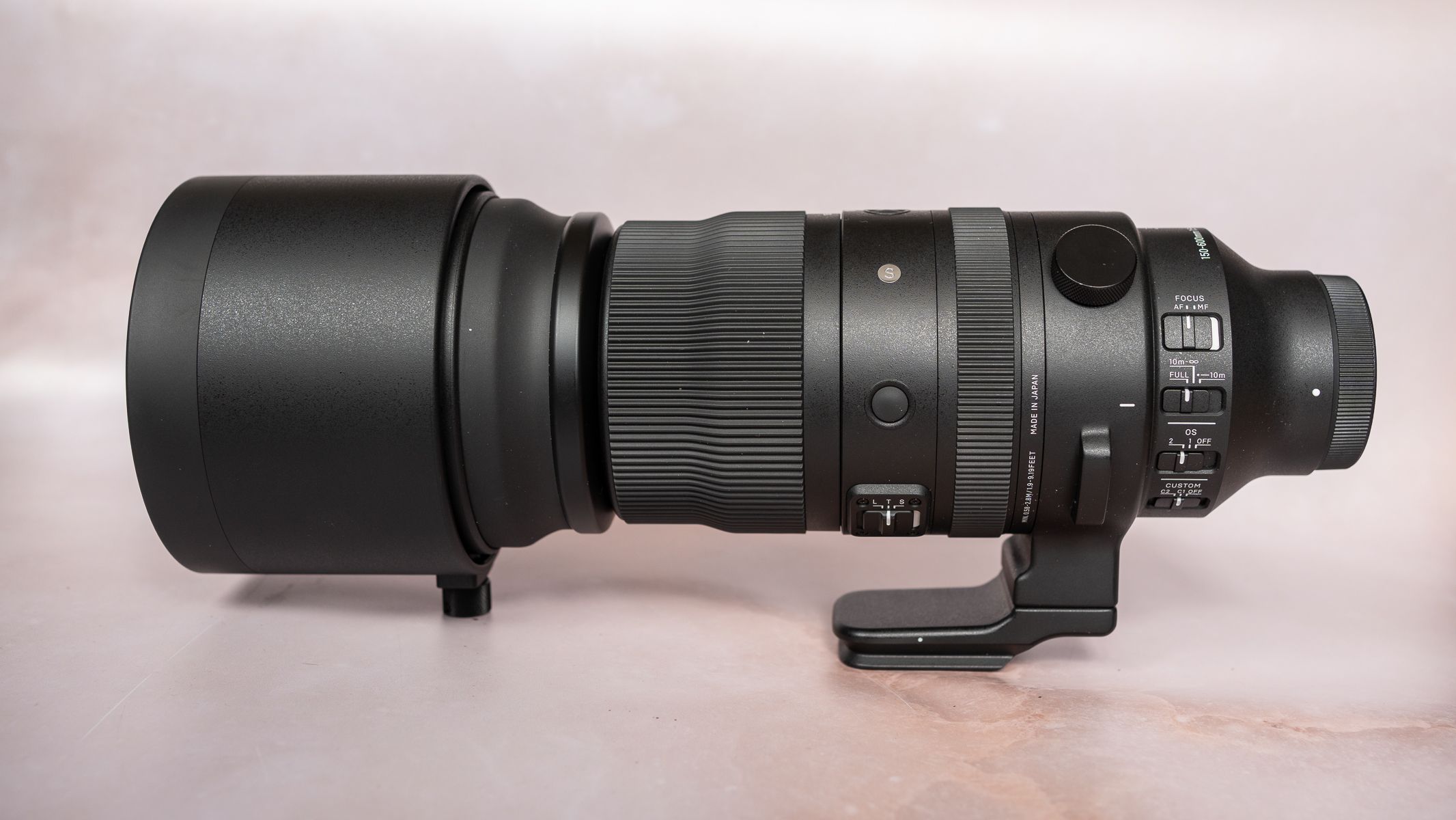
For Sony and Leica users wanting an affordable lens option for wildlife photography, SIGMA offers some attractive options. We spent some time with the SIGMA 150-600mm f/5-6.3 DG DN OS Sport lens for Sony E mount — their closest competitor to the native Sony FE 200-600mm f/5.6-6.3 G OSS in terms of focal length. You get 50mm more focal length on the wide end, and a slightly wider maximum aperture as a result, plus it’s cheaper than the native Sony lens — although you’ll still be paying over $1,500. That said, for a wildlife lens with such a big reach, that’s not bad at all.
It’s a compelling option for wildlife photography beginners looking to invest in their first big lens, so we put it through its paces to test its sharpness, handling and overall performance out in the field, to see whether it earns a spot among the best lenses for wildlife photography.
SIGMA 150-600mm f/5-6.3 DG DN OS Sport review
SIGMA 150-600mm f/5-6.3 DG DN OS Sport: Design
Image 1 of 2
(Image credit: Kimberley Lane)
(Image credit: Kimberley Lane)
Slightly lighter than the Sony equivalent
Two custom buttons
External zoom adds 100 mm to physical length
Getting the obvious out of the way — this is a big lens. It’s long and it’s heavy, but that’s par for the course with this type of super-telephoto lens. What is noteworthy, however, is that it’s actually a few grams lighter than the closest native Sony equivalent.
The SIGMA lens weighs 2,100 grams (approx 74.07 ounces) compared to the 2,115 g (74.60-ounce) Sony. Realistically, 15 g makes basically no difference at all in practice, but third-party lenses are typically substantially heavier (one of the trade-offs of being cheaper), so the similar weight is a point in the SIGMA’s favor.
Image 1 of 3
(Image credit: Kimberley Lane)
(Image credit: Kimberley Lane)
(Image credit: Kimberley Lane)
Specifications
Corresponding mount: Sony E-mount, Leica L-mount Format: Full frame Type: Mirrorless Image stabilized: Yes Filter size: Ø95 Minimum focusing distance: 22.8 – 110 inches (58 – 280 cm) Dimensions: 4.3 x 10.5 inches (109.4 x 265.6 mm) Weight: 74.1 oz (2.1 kg)
It features many of the same buttons and design elements as the native Sony — an AF/MF switch, focus limiter, image stabilization switch with two modes and a custom stabilization switch, also with two modes. There are two custom buttons — one on the top and one on the side of the lens barrel (just one shy of Sony’s three) — and a zoom lock switch with options to lock the zoom completely, or set it to a Smooth (S) or Tight (T) level of friction.
One fairly big difference compared to the Sony lens is that the zoom on the SIGMA lens isn’t internal. Even though the SIGMA is fully weather-sealed, it still leaves room for dust or moisture to get inside the lens, not to mention the zoom adds another 100 mm onto the length of an already long lens.
SIGMA 150-600mm f/5-6.3 DG DN OS Sport: Performance
Image 1 of 5
(Image credit: Kimberley Lane)
(Image credit: Kimberley Lane)
(Image credit: Kimberley Lane)
(Image credit: Kimberley Lane)
(Image credit: Kimberley Lane)
Sharpest wide open (f/5) at 150mm, f/8 at 300mm and f/8 at 600mm
Struggles with small subjects at 600mm
Some colour fringing around tree branches
As we directly compared this lens with the Sony, we could easily see the performance drawbacks associated with the cheaper Sigma model. The overall image quality is great, although we found the images weren’t as sharp when we had to crop in on a small bird, even with a 61 MP camera that allowed for a harsh crop. We still got some great images with beautiful sharpness and detail, but our keep rate was a lot lower than when we were testing the Sony. When the subject fills the frame at 600mm, however, the image is a lot sharper.
Get the world’s most fascinating discoveries delivered straight to your inbox.
There was some chromatic aberration around tree branches, and subjects that were photographed against a bright sky, which isn’t wholly surprising with a lens at this price point — but it’s worth noting that we didn’t see any of this with the native Sony lens. Still, the colors are vibrant and true to life, with only minor vignetting and distortion that can easily be corrected by enabling the lens profile corrections in Lightroom.
Image 1 of 9
150mm f/5(Image credit: Kimberley Lane)
150mm f/8(Image credit: Kimberley Lane)
150mm f/11(Image credit: Kimberley Lane)
300mm f/5.6(Image credit: Kimberley Lane)
300mm f/8(Image credit: Kimberley Lane)
300mm f/11(Image credit: Kimberley Lane)
600mm f/6.3(Image credit: Kimberley Lane)
600mm f/8(Image credit: Kimberley Lane)
600mm f/11(Image credit: Kimberley Lane)
Looking at the test chart images, the sweet spot is around f/8 at 300mm and 600mm, whereas at 150mm, the sharpness and contrast look best when shooting wide open at f/5.6. Interestingly, the lens seems to perform best overall at f/8 at 300mm, and the sharpness and contrast drop significantly compared to the 600mm f/8 shot. In the test chart shots for the Sony FE 200-600mm f/5.6-6.3 G OSS lens, we found it to be sharpest at 600mm. We still took some lovely images with this SIGMA lens at 600mm, but it’s worth knowing if you plan on spending most of your time at full zoom.
SIGMA 150-600mm f/5-6.3 DG DN OS Sport: Functionality
Image 1 of 4
(Image credit: Kimberley Lane)
(Image credit: Kimberley Lane)
(Image credit: Kimberley Lane)
(Image credit: Kimberley Lane)
Compatible with Sony E mount and Leica L mount
Lock switch stops lens creep
Not a low-light lens
As far as compatibility goes, this lens is somewhat limited. It’s only compatible with Sony E and Leica L mounts, which could be frustrating for Canon or Nikon shooters who might want to save money with a third-party lens. Still, we thought it fit well on our Sony camera, and although a lens of this size is naturally going to feel big, the weight distribution was well-balanced. It suffers from strong “lens creep” if you’re holding the lens vertically, but there’s a lock button to prevent it when you aren’t using the lens.
The f/5-6.3 aperture is actually not bad at all for a lens of this focal length at this price point, but it’s not going to be particularly strong at shooting at dawn or dusk, especially as you’ll likely be spending most of your time at the long end with an f/6.3 aperture. Plus, it’s unrealistic to expect a telephoto lens of this price to have a particularly fast aperture.
Should you buy the SIGMA 150-600mm f/5-6.3 DG DN OS Sport?
This lens is certainly good enough as a “first” dedicated super-telephoto lens for wildlife photography. The image quality is sharp, full of contrast and saturated colors, and it’s a great way to save a few hundred dollars if you don’t mind not having a native lens and don’t need to shoot at super-fast speeds.
If, however, you’re at the stage where you want to go pro, you’re going to need a lens with a faster aperture and better image quality than this lens affords. This is where you’re going to need to invest some serious money into a super-telephoto prime lens to take your wildlife images to the next level.
If this product isn’t for you
If you’d prefer a native lens
Sony FE 200-600mm f/5.3-6.3 G OSS
The native Sony equivalent is the Sony FE 200-600mm f/5.3-6.3 G OSS, and the internal zoom makes it a more compact option despite weighing the same. Also, if you can stretch your budget, the Sony lens is just… better.
Read our full Sony FE 200-600mm f/5.3-6.3 G OSS review
If you want a more versatile lens:
SIGMA 60-600mm f/5-6.3 DG DN OS
The SIGMA 60-600mm f/5-6.3 DG DN OS has fantastic image quality and is suitable for other photographic styles like portraits and landscapes, meaning you won’t need to carry multiple lenses around with you.
Read our full SIGMA 60-600mm f/5-6.3 DG DN OS review
If you want to focus on bird photography:
Sony FE 400-800mm f/6.3-8 G OSS
For bird photography, you will want a longer focal length to avoid harsh cropping — the Sony FE 400-800mm f/6.3-8 G OSS would be better suited.