


Close Menu
  • Home
  • United States
  • World
  • Politics
  • Business
  • Lifestyle
  • Entertainment
  • Health
  • Science
  • Tech
  • Sports
  • More
    • Web Stories
    • Editor’s Picks
    • Press Release

Subscribe to Updates

Get the latest USA news and updates directly to your inbox.

What's On
Scott Wiener claims victory in San Francisco’s bitter Nancy Pelosi succession battle

Scott Wiener claims victory in San Francisco’s bitter Nancy Pelosi succession battle

June 3, 2026
From courts to critics, Trump runs into reality as setbacks mount

From courts to critics, Trump runs into reality as setbacks mount

June 3, 2026
Cassie No Longer Resides in U.S., Doesn’t ‘Intend’ to Ever Move Back After Diddy Trial

Cassie No Longer Resides in U.S., Doesn’t ‘Intend’ to Ever Move Back After Diddy Trial

June 3, 2026
Facebook X (Twitter) Instagram
Trending
  • Scott Wiener claims victory in San Francisco’s bitter Nancy Pelosi succession battle
  • From courts to critics, Trump runs into reality as setbacks mount
  • Cassie No Longer Resides in U.S., Doesn’t ‘Intend’ to Ever Move Back After Diddy Trial
  • USMNT’s Brenden Aaronson on getting married during World Cup prep — and the insane travel to pull it off
  • More than 15K votes wasted on Eric Swalwell in California governor’s race
  • Supreme Court lets Alabama use GOP-backed congressional map for midterms
  • Nordstrom’s Sale Section Is Dangerous Right Now — These 17 Summer Finds Are Sitting in My Cart
  • Ball bounces off of Jo Adell’s head and over wall for home run in wild scene
  • Privacy
  • Terms
  • Advertise
  • Contact Us
Join Us
USA TimesUSA Times
Newsletter Login
  • Home
  • United States
  • World
  • Politics
  • Business
  • Lifestyle
  • Entertainment
  • Health
  • Science
  • Tech
  • Sports
  • More
    • Web Stories
    • Editor’s Picks
    • Press Release
USA TimesUSA Times
Home » Scientists tracked faint signals from the stars — and may have turned up hundreds of undiscovered planets
Scientists tracked faint signals from the stars — and may have turned up hundreds of undiscovered planets
Science

Scientists tracked faint signals from the stars — and may have turned up hundreds of undiscovered planets

News RoomBy News RoomMarch 8, 20261 ViewsNo Comments

Scientists have found a potential shortcut for identifying stars that host planets. The technique, based on specific signals in starlight, could make it easier to search for exoplanets, according to a new study.

The team has already used their new method to turn up half a dozen previously undiscovered planets — but because most of the alien worlds are very close to their stars, they are unlikely to be habitable, the study authors say.

Many of the 6,000-plus known exoplanets are located extremely close to their host stars. This proximity often doesn’t turn out well for such close-in worlds, whose surfaces get whipped up by the stars’ intense radiation and form comet-like tails of debris. This includes exoplanets like K2-22b, which was analyzed by the James Webb Space Telescope in 2025. The debris typically remains, for millions of years, as a cloud circling the planet’s host star.


You may like

But this clutter could help astronomers pinpoint stars that host undiscovered exoplanets orbiting close to their stars. That’s because the debris, which is mainly a mixture of different gases, absorbs some of its parent star’s light at specific visible frequencies.

“That absorption could make the star appear artificially [magnetically] less active,” Matthew Standing, a research fellow at the European Space Agency’s European Space Astronomy Centre in Madrid and the new study’s lead author, told Live Science via email. In other words, magnetically inactive stars are potentially good targets in the search for crumbling, close-in exoplanets.

If this hypothesis is confirmed, it could make planet-searching ventures less random.

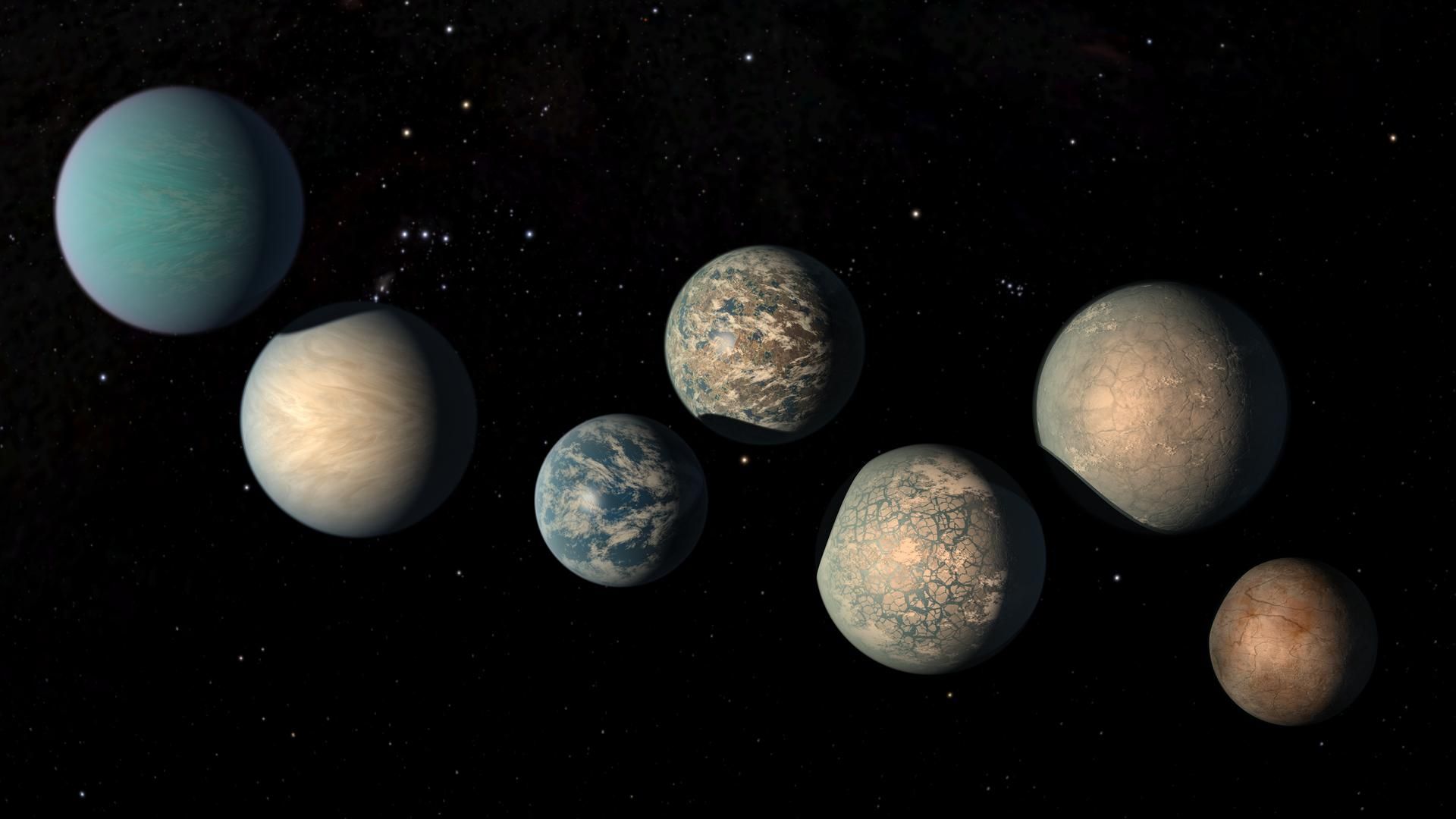
Exoplanets close to their parent stars, like Kepler-1520b in this illustration, crumble, creating clouds of debris. These clouds surround the host stars and absorb specific wavelengths of their light, making these wavelengths missing in the spectra we see from Earth. By looking for stars that have these signatures in their spectra, scientists have hit upon a method to efficiently identify exoplanets. (Image credit: NASA/JPL-Caltech)

Signals from the stars

To test the idea, Standing and an international team of collaborators first identified a set of 24 stars with apparently low magnetic activity as part of the Dispersed Matter Planet Project (DMPP), including a handful of stars that the DMPP had analyzed in 2020. The researchers then collected visible-light spectra — the light curves that correspond to wavelengths of electromagnetic radiation that humans can see — from these stars, using telescopes at the European Space Observatory in Chile.

Get the world’s most fascinating discoveries delivered straight to your inbox.

They observed each star at least 10 times for up to two weeks. If a star hosted one or more planets, its gravitational “tugs” on its star would cause it to wobble, which would be visible in the spectra. (This method of identifying exoplanets is called the radial-velocity technique.)

Next, the team used a computational algorithm to determine if such changes in the light curves could correspond to as many as four planets for each star system. The analysis also allowed the researchers to determine how sensitive the survey was and how common close-in planets are around stars with low magnetic activity levels.

The results, published Feb. 28 in the journal Monthly Notices of the Royal Astronomical Society, showed that 14 stars hosted a total of 24 exoplanets, including a total of seven newly discovered worlds in five of these systems.


What to read next

The team also calculated that the occurrence of exoplanets around the stars they selected was between eight and 10 times higher than in other radial-velocity surveys. This occurrence rate supports the hypothesis that stars that seem magnetically inactive are likely hosts of close-in, highly irradiated exoplanets.

Additionally, the researchers found that the survey was very comprehensive, identifying nearly 95% of exoplanets that were more than 10 times as massive as Earth and orbited their host stars in five days or less.

The team also extrapolated their results to our cosmic neighborhood, curating a list of roughly 16,000 stars lying within 1,600 light-years from the solar system. (For reference, a light-year is the distance light travels in a year — approximately 5.88 trillion miles, or 9.46 trillion kilometers.) From this list, the researchers found 241 stars with similar signatures of low magnetic activity. Given the proportion of exoplanets in the study, they estimate that these stars may host around 300 planets, just waiting to be discovered.

Standing is cautiously enthusiastic about the technique’s potential. “If confirmed with larger samples, this method could help make exoplanet searches more efficient,” he said.

The team plans to do just that, expanding the size of their sample and continuing to monitor radial-velocity data for signs of planets, he added.

Standing, M.R., Barnes, J.R., Haswell, C.A., Stevenson, A.T., Faria, J.P., Quintin, E., Ross, Z.O.B., Fossati, L., Jenkins, J.S., Alves, D. and Staab, D. (2026) The Dispersed Matter Planet Project sample – detection limits, occurrence rates and new planets, Monthly Notices of the Royal Astronomical Society, stag370. https://doi.org/10.1093/mnras/stag370


Share. Facebook Twitter LinkedIn Telegram WhatsApp Email

Keep Reading

‘It was very very good’: Ötzi the Iceman’s body is covered in ancient yeast — and scientists just used it to make a sourdough

‘It was very very good’: Ötzi the Iceman’s body is covered in ancient yeast — and scientists just used it to make a sourdough

Physicists achieve ‘perfect randomness’ in breakthrough quantum experiment

Physicists achieve ‘perfect randomness’ in breakthrough quantum experiment

China launches new Long March 12B rocket, reportedly without any safety warning

China launches new Long March 12B rocket, reportedly without any safety warning

SIGMA 60-600mm f/4.5-6.3 DG DN OS Sport lens review

SIGMA 60-600mm f/4.5-6.3 DG DN OS Sport lens review

17,000-year-old stripes of red in a Welsh cave are the oldest rock art in the UK, study finds

17,000-year-old stripes of red in a Welsh cave are the oldest rock art in the UK, study finds

‘Animals were imprisoned in jails where humans were incarcerated’: The bizarre trials of the Late Middle Ages — and surprising lack of criminal cats

‘Animals were imprisoned in jails where humans were incarcerated’: The bizarre trials of the Late Middle Ages — and surprising lack of criminal cats

Rusty, orange water ‘bleeds’ across brilliant Bolivian lagoon — Earth from space

Rusty, orange water ‘bleeds’ across brilliant Bolivian lagoon — Earth from space

NASA confirms fireball meteor exploded over northeastern US with force of 230 tons of TNT

NASA confirms fireball meteor exploded over northeastern US with force of 230 tons of TNT

Astronauts could use lightning-like plasma jets to kill germs on the moon and Mars, demo hints

Astronauts could use lightning-like plasma jets to kill germs on the moon and Mars, demo hints

Add A Comment
Leave A Reply Cancel Reply

Editors Picks

From courts to critics, Trump runs into reality as setbacks mount

From courts to critics, Trump runs into reality as setbacks mount

June 3, 2026
Cassie No Longer Resides in U.S., Doesn’t ‘Intend’ to Ever Move Back After Diddy Trial

Cassie No Longer Resides in U.S., Doesn’t ‘Intend’ to Ever Move Back After Diddy Trial

June 3, 2026
USMNT’s Brenden Aaronson on getting married during World Cup prep — and the insane travel to pull it off

USMNT’s Brenden Aaronson on getting married during World Cup prep — and the insane travel to pull it off

June 3, 2026
More than 15K votes wasted on Eric Swalwell in California governor’s race

More than 15K votes wasted on Eric Swalwell in California governor’s race

June 3, 2026

Subscribe to News

Get the latest USA news and updates directly to your inbox.

Latest News
Supreme Court lets Alabama use GOP-backed congressional map for midterms

Supreme Court lets Alabama use GOP-backed congressional map for midterms

June 3, 2026
Nordstrom’s Sale Section Is Dangerous Right Now — These 17 Summer Finds Are Sitting in My Cart

Nordstrom’s Sale Section Is Dangerous Right Now — These 17 Summer Finds Are Sitting in My Cart

June 3, 2026
Ball bounces off of Jo Adell’s head and over wall for home run in wild scene

Ball bounces off of Jo Adell’s head and over wall for home run in wild scene

June 3, 2026
Facebook X (Twitter) Pinterest WhatsApp TikTok Instagram
© 2026 USA Times. All Rights Reserved.
  • Privacy Policy
  • Terms
  • Advertise
  • Contact

Type above and press Enter to search. Press Esc to cancel.