

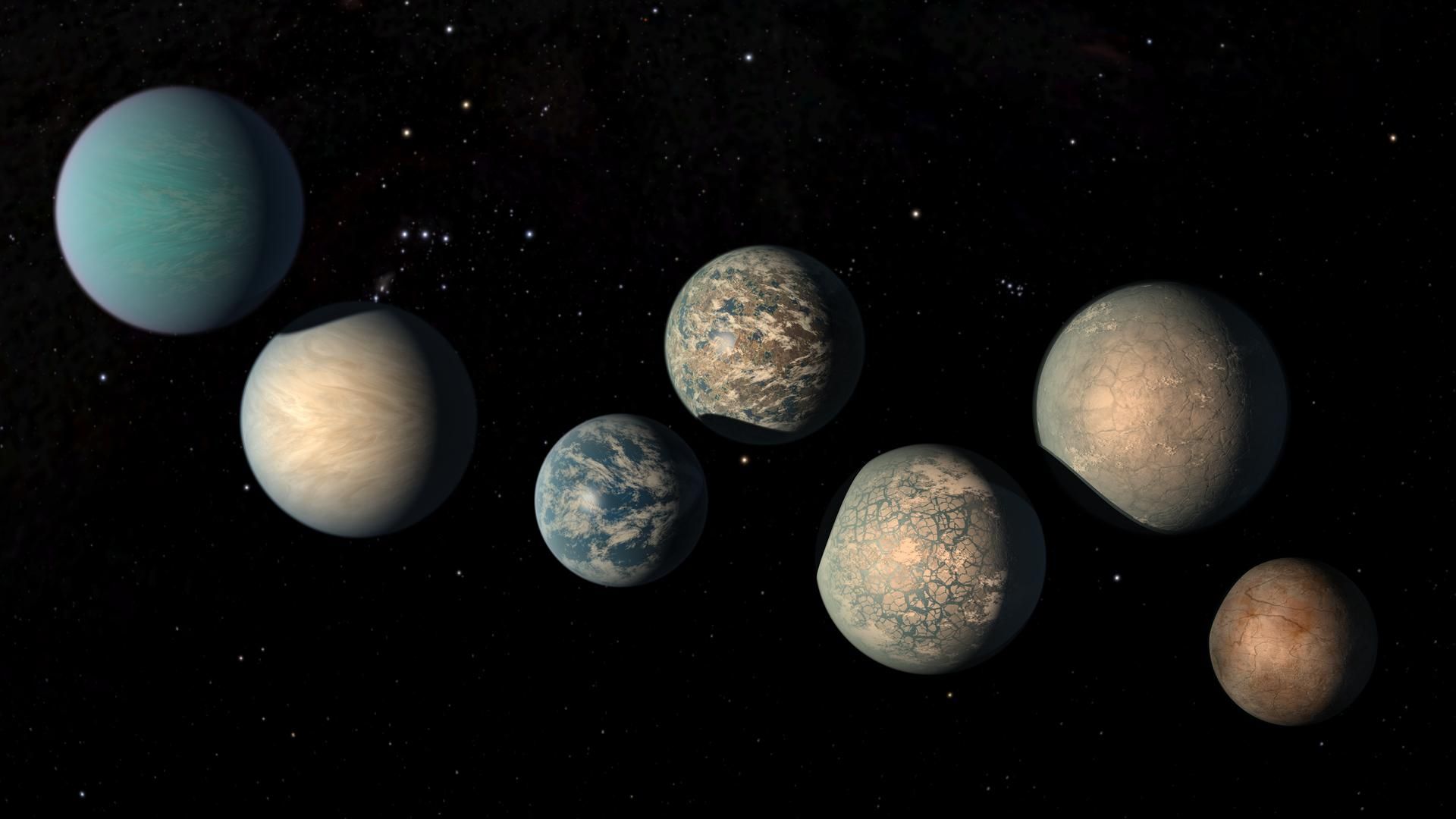

Scientists have found a potential shortcut for identifying stars that host planets. The technique, based on specific signals in starlight, could make it easier to search for exoplanets, according to a new study.
The team has already used their new method to turn up half a dozen previously undiscovered planets — but because most of the alien worlds are very close to their stars, they are unlikely to be habitable, the study authors say.
But this clutter could help astronomers pinpoint stars that host undiscovered exoplanets orbiting close to their stars. That’s because the debris, which is mainly a mixture of different gases, absorbs some of its parent star’s light at specific visible frequencies.
“That absorption could make the star appear artificially [magnetically] less active,” Matthew Standing, a research fellow at the European Space Agency’s European Space Astronomy Centre in Madrid and the new study’s lead author, told Live Science via email. In other words, magnetically inactive stars are potentially good targets in the search for crumbling, close-in exoplanets.
If this hypothesis is confirmed, it could make planet-searching ventures less random.
Signals from the stars
To test the idea, Standing and an international team of collaborators first identified a set of 24 stars with apparently low magnetic activity as part of the Dispersed Matter Planet Project (DMPP), including a handful of stars that the DMPP had analyzed in 2020. The researchers then collected visible-light spectra — the light curves that correspond to wavelengths of electromagnetic radiation that humans can see — from these stars, using telescopes at the European Space Observatory in Chile.
They observed each star at least 10 times for up to two weeks. If a star hosted one or more planets, its gravitational “tugs” on its star would cause it to wobble, which would be visible in the spectra. (This method of identifying exoplanets is called the radial-velocity technique.)
Next, the team used a computational algorithm to determine if such changes in the light curves could correspond to as many as four planets for each star system. The analysis also allowed the researchers to determine how sensitive the survey was and how common close-in planets are around stars with low magnetic activity levels.
The results, published Feb. 28 in the journal Monthly Notices of the Royal Astronomical Society, showed that 14 stars hosted a total of 24 exoplanets, including a total of seven newly discovered worlds in five of these systems.
The team also calculated that the occurrence of exoplanets around the stars they selected was between eight and 10 times higher than in other radial-velocity surveys. This occurrence rate supports the hypothesis that stars that seem magnetically inactive are likely hosts of close-in, highly irradiated exoplanets.
Additionally, the researchers found that the survey was very comprehensive, identifying nearly 95% of exoplanets that were more than 10 times as massive as Earth and orbited their host stars in five days or less.
The team also extrapolated their results to our cosmic neighborhood, curating a list of roughly 16,000 stars lying within 1,600 light-years from the solar system. (For reference, a light-year is the distance light travels in a year — approximately 5.88 trillion miles, or 9.46 trillion kilometers.) From this list, the researchers found 241 stars with similar signatures of low magnetic activity. Given the proportion of exoplanets in the study, they estimate that these stars may host around 300 planets, just waiting to be discovered.
Standing is cautiously enthusiastic about the technique’s potential. “If confirmed with larger samples, this method could help make exoplanet searches more efficient,” he said.
The team plans to do just that, expanding the size of their sample and continuing to monitor radial-velocity data for signs of planets, he added.
Standing, M.R., Barnes, J.R., Haswell, C.A., Stevenson, A.T., Faria, J.P., Quintin, E., Ross, Z.O.B., Fossati, L., Jenkins, J.S., Alves, D. and Staab, D. (2026) The Dispersed Matter Planet Project sample – detection limits, occurrence rates and new planets, Monthly Notices of the Royal Astronomical Society, stag370. https://doi.org/10.1093/mnras/stag370