

Close Menu
  • Home
  • United States
  • World
  • Politics
  • Business
  • Lifestyle
  • Entertainment
  • Health
  • Science
  • Tech
  • Sports
  • More
    • Web Stories
    • Editor’s Picks
    • Press Release

Subscribe to Updates

Get the latest USA news and updates directly to your inbox.

What's On
HuffPost report suggests Pentagon excluded Catholics from Good Friday service

HuffPost report suggests Pentagon excluded Catholics from Good Friday service

April 4, 2026
Meghan Markle Reacts After Her ‘Suits’ Costar Patrick J. Adams Speaks About Her on Podcast

Meghan Markle Reacts After Her ‘Suits’ Costar Patrick J. Adams Speaks About Her on Podcast

April 4, 2026
WWE has Pat McAfee mess to clean up at WrestleMania after  Randy Orton mystery caller reveal dud

WWE has Pat McAfee mess to clean up at WrestleMania after Randy Orton mystery caller reveal dud

April 4, 2026
Facebook X (Twitter) Instagram
Trending
  • HuffPost report suggests Pentagon excluded Catholics from Good Friday service
  • Meghan Markle Reacts After Her ‘Suits’ Costar Patrick J. Adams Speaks About Her on Podcast
  • WWE has Pat McAfee mess to clean up at WrestleMania after Randy Orton mystery caller reveal dud
  • Octopus quiz: Are you a sucker for cephalopod science?
  • Attempted bomber revealed to be child of illegal aliens after alleged incident
  • ‘The Hills’ Alum Spencer Pratt Currently Ranks 2nd Place in Race to Become Los Angeles Mayor
  • Knicks embrace change of pace as they get off to needed fast start against Bulls
  • Science news this week: Artemis II lifts off, diabetes cured in mice, and smog in China shapes Arctic storms
  • Privacy
  • Terms
  • Advertise
  • Contact Us
Join Us
USA TimesUSA Times
Newsletter Login
  • Home
  • United States
  • World
  • Politics
  • Business
  • Lifestyle
  • Entertainment
  • Health
  • Science
  • Tech
  • Sports
  • More
    • Web Stories
    • Editor’s Picks
    • Press Release
USA TimesUSA Times
Home » Enormous 3D map of the universe shows brilliant ‘sea of light’ near the cosmic dawn
Enormous 3D map of the universe shows brilliant ‘sea of light’ near the cosmic dawn
Science

Enormous 3D map of the universe shows brilliant ‘sea of light’ near the cosmic dawn

News RoomBy News RoomMarch 7, 20261 ViewsNo Comments

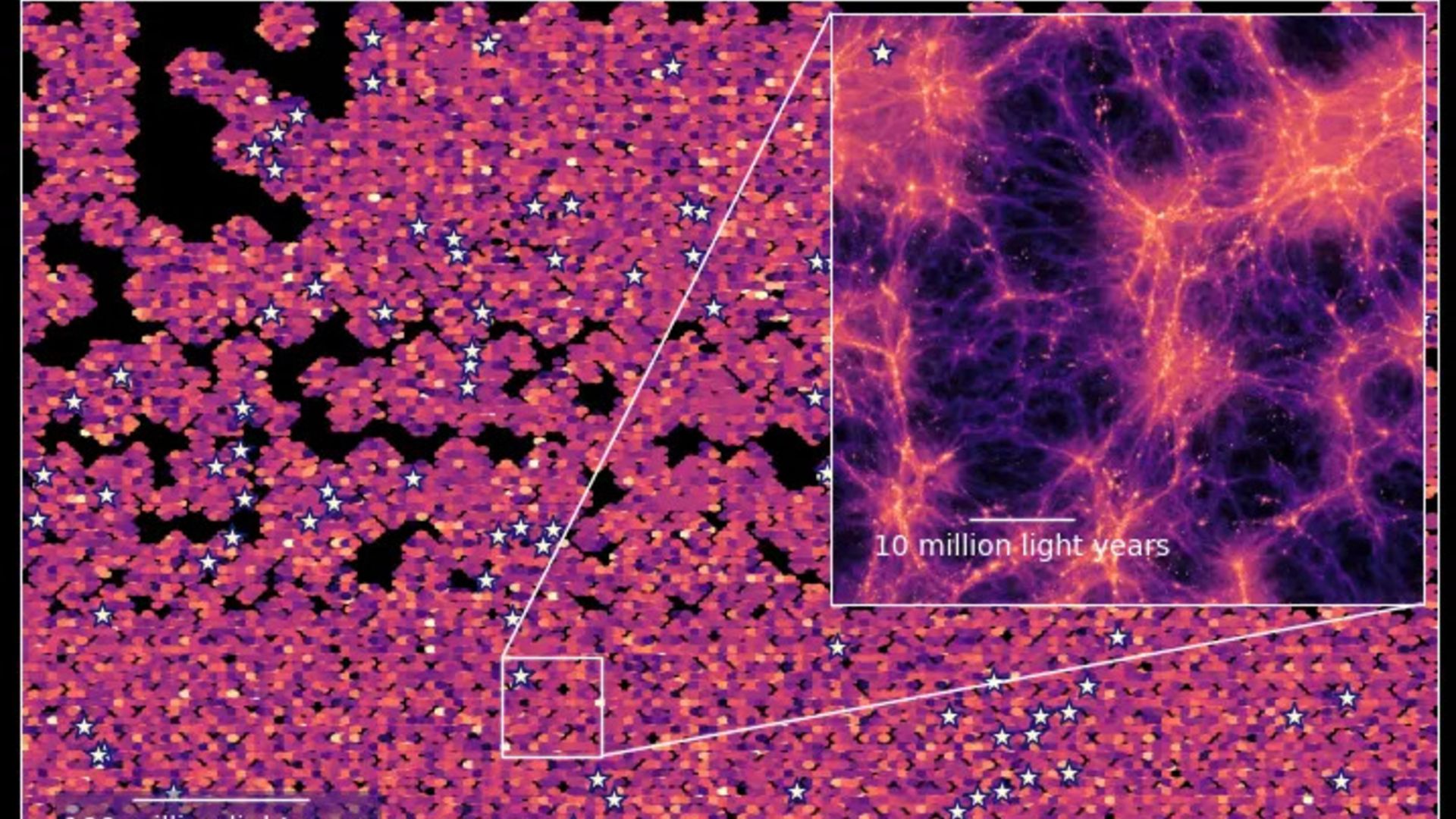
Astronomers have produced one of the most accurate, comprehensive cosmic maps ever made, revealing a brilliant “sea of light” that permeated the early universe.

Unlike other universal maps, this 3D representation is composed of light emitted by a single element: hydrogen, the simplest and most abundant element in the universe, which emits large quantities of a specific wavelength of light when it becomes excited by energy from nearby stars.

By measuring this light across a vast patch of sky, astronomers got a glimpse of what the universe looked like 9 billion to 11 billion years ago, during an epoch of vigorous star formation.


You may like

The new research, described in a paper published March 3 in The Astrophysical Journal, is part of the Hobby-Eberly Telescope Dark Energy Experiment (HETDEX), a sky survey that aims to illuminate how dark energy and gravity shape the universe. The researchers can now compare their simulations with this new data, gathered with the Hobby-Eberly Telescope at the McDonald Observatory in Texas, to assess how cosmological models differ from observations.

An exciting way to see the baby universe

When hydrogen atoms are bombarded by stellar radiation, they become excited and emit Lyman-alpha light, a specific wavelength in the ultraviolet part of the electromagnetic spectrum.

Massive, bright galaxies are easier to detect, but fainter galactic structures and the immense interstellar gas clouds that form stars and galaxies have remained largely undetected — until now.

To reveal the sea of light that permeated the fledgling cosmos, the researchers used a technique called line-intensity mapping, which focuses on the telltale wavelengths, or signature spectral emissions, given off by different elements. Astronomers can therefore use line mapping to chart the concentration and distribution of those specific elements throughout the cosmos, forming a map of the luminous galaxies and glowing gas clouds lit up by excited hydrogen atoms.

Get the world’s most fascinating discoveries delivered straight to your inbox.

Cosmology is about zooming out

When studying individual galaxies, stars or other discrete celestial objects, astronomers analyze their characteristics by zooming in. Cosmology, however, requires zooming out. Accordingly, the HETDEX survey doesn’t observe individual galaxies but rather the combined light from every object in a designated region of the sky. As a result, astronomers can gather integrated data from a multitude of galaxies and intergalactic gas clouds simultaneously.

“Imagine you’re in a plane looking down,” study co-author Julian Muñoz, a theoretical cosmologist at The University of Texas at Austin, said in a statement. “The ‘traditional’ way to do galaxy surveys is like mapping the brightest cities only: you learn where the big population centers are, but you miss everyone that lives in the suburbs and small towns. Intensity mapping is like viewing the same scene through a smudged plane window: you get a blurrier picture, but you capture all the light and not just the brightest spots.”

In the quest to understand dark energy and chart more than 1 million bright galaxies, HETDEX “has gathered more than 600 million spectra over an area equivalent to more than 2,000 full moons, creating an unprecedented dataset,” the researchers said in a different statement.


What to read next

A golden age of cosmic mapping

The mapping method made possible by HETDEX offers another way to examine cosmology’s driving forces and how mass is distributed throughout the universe.

A spectrum made by statistically combining 500,000 objects that emit Lyman alpha light, which appears as a dramatic peak and reveals bright galaxies and glowing gas in the early universe. (Image credit: HETDEX)

“These new 3D maps allow us to study how galaxies cluster together,” study co-author Karl Gebhardt, a professor of astrophysics at The University of Texas at Austin, told Live Science via email. “The culprit that causes galaxies to come together is gravity. So by studying the clustering properties, we are understanding the properties of gravity and how much mass exists,” Gebhardt explained.

Seeing galactic structures as a collective is invaluable for measuring large-scale density fluctuations across the cosmos to explore the influence of dark energy, the mysterious entity that appears to be accelerating the universe’s expansion.

Unsurprisingly, detecting the signals from ancient galaxies is hard, “but excluding the faint signal from everything else — faint galaxies in the foreground, noise from the detector, artifacts produced by the analysis techniques, scattered light sources like the moon, weak absorption/emission lines from the Earth’s atmosphere, is even harder,” study co-author Robin Ciardullo, a professor of astronomy and astrophysics at Penn State and the observing manager of HETDEX, told Live Science via email.

The next step is to improve noise-reduction techniques and separate the desired signals from the numerous astronomical and Earthly contaminants. The researchers can then use fainter sources and lower-mass objects as tracers of cosmic evolution to more robustly constrain gravity models.

“The Hobby-Eberly is a pioneering telescope,” Muñoz said. “And with new, complementary instruments coming online, we’re entering a golden age for mapping the cosmos.”

Share. Facebook Twitter LinkedIn Telegram WhatsApp Email

Keep Reading

Octopus quiz: Are you a sucker for cephalopod science?

Octopus quiz: Are you a sucker for cephalopod science?

Science news this week: Artemis II lifts off, diabetes cured in mice, and smog in China shapes Arctic storms

Science news this week: Artemis II lifts off, diabetes cured in mice, and smog in China shapes Arctic storms

I’ve witnessed nearly 100 rocket launches. Artemis II was like nothing I’ve ever experienced.

I’ve witnessed nearly 100 rocket launches. Artemis II was like nothing I’ve ever experienced.

Are allergies genetic? | Live Science

Are allergies genetic? | Live Science

‘Trust us; you look amazing’: Artemis II crewmembers share first message from space

‘Trust us; you look amazing’: Artemis II crewmembers share first message from space

New tweak to Einstein’s relativity could transform our understanding of the Big Bang

New tweak to Einstein’s relativity could transform our understanding of the Big Bang

Homo habilis is the earliest named human. But is it even human?

Homo habilis is the earliest named human. But is it even human?

First-ever 3D map of the clitoris maps every nerve in high resolution

First-ever 3D map of the clitoris maps every nerve in high resolution

IBM quantum processor achieves highest fidelity calculations for the longest period of time on record

IBM quantum processor achieves highest fidelity calculations for the longest period of time on record

Add A Comment
Leave A Reply Cancel Reply

Editors Picks

Meghan Markle Reacts After Her ‘Suits’ Costar Patrick J. Adams Speaks About Her on Podcast

Meghan Markle Reacts After Her ‘Suits’ Costar Patrick J. Adams Speaks About Her on Podcast

April 4, 2026
WWE has Pat McAfee mess to clean up at WrestleMania after  Randy Orton mystery caller reveal dud

WWE has Pat McAfee mess to clean up at WrestleMania after Randy Orton mystery caller reveal dud

April 4, 2026
Octopus quiz: Are you a sucker for cephalopod science?

Octopus quiz: Are you a sucker for cephalopod science?

April 4, 2026
Attempted bomber revealed to be child of illegal aliens after alleged incident

Attempted bomber revealed to be child of illegal aliens after alleged incident

April 4, 2026

Subscribe to News

Get the latest USA news and updates directly to your inbox.

Latest News
‘The Hills’ Alum Spencer Pratt Currently Ranks 2nd Place in Race to Become Los Angeles Mayor

‘The Hills’ Alum Spencer Pratt Currently Ranks 2nd Place in Race to Become Los Angeles Mayor

April 4, 2026
Knicks embrace change of pace as they get off to needed fast start against Bulls

Knicks embrace change of pace as they get off to needed fast start against Bulls

April 4, 2026
Science news this week: Artemis II lifts off, diabetes cured in mice, and smog in China shapes Arctic storms

Science news this week: Artemis II lifts off, diabetes cured in mice, and smog in China shapes Arctic storms

April 4, 2026
Facebook X (Twitter) Pinterest WhatsApp TikTok Instagram
© 2026 USA Times. All Rights Reserved.
  • Privacy Policy
  • Terms
  • Advertise
  • Contact

Type above and press Enter to search. Press Esc to cancel.