Close Menu
  • Home
  • United States
  • World
  • Politics
  • Business
  • Lifestyle
  • Entertainment
  • Health
  • Science
  • Tech
  • Sports
  • More
    • Web Stories
    • Editor’s Picks
    • Press Release

Subscribe to Updates

Get the latest USA news and updates directly to your inbox.

What's On
Nicole Kidman Reveals Identity of Her 2026 Met Gala Date After Finalizing Divorce: ‘So Happy’

Nicole Kidman Reveals Identity of Her 2026 Met Gala Date After Finalizing Divorce: ‘So Happy’

March 14, 2026
St. John’s repeats as Big East Tournament champs for first time after destroying UConn in second half

St. John’s repeats as Big East Tournament champs for first time after destroying UConn in second half

March 14, 2026
Why millions of lovesick people are falling victim to ‘AI psychosis’

Why millions of lovesick people are falling victim to ‘AI psychosis’

March 14, 2026
Facebook X (Twitter) Instagram
Trending
  • Nicole Kidman Reveals Identity of Her 2026 Met Gala Date After Finalizing Divorce: ‘So Happy’
  • St. John’s repeats as Big East Tournament champs for first time after destroying UConn in second half
  • Why millions of lovesick people are falling victim to ‘AI psychosis’
  • Obama Presidential Center wants 100 unpaid volunteers — while CEO Valerie Jarrett makes $740K
  • Jim Irsay’s memorabilia collection shatters estimate at auction
  • Kylie Jenner’s Cool-Girl Phone Case Doubles as a Mirror — And It’s Secretly on Amazon
  • Italy advances to WBC semifinal with win over Puerto Rico to continue Cinderella run
  • Sharon Osbourne says artists should skip political speeches at award shows
  • Privacy
  • Terms
  • Advertise
  • Contact Us
Join Us
USA TimesUSA Times
Newsletter Login
  • Home
  • United States
  • World
  • Politics
  • Business
  • Lifestyle
  • Entertainment
  • Health
  • Science
  • Tech
  • Sports
  • More
    • Web Stories
    • Editor’s Picks
    • Press Release
USA TimesUSA Times
Home » Scientists spot ‘unprecedented celestial event’ around the ‘Eye of Sauron’ star just 25 light-years from Earth
Scientists spot ‘unprecedented celestial event’ around the ‘Eye of Sauron’ star just 25 light-years from Earth
Science

Scientists spot ‘unprecedented celestial event’ around the ‘Eye of Sauron’ star just 25 light-years from Earth

News RoomBy News RoomDecember 20, 20251 ViewsNo Comments

Astronomers hoping to observe a planet around a nearby star have witnessed a much rarer “unprecedented celestial event,” the team said: The violent aftermath of not one, but two collisions between the rocky building blocks of planets.

Over the past two decades, astronomers witnessed two separate catastrophic collisions around the star Fomalhaut, located just 25 light-years away in the constellation Piscis Austrinus. The detections occurred after planetesimals (rocky pieces of unformed planets) measuring much larger than the dinosaur-killing asteroid smashed each other into massive clouds of glittering debris.

The Fomalhaut system is no stranger to such crashes. It’s famously known as the “Eye of Sauron” due to its resemblance to the fiery, all-seeing eye from J.R.R. Tolkien’s Lord of The Rings franchise. The likeness comes from the spectacular dust belt that surrounds Fomalhaut at a distance of 133 astronomical units (AU), with one AU being equal to 93 million miles (150 million km) — the average distance between the sun and Earth.


You may like

Formed from countless rocky, icy collisions, this belt of dust and debris provides a dustier analog of our early solar system as it appeared more than 4 billion years ago, the team said — offering a glimpse of our neighborhood’s chaotic infancy, when planets were being created, destroyed, and reassembled.

False planet syndrome

A new study, conducted by an international team of researchers and led by Paul Kalas, an astronomer at the University of California, Berkeley, described these two collision events in destructive detail to help solve a planetary mystery.

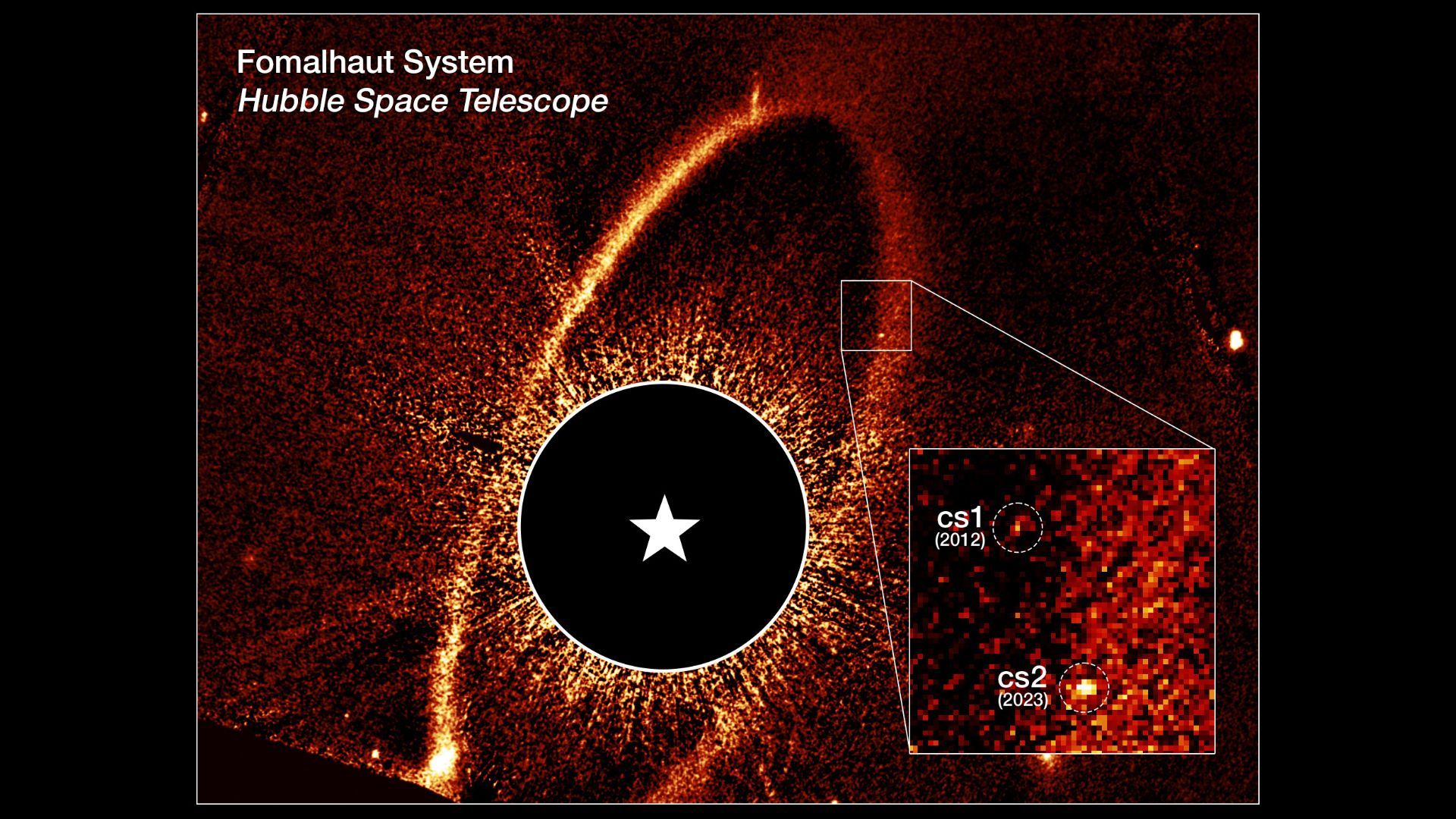
In the early 2000s, astronomers observing the Fomalhaut system spotted a large, luminous object that many assumed to be a dust-covered exoplanet reflecting light. They designated this exoplanet candidate Fomalhaut b.

Yet when this supposed planet blinked out of existence and another bright point of light appeared nearby, all in the span of approximately 20 years, researchers realized they weren’t viewing planets, but the shining debris clouds formed by what they call a “cosmic fender bender.”

Get the world’s most fascinating discoveries delivered straight to your inbox.

An artist’s illustration tracks the creation of dust cloud cs2 around the star Fomalhaut. In panel 1, the star appears in the top left corner while two white dots, located in the bottom right corner, represent the massive objects about to collide. In panel 2, the objects approach each other. In panel 3, they collide. In panel 4, dust cloud cs2 becomes visible and starlight pushes the dust grains away. (Image credit: NASA, ESA, STScI, Ralf Crawford (STScI))

Fomalhaut forensics: a history of catastrophic crashes

The two collision events, now known as Fomalhaut cs1 and Fomalhaut cs2, appear to be incredibly serendipitous. Theory suggests that collisions of this size should only happen once every 100,000 years or so, but the Fomalhaut system surprised scientists with two such smash-ups in just 20 years.

Indeed, based on this timeline, the study infers that 22 million similar events may have occurred during the Fomalhaut system’s relatively young, 440-million-year-old life so far. Even if one could rewind only the past 3,000 years or so, “Fomalhaut’s planetary system would be sparkling with these collisions,” Kalas explained in a statement.

Reverse engineering the collisions based on factors like the mass of the debris clouds and the size of the dust grains suggests that Fomalhaut cs1 and cs2 were the result of colliding planetesimals around 37 miles (60 km) in diameter, or around four to six times the size of the asteroid that devastated the non-avian dinosaurs 66 million years ago.


You may like

It’s an alien event with a relatable twist: “These larger bodies are like the larger bodies that comprise our own asteroid and Kuiper belts,” study co-author Jason Wang, an astronomer at Northwestern University, told Live Science via email.

And there are a lot of these bodies. Based on their reconstruction of the event, the researchers suggest that the Fomalhaut system may host 1.8 Earth masses of these primordial planetesimals. This may amount to about 300 million such bodies, according to a separate statement.

Furthermore, the system holds another 1.8 Earth masses in smaller bodies measuring less than 0.186 miles (0.3 kilometers) across. These relative runts constantly replenish the tiny dust grains, many just a few 10,000ths of an inch in size, that swirl and shimmer in Fomalhaut’s dust belt. Without this rocky reservoir, the dust belt would disappear as its grains are blown out of the system by stellar wind or engulfed by its star.

A fiery white, yellow, and orange burst sits in the bottom right quadrant of the image and a bright white orb is on the top left quadrant. The background is a very dark blue to black.

An illustration of the violent collision between two planetesimals orbiting Fomalhaut. (Image credit: NASA, ESA, STScI, Ralf Crawford (STScI))

The planet that never was, still may be

Even though Fomalhaut b no longer exists — as a planet, at least — this “planet that never was” may actually still be hiding within the system.

Researchers calculated that, given the specific conditions, there’s about a 10% chance that Fomalhaut cs1 and cs2 are not random collisions. Their similar timing and location may point to a hidden influence, such as the ghostly gravitational pull of an unseen exoplanet.

“For example, something — like planets — should be responsible for carving out the planetesimals into a dust belt that we see,” Wang told LiveScience. “Additionally, we speculate that the proximity in location of the cs1 and cs2 impact sites may be driven by a planet that preferentially causes planetesimals to collide there.”

Playing planetary peek-a-boo

This exoplanetary confusion highlights an important consideration for planet-hunters, and for next-generation facilities like NASA’s Habitable Worlds Observatory that are designed to directly image habitable-zone exoplanets in the nearby universe: “Fomalhaut cs2 looks exactly like an extrasolar planet reflecting starlight,” explained Kalas.

As a result, this unique study not only informs our ideas about planetary formation, such as collision rates and debris belt mechanics, but can also help astronomers more precisely identify planetary bodies from among all the other shining celestial objects with which the universe continually dazzles us.

Share. Facebook Twitter LinkedIn Telegram WhatsApp Email

Keep Reading

GPS is being weaponized in electronic warfare ‪—‬ and it’s putting ships at risk

GPS is being weaponized in electronic warfare ‪—‬ and it’s putting ships at risk

The appendix evolved at least 32 times across 361 species, so it’s ‘unlikely to be a useless evolutionary accident,’ research finds

The appendix evolved at least 32 times across 361 species, so it’s ‘unlikely to be a useless evolutionary accident,’ research finds

Roman military fort discovered in Scotland far north of Hadrian’s Wall

Roman military fort discovered in Scotland far north of Hadrian’s Wall

Pi has been calculated to trillions of digits ‪—‬ is that completely irrational?

Pi has been calculated to trillions of digits ‪—‬ is that completely irrational?

Science news this week: AMOC’s collapse signal, the sun’s galactic migration, the world’s smallest QR code and oil’s dying days

Science news this week: AMOC’s collapse signal, the sun’s galactic migration, the world’s smallest QR code and oil’s dying days

Garmin Venu 4 smartwatch review: A reliable everyday fitness tracker

Garmin Venu 4 smartwatch review: A reliable everyday fitness tracker

Reading AI summaries makes people more likely to buy something — despite alarming 60% hallucination rate

Reading AI summaries makes people more likely to buy something — despite alarming 60% hallucination rate

Can you see Earth’s shadow?

Can you see Earth’s shadow?

Microplastics that accumulate in the body may ‘clog up’ immune cells

Microplastics that accumulate in the body may ‘clog up’ immune cells

Add A Comment
Leave A Reply Cancel Reply

Editors Picks

St. John’s repeats as Big East Tournament champs for first time after destroying UConn in second half

St. John’s repeats as Big East Tournament champs for first time after destroying UConn in second half

March 14, 2026
Why millions of lovesick people are falling victim to ‘AI psychosis’

Why millions of lovesick people are falling victim to ‘AI psychosis’

March 14, 2026
Obama Presidential Center wants 100 unpaid volunteers — while CEO Valerie Jarrett makes 0K

Obama Presidential Center wants 100 unpaid volunteers — while CEO Valerie Jarrett makes $740K

March 14, 2026
Jim Irsay’s memorabilia collection shatters estimate at auction

Jim Irsay’s memorabilia collection shatters estimate at auction

March 14, 2026

Subscribe to News

Get the latest USA news and updates directly to your inbox.

Latest News
Kylie Jenner’s Cool-Girl Phone Case Doubles as a Mirror — And It’s Secretly on Amazon

Kylie Jenner’s Cool-Girl Phone Case Doubles as a Mirror — And It’s Secretly on Amazon

March 14, 2026
Italy advances to WBC semifinal with win over Puerto Rico to continue Cinderella run

Italy advances to WBC semifinal with win over Puerto Rico to continue Cinderella run

March 14, 2026
Sharon Osbourne says artists should skip political speeches at award shows

Sharon Osbourne says artists should skip political speeches at award shows

March 14, 2026
Facebook X (Twitter) Pinterest WhatsApp TikTok Instagram
© 2026 USA Times. All Rights Reserved.
  • Privacy Policy
  • Terms
  • Advertise
  • Contact

Type above and press Enter to search. Press Esc to cancel.