


Close Menu
  • Home
  • United States
  • World
  • Politics
  • Business
  • Lifestyle
  • Entertainment
  • Health
  • Science
  • Tech
  • Sports
  • More
    • Web Stories
    • Editor’s Picks
    • Press Release

Subscribe to Updates

Get the latest USA news and updates directly to your inbox.

What's On
Doja Cat Calls Elon Musk a ‘Barrel-Chested Ewok’ With a ‘Frog Build’ as She Requests Changes to X

Doja Cat Calls Elon Musk a ‘Barrel-Chested Ewok’ With a ‘Frog Build’ as She Requests Changes to X

June 4, 2026
NBA investigating ‘vulgar’ Jalen Brunson hecklers after tense Game 1 Finals moment

NBA investigating ‘vulgar’ Jalen Brunson hecklers after tense Game 1 Finals moment

June 4, 2026
Archaeologists study the International Space Station and Everest to figure out ‘how humans adapt in this impossible place where we have no business going’

Archaeologists study the International Space Station and Everest to figure out ‘how humans adapt in this impossible place where we have no business going’

June 4, 2026
Facebook X (Twitter) Instagram
Trending
  • Doja Cat Calls Elon Musk a ‘Barrel-Chested Ewok’ With a ‘Frog Build’ as She Requests Changes to X
  • NBA investigating ‘vulgar’ Jalen Brunson hecklers after tense Game 1 Finals moment
  • Archaeologists study the International Space Station and Everest to figure out ‘how humans adapt in this impossible place where we have no business going’
  • John Bolton set to plead guilty in classified documents case: report
  • Red Sox third base coach does something never seen before in baseball, leaving fans confused
  • President Donald Trump Claims CNN’s Kaitlan Collins ‘Never Smiles’ and Has ‘Hatred in Her Eyes’
  • Polymarket promo code NYPMAX: Deposit $20, get $50 trading bonus for World Cup markets
  • Graham Platner tells Dem senators ‘worst of the rumors are not true’ in high-stakes DC meeting: report
  • Privacy
  • Terms
  • Advertise
  • Contact Us
Join Us
USA TimesUSA Times
Newsletter Login
  • Home
  • United States
  • World
  • Politics
  • Business
  • Lifestyle
  • Entertainment
  • Health
  • Science
  • Tech
  • Sports
  • More
    • Web Stories
    • Editor’s Picks
    • Press Release
USA TimesUSA Times
Home » GPS is being weaponized in electronic warfare ‪—‬ and it’s putting ships at risk
GPS is being weaponized in electronic warfare ‪—‬ and it’s putting ships at risk
Science

GPS is being weaponized in electronic warfare ‪—‬ and it’s putting ships at risk

News RoomBy News RoomMarch 14, 20261 ViewsNo Comments

The war in Iran has dominated headlines with reports of airstrikes and escalating military activity. But beyond the immediate devastation, the conflict has also illuminated a quieter and rapidly growing danger: the vulnerability of ships, and the people who operate them, to disruption of their navigation systems.

Modern shipping depends heavily on GPS satellite navigation. When those signals are disrupted or manipulated, ships can suddenly appear to their navigators and to other ships to be somewhere they are not. In some cases, vessels have been shown jumping across maps, drifting miles inland or appearing to circle in impossible patterns. The risk is even higher in war zones, where ships could be misdirected into harm’s way.

As a cybersecurity researcher studying critical infrastructure and maritime systems, I investigate how digital threats affect ships and the people who operate them.

Article continues below


You may like

To understand the threat from GPS disruptions, it helps to first understand how GPS works. GPS systems determine location using signals from satellites orbiting Earth. A receiver calculates its position by measuring how long those signals take to arrive. Because those signals are extremely weak by the time they reach Earth, they are relatively easy to disrupt.

GPS jamming and spoofing

In GPS jamming, an attacker blocks the real satellite signals by overwhelming them with electromagnetic noise so receivers cannot detect them. When this happens, navigation systems lose their position. On a phone, it might look like the map freezing or jumping erratically.

GPS spoofing is more sophisticated. Instead of blocking signals, an attacker transmits fake satellite signals designed to mimic the real ones. The receiver accepts these signals and gives a false location. Imagine driving north while your navigation system suddenly insists you are traveling south. The receiver is not malfunctioning; it has simply been tricked.

Circular loops in the Black Sea show spoofed ship positions recorded in January 2025. The red points represent false GPS locations broadcast during spoofing events, making vessels appear to move in perfect circles on tracking maps even though they were actually hundreds of miles away. These disruptions are widely believed to be linked to electronic interference in the region during the war in Ukraine. (Image credit: Anna Raymaker )

For mariners at sea, spoofing can have serious consequences. In the open ocean, there are few landmarks to verify a ship’s position if GPS behaves strangely. Nearshore, the margin for error disappears: Water depths change quickly and hazards are everywhere, especially in narrow routes like the Strait of Hormuz near Iran, where reports indicate that GPS spoofing has been happening since the outbreak of the war. Because ships are large and slow to maneuver, even small navigation errors can lead to groundings or collisions.

Get the world’s most fascinating discoveries delivered straight to your inbox.

Red Sea grounding

One example came in May 2025. While transiting the Red Sea, the container ship MSC Antonia began showing positions far from its true location. To navigators onboard, this looked like they had jumped hundreds of miles south on the map and started moving in a new direction. This caused the crew to become disoriented, and the ship eventually ran aground. The grounding caused millions of dollars in damage and required a salvage operation that lasted over five weeks.

Two side by side illustrations showing the Strait of Hormuz with Sudan labeled to the left and Saudi Arabia to the right. The right image shows a GPS spoof while the left shows the real route

MSC Antonia route comparison showing the vessel’s true route and grounding point, left, versus the spoofed route, right. The red and black lines on the right show the spoofed locations where the ship appeared to suddenly jump to on GPS. These lines confused the navigators and caused them to run aground. Images created with data from VT Explorer. (Image credit: Anna Raymaker)

Incidents like the MSC Antonia are not isolated. Vessel-tracking data has revealed clusters of ships suddenly appearing in impossible locations, sometimes far inland or moving in perfect circles. These anomalies are increasingly linked to GPS spoofing in regions experiencing geopolitical conflict.

But GPS interference is only one type of cyber threat facing ships. Industry reports have documented ransomware attacks on shipping companies, supply chain compromises and increasing concern about the security of onboard control systems, including engines, propulsion and navigation equipment. As ships become more connected through satellite internet systems and remote monitoring tools, the number of potential entry points for cyberattacks is growing.


What to read next

Military vessels often address these risks through stricter network segregation and regular training exercises such as “mission control” drills, which simulate operating with compromised communications or navigation systems. Some cybersecurity experts argue that similar practices could help commercial shipping improve its resilience, although smaller crews and limited resources make adopting military-style procedures more difficult.

Mariners’ experiences

Much of the public discussion around maritime cybersecurity focuses on technical vulnerabilities in ship systems. But an equally important piece of the puzzle is the people who must interpret and respond to these technologies when something goes wrong.

In recent research, my colleagues and I interviewed professional mariners about their experiences with cyber incidents and their preparedness to respond to them. The interviews included navigation officers, engineers and other crew members responsible for ship systems. What emerged was a consistent picture: Cyber threats are increasingly occurring at sea, but crews are not well prepared to deal with them.

If you don’t have charts and you’re being spoofed, you’re a little screwed.

A mariner

Many mariners told us that their cybersecurity training focused almost entirely on email phishing and USB drives. That kind of training may make sense in an office, but it does little to prepare crews for cyber incidents on a ship, where navigation and control systems can be the primary targets. As a result, many mariners lack clear guidance on how cyberattacks might affect the equipment they rely on every day.

This becomes a problem when ship systems begin behaving strangely. Mariners described GPS showing incorrect positions or temporarily losing signal. It can be difficult to tell whether these incidents are equipment failures or signs of cyber interference.

Even when mariners suspect something may be wrong, many ships lack clear procedures for responding to cyber incidents. Participants frequently described situations where they would have to improvise if navigation or other digital systems behaved unexpectedly. Unlike equipment failures, which have established checklists and procedures, cyber incidents often fall into a gray area where responsibility and response plans are unclear.

Another challenge is the gradual disappearance of traditional navigation practices. For centuries, mariners relied on paper charts and celestial navigation to determine their position. Today, most commercial vessels rely almost entirely on electronic systems.

Many mariners noted that paper charts are not available onboard, and celestial navigation is rarely practiced. If GPS or electronic navigation systems fail, crews have limited ways to independently verify their position. One mariner bluntly described the risk to us: “If you don’t have charts and you’re being spoofed, you’re a little screwed.”
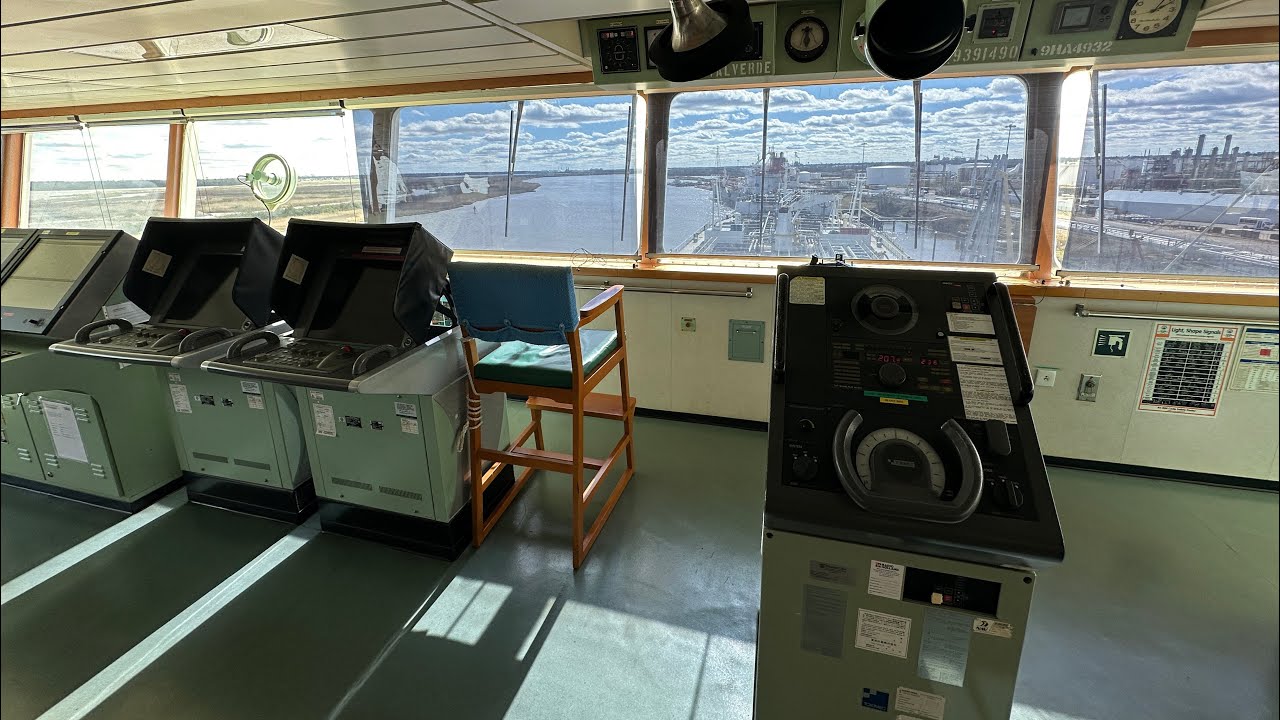
Onboard The Bridge of A Crude Oil Tanker Ship – YouTube
Onboard The Bridge of A Crude Oil Tanker Ship - YouTube


Watch On

Increasing connectivity, increasing risk

At the same time, ships are becoming more connected. Modern vessels increasingly rely on satellite internet systems like Starlink and remote monitoring tools to manage operations and communicate with shore.

While these technologies improve efficiency, they also expand the vulnerability of ship systems. Connectivity that allows crews to send emails or access the internet can also provide pathways for cyber threats to reach onboard systems.

As GPS spoofing becomes more common in regions experiencing geopolitical conflict, the challenges mariners described in our research are becoming harder to ignore. The oceans may seem vast and empty, but the digital signals that guide modern ships travel through crowded and contested space.

When those signals are manipulated, the consequences do not stay confined to military systems. They reach the commercial vessels that carry most of the world’s goods and the crews responsible for navigating them safely.

This edited article is republished from The Conversation under a Creative Commons license. Read the original article.

Share. Facebook Twitter LinkedIn Telegram WhatsApp Email

Keep Reading

Archaeologists study the International Space Station and Everest to figure out ‘how humans adapt in this impossible place where we have no business going’

Archaeologists study the International Space Station and Everest to figure out ‘how humans adapt in this impossible place where we have no business going’

Celestron StarSense Explorer LT 70AZ review

Celestron StarSense Explorer LT 70AZ review

Daddy longlegs may be capturing and devouring frogs in the tropical forests of South America

Daddy longlegs may be capturing and devouring frogs in the tropical forests of South America

Google wants to release 64 million bacteria-riddled mosquitoes across California and Florida. Here’s why scientists are enthusiastic.

Google wants to release 64 million bacteria-riddled mosquitoes across California and Florida. Here’s why scientists are enthusiastic.

‘In an unrecoverable state’: NASA confirms MAVEN spacecraft is officially dead after loss of signal behind Mars

‘In an unrecoverable state’: NASA confirms MAVEN spacecraft is officially dead after loss of signal behind Mars

Arthritis drug shows antiviral effects against RSV, the leading cause of infant hospitalization

Arthritis drug shows antiviral effects against RSV, the leading cause of infant hospitalization

The Celestron NexStar 8SE telescope is at its lowest price of the year in this early Amazon Prime Day deal

The Celestron NexStar 8SE telescope is at its lowest price of the year in this early Amazon Prime Day deal

SIGMA 150-600mm f/5-6.3 DG DN OS Sport lens review

SIGMA 150-600mm f/5-6.3 DG DN OS Sport lens review

Diagnostic dilemma: Doctors couldn’t explain why a boy was bleeding from his eyes, ears and nose

Diagnostic dilemma: Doctors couldn’t explain why a boy was bleeding from his eyes, ears and nose

Add A Comment
Leave A Reply Cancel Reply

Editors Picks

NBA investigating ‘vulgar’ Jalen Brunson hecklers after tense Game 1 Finals moment

NBA investigating ‘vulgar’ Jalen Brunson hecklers after tense Game 1 Finals moment

June 4, 2026
Archaeologists study the International Space Station and Everest to figure out ‘how humans adapt in this impossible place where we have no business going’

Archaeologists study the International Space Station and Everest to figure out ‘how humans adapt in this impossible place where we have no business going’

June 4, 2026
John Bolton set to plead guilty in classified documents case: report

John Bolton set to plead guilty in classified documents case: report

June 4, 2026
Red Sox third base coach does something never seen before in baseball, leaving fans confused

Red Sox third base coach does something never seen before in baseball, leaving fans confused

June 4, 2026

Subscribe to News

Get the latest USA news and updates directly to your inbox.

Latest News
President Donald Trump Claims CNN’s Kaitlan Collins ‘Never Smiles’ and Has ‘Hatred in Her Eyes’

President Donald Trump Claims CNN’s Kaitlan Collins ‘Never Smiles’ and Has ‘Hatred in Her Eyes’

June 4, 2026
Polymarket promo code NYPMAX: Deposit , get  trading bonus for World Cup markets

Polymarket promo code NYPMAX: Deposit $20, get $50 trading bonus for World Cup markets

June 4, 2026
Graham Platner tells Dem senators ‘worst of the rumors are not true’ in high-stakes DC meeting: report

Graham Platner tells Dem senators ‘worst of the rumors are not true’ in high-stakes DC meeting: report

June 4, 2026
Facebook X (Twitter) Pinterest WhatsApp TikTok Instagram
© 2026 USA Times. All Rights Reserved.
  • Privacy Policy
  • Terms
  • Advertise
  • Contact

Type above and press Enter to search. Press Esc to cancel.