




Deep in a limestone cave on Turkey’s Mediterranean coast, archaeologists have uncovered evidence that Neanderthals and the modern humans who moved in later left behind surprisingly similar traces of their daily lives — evidence that they hunted the same animals, crafted the same stone tools and collected the same type of seashells.
The findings, published Monday (July 6) in the journal PNAS, feed into some of the biggest questions in human evolution: How similar were the cultures of Neanderthals and Homo sapiens, given that we’re so closely related? And did we share information with one another?
A series of archaeological finds over the past few decades, including the new paper’s finding that the two had similar cultural practices, suggests that Neanderthals and H. sapiens behaved far more similarly in the Middle East than once assumed.
The new evidence comes from Üçağızlı II Cave (pronounced Ooch-ah-UHZ’-luh), on a stretch of coastline just north of Syria that served as a prehistoric corridor between the Levant (an area of land east of the Mediterranean) and Eurasia. Although the team found only teeth and a partial jawbone within the cave, they were able to distinguish between the remains of Neanderthals and H. sapiens by analyzing the internal structure of the fossilized teeth. Meanwhile, they dated the sediment at the site using optically stimulated luminescence, a technique that reveals how long ago buried mineral grains last saw sunlight.
The team found that the Neanderthals had lived within the cave between approximately 77,000 and 59,000 years ago, while H. sapiens stayed there between about 59,000 and 47,000 years ago. Despite the different time periods, the layers from both of these periods show “substantially uniform hunting-gathering strategies and lithic technology,” showing how similar the Neanderthals and H. sapiens were in their hunting-gathering strategies and stone-tool use, the team wrote in the study.
The research team performs excavations at the Üçağızlı II cave site in 2024.
(Image credit: KyotoU/Naoki Morimoto)
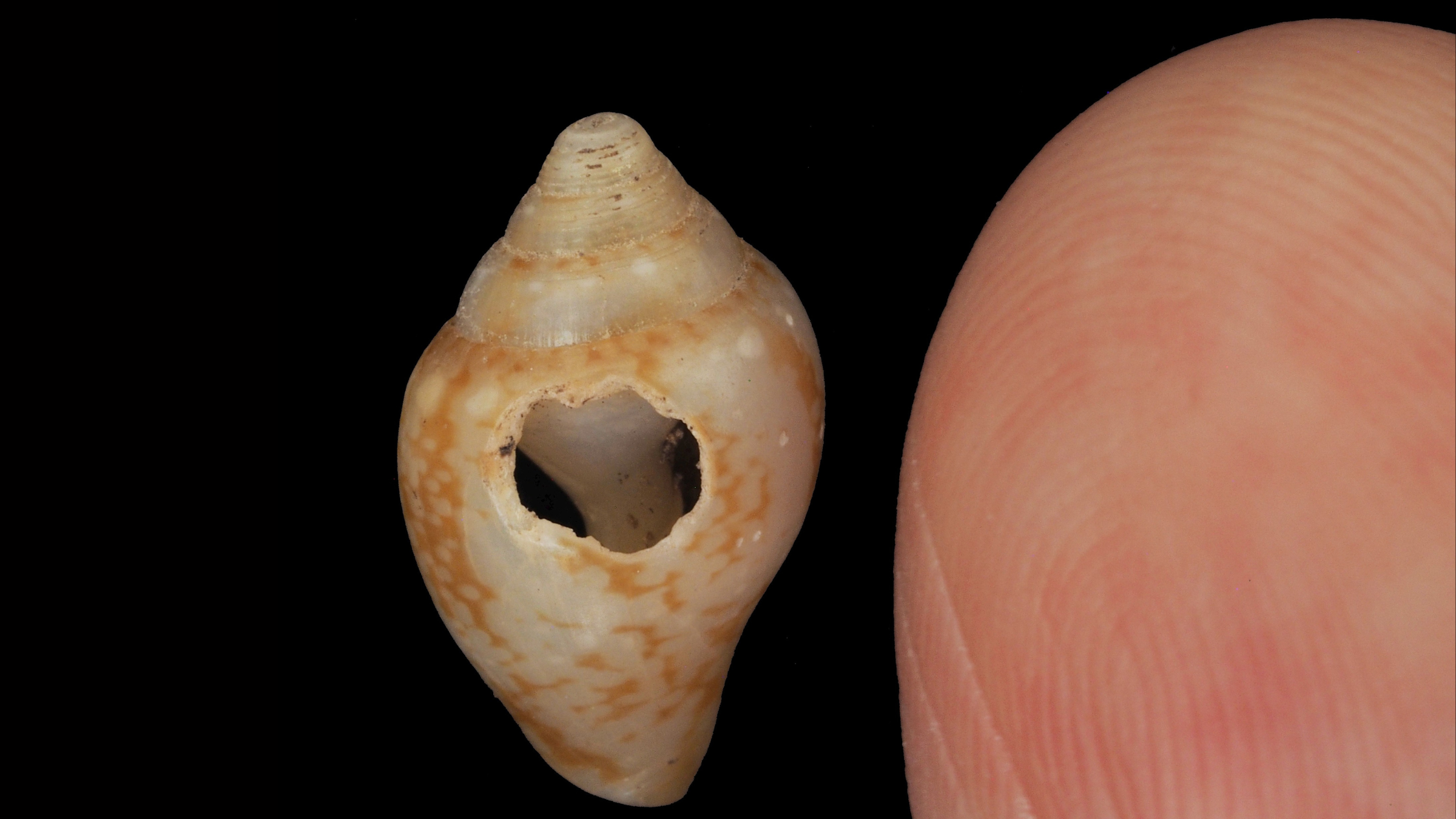
What’s more, Neanderthals and H. sapiens got raw materials, such as flint, from the same local sources and hunted the same prey: wild goats (Capra aegagrus), fallow deer (Dama mesopotamica), roe deer (Capreolus capreolus) and wild boar (Sus scrofa). Layer after layer also turned up 29 shells of a small marine snail, Columbella rustica, carried into the cave not for food but seemingly as ornaments. Some were pierced as if meant to be strung, and one shell dating to the Neanderthal occupation showed signs of deliberate heating that altered its color.
“Our findings indicate a deep level of cultural interaction,” study co-author Naoki Morimoto, paleoanthropologist at Kyoto University, said in a statement. “These two distinct but closely related human groups were not just adapting to the same environment: they were probably sharing symbolic preferences.”
Get the world’s most fascinating discoveries delivered straight to your inbox.
That pattern breaks from findings at Mandrin Cave in France, where Neanderthals and modern humans are thought to have alternated occupation in distinct pulses from about 56,800 and 41,500 years ago, but did not leave evidence of a continuous culture. Instead, it echoes evidence from Tinshemet Cave in Israel, where researchers recently reported similar signs of shared behavior between the two groups tens of thousands of years earlier, from about 130,000 to 80,000 years ago.

A view of Turkey’s Üçağızlı II Cave, which housed Neanderthals and Homo sapiens at different times.
(Image credit: KyotoU/Naoki Morimoto)
Üçağızlı II Cave in Turkey and Tinshemet Cave in Israel suggest that even though there was a “biological” turnover as the caves went from being occupied by Neanderthal groups to modern humans, there weren’t major cultural turnovers, too.
“Rather, we hypothesize that the two human species that coexisted in the region were in contact and shared cultural aspects,” the researchers wrote in the study.
“A fascinating region”
Sites like these are forcing a rethink of how these two types of human were culturally related to each other, April Nowell, a Paleolithic archaeologist at the University of Victoria in Canada who was not involved in the new study, told Live Science in an email. “By demonstrating cultural continuity and elevated levels of interaction, sites such as Tinshemet and Üçağızlı II are changing what we thought we knew about Neandertals, Homo sapiens and other contemporary Homo groups … a fascinating region just got even more so!” she said.
But that cultural continuity only heightens the mystery of how modern humans and Neanderthals interacted, with Neanderthals eventually going extinct around 40,000 years ago. Two types of human can’t occupy the same ecological niche indefinitely, Nowell noted, and some research into Neanderthal cognition suggests Neanderthals were less-flexible thinkers than modern humans, with more limited capacity for language and less of the kind of self-awareness and creativity that may have given H. sapiens an edge. (However, there is pushback against the idea that Neanderthals weren’t as cognitively complex as H. sapiens.)
If the archaeological record at sites like Üçağızlı II shows this much overlap in behavior, Nowell said, the real differences between the two may be ones the fossil record simply hasn’t revealed yet.
The authors noted that many big questions remain, including when and where these shared cultural practices took place and whether these cultural similarities happened because modern humans mated with Neanderthals.
Ongoing and future excavations at sites like Üçağızlı II Cave may help to answer these questions and build a “more comprehensive picture of human evolution and cultural development during the Late Pleistocene,” the team wrote in the study.
Baykara, İsmail, Baykara,D. Turan,E. Eren Kural,D. Silibolatlaz,M.K. Agras,E. Şahiner,S. Kavak,C. Zanolli,Y. Ishihara,W. Morita, & N. Morimoto. (2026). Long-term cultural continuity across the Neanderthal–modern human sequence at Üçağızlı II Cave, northern Levant. PNAS, 123(0). https://doi.org/10.1073/pnas.2609061123.
How much do you know about our closest relatives? Find out with our Neanderthal quiz!