Close Menu
  • Home
  • United States
  • World
  • Politics
  • Business
  • Lifestyle
  • Entertainment
  • Health
  • Science
  • Tech
  • Sports
  • More
    • Web Stories
    • Editor’s Picks
    • Press Release

Subscribe to Updates

Get the latest USA news and updates directly to your inbox.

What's On
Jonathan Taylor trade talks ‘active and ongoing’ as Colts now fielding calls on All-Pro running back: report

Jonathan Taylor trade talks ‘active and ongoing’ as Colts now fielding calls on All-Pro running back: report

October 31, 2026
Influencer Allison Kuch Reveals She’s Running NYC Marathon 6 Months Postpartum: ‘I’m Still Here’

Influencer Allison Kuch Reveals She’s Running NYC Marathon 6 Months Postpartum: ‘I’m Still Here’

October 31, 2026
Lightning coach sheds new light on Nikita Kucherov trade drama — with caution

Lightning coach sheds new light on Nikita Kucherov trade drama — with caution

October 31, 2026
Facebook X (Twitter) Instagram
Trending
  • Jonathan Taylor trade talks ‘active and ongoing’ as Colts now fielding calls on All-Pro running back: report
  • Influencer Allison Kuch Reveals She’s Running NYC Marathon 6 Months Postpartum: ‘I’m Still Here’
  • Lightning coach sheds new light on Nikita Kucherov trade drama — with caution
  • Trump ask to set aside ‘Decoy Dan’ Alaska Senate ballots ‘not even possible’: attorneys
  • Elissa Slotkin’s remarks may hurt Democratic probes, warns prosecutor
  • Kaitlyn Bristowe Details Anxiety After Dog’s Overdose: ‘Can Never Let Anything Happen to Him Again’
  • Islanders get served an ugly reminder in blowout loss to Oilers
  • Xavier Becerra roasted for bizarre deflection on California housing debate: ‘Maybe in my backyard?’
  • Privacy
  • Terms
  • Advertise
  • Contact Us
Join Us
USA TimesUSA Times
Newsletter Login
  • Home
  • United States
  • World
  • Politics
  • Business
  • Lifestyle
  • Entertainment
  • Health
  • Science
  • Tech
  • Sports
  • More
    • Web Stories
    • Editor’s Picks
    • Press Release
USA TimesUSA Times
Home » Rare red northern lights may be visible alongside red moon during tomorrow night’s partial lunar eclipse
Rare red northern lights may be visible alongside red moon during tomorrow night’s partial lunar eclipse
Science

Rare red northern lights may be visible alongside red moon during tomorrow night’s partial lunar eclipse

News RoomBy News RoomAugust 26, 20262 ViewsNo Comments

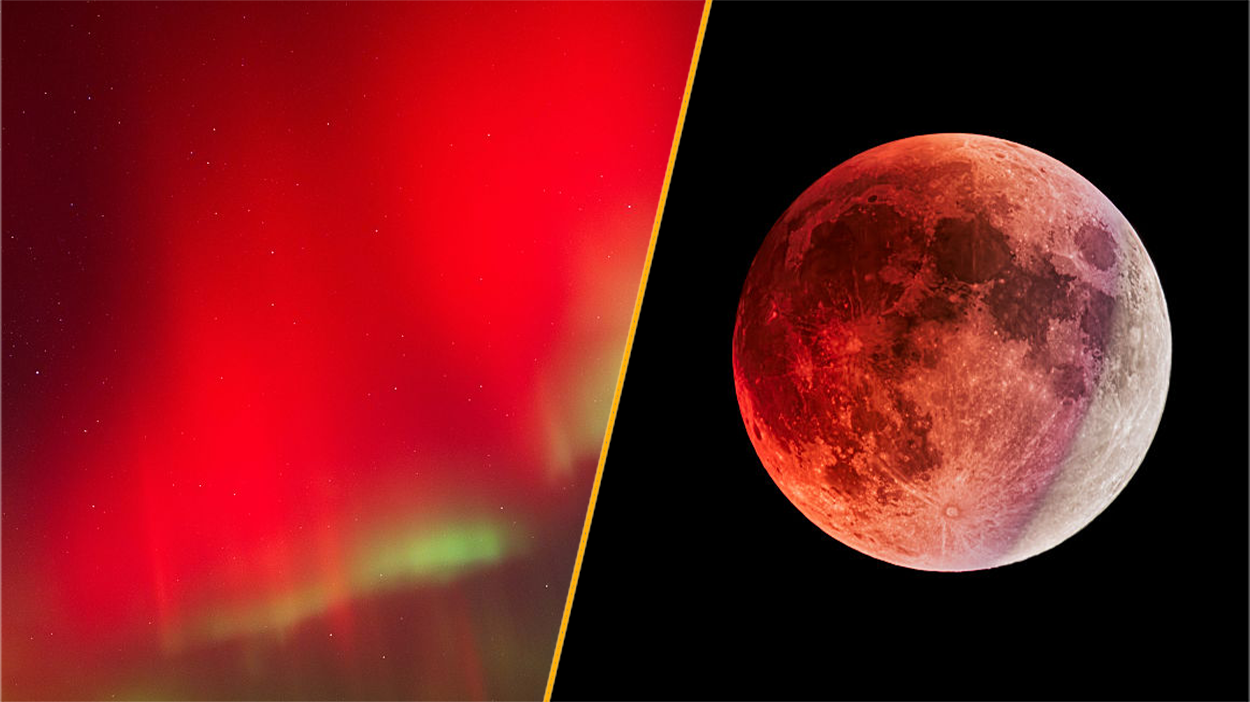
A striking red aurora may be visible to some skywatchers alongside tomorrow night’s blood-red partial lunar eclipse, astronomers say.

The full moon is expected to slide into Earth’s shadow tomorrow night (Aug. 27-28), casting an eerie red glow over 96% of the lunar surface. At the same time, the National Oceanic and Atmospheric Administration (NOAA) has issued a moderate (G2) geomagnetic storm warning for 9:03 p.m. EDT (1303 GMT) Thursday night (Aug. 27) — 20 minutes before the eclipse starts. According to NOAA, the resulting auroras may be visible over several states, ranging from New York to Idaho.

However, skywatchers farther north have better odds of catching both spectacular sights together.

Latest Videos FromLive Science

“Though it’s unlikely the moon and aurora would occupy the same part of the sky, observers in Canada and Alaska have the best chance to see them together,” Tom Kerss, an astronomer and co-author of the “Little Book of Eclipses: An essential companion to solar and lunar events” (Octopus Publishing Group, 2026), told Live Science. “The further west you are, the lower the moon will be in the East during the deepest part of the eclipse, where it may overlap with the brightest region of the auroral oval.”

The aurora borealis, also known as the northern lights, is an atmospheric phenomenon caused by the solar wind ‪—‬ clouds of electrically charged particles spewed from the sun. Most of these particles are deflected by the geomagnetic shield that surrounds our planet, but some get swept into Earth’s magnetic field and channeled toward the planet’s poles.


You may like

Once there, the particles collide with atoms and molecules in the atmosphere, causing them to heat up and glow and producing the mesmerizing light show we know as the northern lights.

The intensity of these lights depends on the strength of the solar wind that hits our planet. Yesterday (Aug. 25), a powerful M-class solar flare — the second-strongest class of solar flare — flashed from a restless sunspot called 4513, according to Live Science’s sister website Space.com. This was followed by a large ejection of solar plasma known as a coronal mass ejection.

Get the world’s most fascinating discoveries delivered straight to your inbox.

This cloud of electrified, magnetic gas is expected to reach our planet between Aug. 27 and 28, with NOAA forecasting moderate (G1 and G2) geomagnetic storm conditions from 5 p.m. to 11 p.m. EDT on Aug. 27. Meanwhile, the lunar eclipse will begin at 9:23 p.m. EDT, peak just after midnight, and end around 3 a.m. EDT Friday (Aug. 28).

The moon won’t fall totally under Earth’s shadow, so we can’t officially call it a “blood moon,” but it will be the deepest lunar eclipse anywhere in the world until the next total lunar eclipse on Dec. 31, 2028. This could allow for particularly unusual viewing conditions.

“Typically, a full moon competes with aurorae by brightening the sky, but when submerged in the Earth’s shadow, it will be relatively dark, increasing the odds of spotting the northern lights,” Kerss said.


What to read next

The contrasting green of the auroral bands and coppery-red surface of the moon should make for striking views on their own. But with G2-class geomagnetic storms on the horizon, some viewers may catch a glimpse of an even rarer sight.

“If the northern lights are occurring over your horizon, you may even witness the high-altitude red auroras in concert with a reddened moon,” Kerss said.

The colors of the northern lights are influenced by the different gases in Earth’s atmosphere — primarily nitrogen and oxygen — and where these gases sit in the atmosphere, according to NASA. At lower altitudes, for example, oxygen usually glows green. However, during more intense geomagnetic storms, an aurora may reach oxygen particles high in our planet’s atmosphere. At these altitudes, above 120 miles (200 kilometers), oxygen glows red.

Meanwhile, the moon appears coppery red due to the way Earth’s atmosphere bends and absorbs light. Sunlight comprises a spectrum of colors, and the blue and yellow parts of this spectrum are absorbed by the atmosphere. However, red light gets bent, or refracted, by Earth’s atmosphere, which directs it toward the moon and lights up our rocky satellite like a blood-red flashlight beam, according to the European Space Agency.


Share. Facebook Twitter LinkedIn Telegram WhatsApp Email

Keep Reading

Mysterious force that cleared the cosmic fog at the dawn of the universe may not be what we thought

Mysterious force that cleared the cosmic fog at the dawn of the universe may not be what we thought

Ghostly statue of ‘shrine maiden’ discovered at 1,500-year-old burial mound in Japan

Ghostly statue of ‘shrine maiden’ discovered at 1,500-year-old burial mound in Japan

Can animals lie? This sneaky bird might be proof.

Can animals lie? This sneaky bird might be proof.

How to watch ‘Blue Planet III’ online: Stream Sir David Attenborough’s spectacular new series

How to watch ‘Blue Planet III’ online: Stream Sir David Attenborough’s spectacular new series

‘You start painting pictures of squirrels twirling their mustaches’: A biologist on whether animals can lie

‘You start painting pictures of squirrels twirling their mustaches’: A biologist on whether animals can lie

Are sharks really older than trees?

Are sharks really older than trees?

‘It isn’t under control at all’: Live Science readers respond to whether AI is making them lazy

‘It isn’t under control at all’: Live Science readers respond to whether AI is making them lazy

Just 1 month of virtual reality training can turn people into lucid dreamers, small study finds

Just 1 month of virtual reality training can turn people into lucid dreamers, small study finds

Jupiter, Saturn, Uranus and Neptune will probably destroy each other after the sun runs out of fuel, new simulations hint

Jupiter, Saturn, Uranus and Neptune will probably destroy each other after the sun runs out of fuel, new simulations hint

Add A Comment
Leave A Reply Cancel Reply

Editors Picks

Influencer Allison Kuch Reveals She’s Running NYC Marathon 6 Months Postpartum: ‘I’m Still Here’

Influencer Allison Kuch Reveals She’s Running NYC Marathon 6 Months Postpartum: ‘I’m Still Here’

October 31, 2026
Lightning coach sheds new light on Nikita Kucherov trade drama — with caution

Lightning coach sheds new light on Nikita Kucherov trade drama — with caution

October 31, 2026
Trump ask to set aside ‘Decoy Dan’ Alaska Senate ballots ‘not even possible’: attorneys

Trump ask to set aside ‘Decoy Dan’ Alaska Senate ballots ‘not even possible’: attorneys

October 31, 2026
Elissa Slotkin’s remarks may hurt Democratic probes, warns prosecutor

Elissa Slotkin’s remarks may hurt Democratic probes, warns prosecutor

October 31, 2026

Subscribe to News

Get the latest USA news and updates directly to your inbox.

Latest News
Kaitlyn Bristowe Details Anxiety After Dog’s Overdose: ‘Can Never Let Anything Happen to Him Again’

Kaitlyn Bristowe Details Anxiety After Dog’s Overdose: ‘Can Never Let Anything Happen to Him Again’

October 31, 2026
Islanders get served an ugly reminder in blowout loss to Oilers

Islanders get served an ugly reminder in blowout loss to Oilers

October 31, 2026
Xavier Becerra roasted for bizarre deflection on California housing debate: ‘Maybe in my backyard?’

Xavier Becerra roasted for bizarre deflection on California housing debate: ‘Maybe in my backyard?’

October 31, 2026
Facebook X (Twitter) Pinterest WhatsApp TikTok Instagram
© 2026 USA Times. All Rights Reserved.
  • Privacy Policy
  • Terms
  • Advertise
  • Contact

Type above and press Enter to search. Press Esc to cancel.