

Close Menu
  • Home
  • United States
  • World
  • Politics
  • Business
  • Lifestyle
  • Entertainment
  • Health
  • Science
  • Tech
  • Sports
  • More
    • Web Stories
    • Editor’s Picks
    • Press Release

Subscribe to Updates

Get the latest USA news and updates directly to your inbox.

What's On
‘Buffy’ Reboot Star Ryan Kiera Armstrong Speaks Out After Hulu Pulls the Plug on Show

‘Buffy’ Reboot Star Ryan Kiera Armstrong Speaks Out After Hulu Pulls the Plug on Show

March 15, 2026
St. John’s legends: ‘No brainer’ Zuby Ejiofor will be good NBA pro

St. John’s legends: ‘No brainer’ Zuby Ejiofor will be good NBA pro

March 15, 2026
Son of jailed British couple appeals to Trump over parents’ Iran detention amid war

Son of jailed British couple appeals to Trump over parents’ Iran detention amid war

March 15, 2026
Facebook X (Twitter) Instagram
Trending
  • ‘Buffy’ Reboot Star Ryan Kiera Armstrong Speaks Out After Hulu Pulls the Plug on Show
  • St. John’s legends: ‘No brainer’ Zuby Ejiofor will be good NBA pro
  • Son of jailed British couple appeals to Trump over parents’ Iran detention amid war
  • Prince Harry Responds to Claim Queen Camilla Allegedly Said He Was ‘Brainwashed’ By Meghan Markle
  • Keegan Bradley reveals his bitter reality after Ryder Cup loss: ‘still heartbroken’
  • US flag raised at embassy in Venezuela for first time in 7 years
  • Candace Owens Shares Alleged Message From Late Charlie Kirk Calling Meghan McCain a ‘Piece of S***’
  • St. John’s helped Rick Pitino keep promise to wife with Big East repeat — and issued an MSG reminder
  • Privacy
  • Terms
  • Advertise
  • Contact Us
Join Us
USA TimesUSA Times
Newsletter Login
  • Home
  • United States
  • World
  • Politics
  • Business
  • Lifestyle
  • Entertainment
  • Health
  • Science
  • Tech
  • Sports
  • More
    • Web Stories
    • Editor’s Picks
    • Press Release
USA TimesUSA Times
Home » Mysterious, irradiated ‘scar’ in our galaxy points to 2 stars that almost hit the sun
Mysterious, irradiated ‘scar’ in our galaxy points to 2 stars that almost hit the sun
Science

Mysterious, irradiated ‘scar’ in our galaxy points to 2 stars that almost hit the sun

News RoomBy News RoomDecember 18, 20250 ViewsNo Comments

Roughly 4.5 million years ago, the sun passed remarkably close to two intensely bright stars whose radiation flooded nearby space — and the encounter left a ghostly scar that astronomers can still detect today, according to a new study.

The research team says the close pass helps to solve a decades-old mystery of why the space around our solar system is far more energized than models predict, including why it contains a surplus of ionized helium.

Using computer models to rewind the paths of stars near the sun, a team led by University of Colorado Boulder astrophysicist Michael Shull found that two blue-white stars, Beta Canis Majoris and Epsilon Canis Majoris, passed within 30 light-years of the sun about 4.5 million years ago.


You may like

Today, the stars mark the front and rear legs of the constellation Canis Major (the Great Dog), more than 400 light-years from the solar system. But roughly 4.5 million years ago, when the stars brushed past the solar system, they were younger, hotter and brighter. Their passage also may have overlapped with the time when Lucy — a remarkably complete fossil of an early human ancestor discovered in Ethiopia in 1974 — walked the Earth.

“They weren’t headed straight toward us…but that’s close,” Shull told Live Science. “If Lucy and her friends had looked up and had noticed the stars, the two brightest stars in the sky would have been not Sirius, but Beta and Epsilon Canis Majoris.”

The findings were published Nov. 24 in The Astrophysical Journal.

A lingering mystery

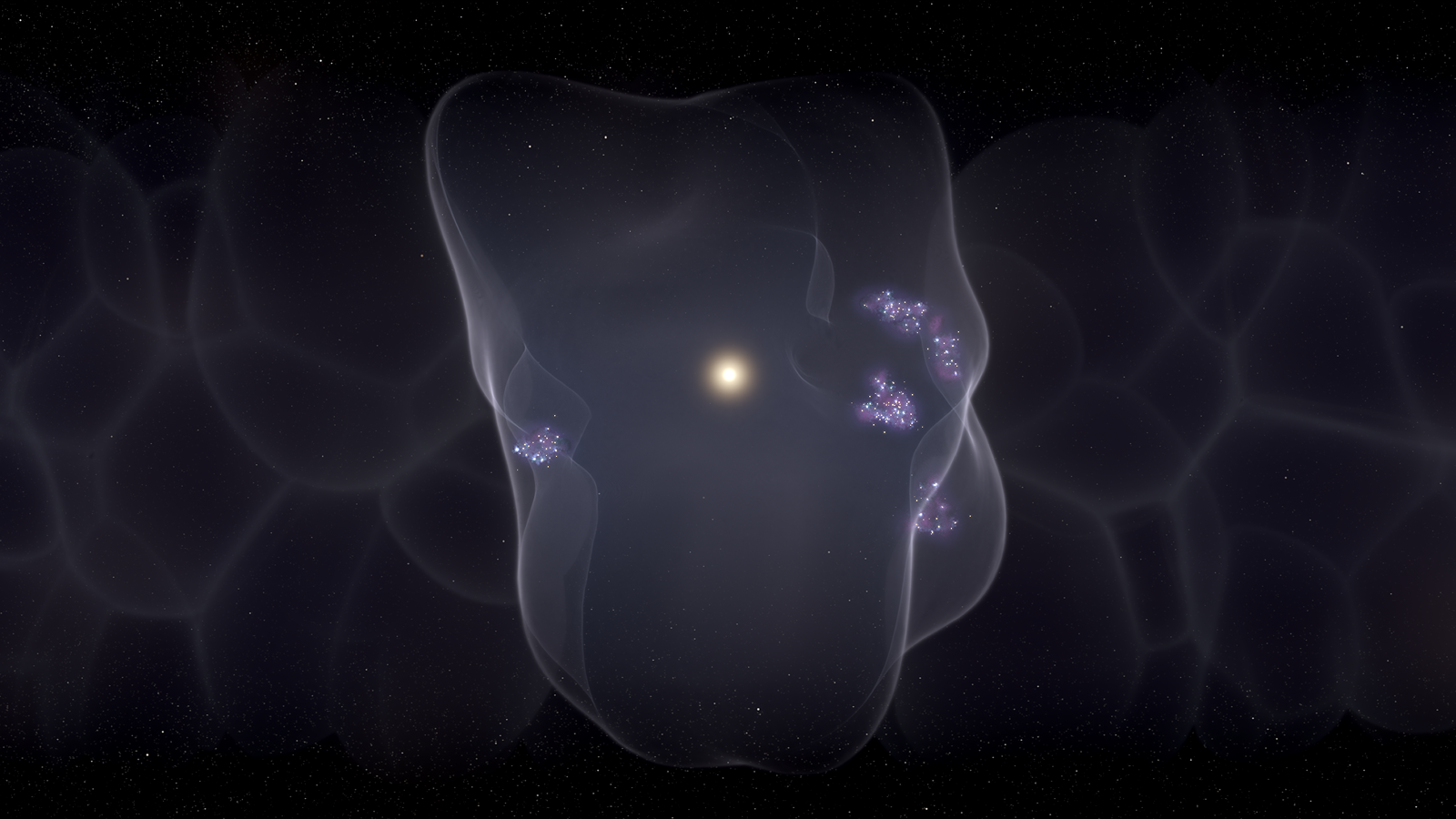
Today, the solar system drifts through a diffuse patchwork of more than a dozen nearby wisps of gas and dust called the local interstellar medium, made primarily of hydrogen and helium and extending roughly 30 light-years from the sun.

Get the world’s most fascinating discoveries delivered straight to your inbox.

Astronomers think these clouds were sculpted over several million years by shock waves from exploding stars in the Scorpius-Ophiuchus region, a rich cluster of massive stars about 300 light-years from Earth, which compressed interstellar gas into the thin local clouds seen today.

A map of the local interstellar clouds just outside our solar system. Blue arrows show the directions that these clouds are moving. The yellow arrow shows the direction of the sun’s motion. (Image credit: NASA/Adler/U. Chicago/Wesleyan; https://svs.gsfc.nasa.gov/10906)

Observations dating back to the 1990s, including from NASA’s now-retired Extreme Ultraviolet Explorer space telescope, revealed that this region is unusually ionized. Helium atoms, in particular, have been stripped of their electrons at nearly twice the rate expected relative to hydrogen.

That imbalance has puzzled astronomers, because helium requires more energetic radiation to ionize than hydrogen does. This makes its elevated ionization difficult to explain with the sun’s radiation alone, which does not extend that far beyond the solar system.


You may like

To investigate the mystery, Shull and his colleagues calculated the properties and ultraviolet output of Beta and Epsilon Canis Majoris, using measurements from the European Space Agency’s Hipparcos satellite, which mapped the positions of more than a million stars across a four-year mission that ended in 1993.

Knowing how far away the two stars are today — about 400 light-years — and how fast they are moving allowed the team to trace the stars’ paths backward through time to reconstruct their close pass by the solar system roughly 4.5 million years ago.

“It’s like a dance floor”

The team’s models show that the wispy local clouds would have been intensely ionized by the two stars’ radiation — at levels up to 100 times stronger than those seen today. Over time, the gas would have slowly returned to a more neutral state through a process called recombination, in which free electrons reattach to ions and become atoms.

“It’s like a dance floor,” Shull told Live Science. “You’ve got protons and electrons dancing around, and sometimes they’re dancing together and sometimes they’re popping apart.”

But that process takes time, and continued exposure to radiation from other sources continues to keep the gas partially ionized, Shull said. Astronomers had previously identified other sources of ionizing radiation, including three nearby white dwarf stars — G191-B2B, Feige 24 and HZ 43A — compact stellar remnants that are known to emit strong ultraviolet light. Researchers also pointed to the Local Bubble — a vast, supernova-blown region of hot gas that extends about 1,000 light-years around the solar system.

“More energetic photons preferentially ionized helium,” he said. “That’s the bottom line.”

The pieces come together

Although astronomers have had reliable stellar motion data for decades, Shull said the problem became solvable only recently. Advances in ultraviolet and X-ray observations made possible by suborbital rocket flights, along with improved models of stellar evolution and atmospheres — and the computing power needed to run them — finally allowed researchers to connect the dots.

“The problem was ripe in the sense that all the pieces of the puzzle of the mystery were starting to come together,” Shull said.

The findings also may have implications closer to home. The local clouds help shield the planet from high-energy particles that roam the galaxy and that scientists suspect could erode Earth’s ozone layer.

The sun, however, is not expected to remain inside these clouds indefinitely. As it drifts onward through the galaxy, researchers estimate it could exit the protective region in as few as 2,000 to a few tens of thousands of years. “Then, we’re going to be in for a big dose of radiation,” Shull said.

Looking ahead, Shull said that understanding how atoms in the wispy local clouds shifted between more charged and more neutral states as radiation waxed and waned while the two stars approached, passed by and moved away from our solar system remains part of a larger puzzle researchers are still assembling. “The problem isn’t completely solved,” Shull said, “but I think we have the right track.”


Share. Facebook Twitter LinkedIn Telegram WhatsApp Email

Keep Reading

Amazon Spring Sale 2026: Stargazing deals on telescopes, cameras and binoculars

Amazon Spring Sale 2026: Stargazing deals on telescopes, cameras and binoculars

Amazon Spring Sale 2026: Wildlife observation edition

Amazon Spring Sale 2026: Wildlife observation edition

GPS is being weaponized in electronic warfare ‪—‬ and it’s putting ships at risk

GPS is being weaponized in electronic warfare ‪—‬ and it’s putting ships at risk

The appendix evolved at least 32 times across 361 species, so it’s ‘unlikely to be a useless evolutionary accident,’ research finds

The appendix evolved at least 32 times across 361 species, so it’s ‘unlikely to be a useless evolutionary accident,’ research finds

Roman military fort discovered in Scotland far north of Hadrian’s Wall

Roman military fort discovered in Scotland far north of Hadrian’s Wall

Pi has been calculated to trillions of digits ‪—‬ is that completely irrational?

Pi has been calculated to trillions of digits ‪—‬ is that completely irrational?

Science news this week: AMOC’s collapse signal, the sun’s galactic migration, the world’s smallest QR code and oil’s dying days

Science news this week: AMOC’s collapse signal, the sun’s galactic migration, the world’s smallest QR code and oil’s dying days

Garmin Venu 4 smartwatch review: A reliable everyday fitness tracker

Garmin Venu 4 smartwatch review: A reliable everyday fitness tracker

Reading AI summaries makes people more likely to buy something — despite alarming 60% hallucination rate

Reading AI summaries makes people more likely to buy something — despite alarming 60% hallucination rate

Add A Comment
Leave A Reply Cancel Reply

Editors Picks

St. John’s legends: ‘No brainer’ Zuby Ejiofor will be good NBA pro

St. John’s legends: ‘No brainer’ Zuby Ejiofor will be good NBA pro

March 15, 2026
Son of jailed British couple appeals to Trump over parents’ Iran detention amid war

Son of jailed British couple appeals to Trump over parents’ Iran detention amid war

March 15, 2026
Prince Harry Responds to Claim Queen Camilla Allegedly Said He Was ‘Brainwashed’ By Meghan Markle

Prince Harry Responds to Claim Queen Camilla Allegedly Said He Was ‘Brainwashed’ By Meghan Markle

March 15, 2026
Keegan Bradley reveals his bitter reality after Ryder Cup loss: ‘still heartbroken’

Keegan Bradley reveals his bitter reality after Ryder Cup loss: ‘still heartbroken’

March 15, 2026

Subscribe to News

Get the latest USA news and updates directly to your inbox.

Latest News
US flag raised at embassy in Venezuela for first time in 7 years

US flag raised at embassy in Venezuela for first time in 7 years

March 15, 2026
Candace Owens Shares Alleged Message From Late Charlie Kirk Calling Meghan McCain a ‘Piece of S***’

Candace Owens Shares Alleged Message From Late Charlie Kirk Calling Meghan McCain a ‘Piece of S***’

March 15, 2026
St. John’s helped Rick Pitino keep promise to wife with Big East repeat — and issued an MSG reminder

St. John’s helped Rick Pitino keep promise to wife with Big East repeat — and issued an MSG reminder

March 15, 2026
Facebook X (Twitter) Pinterest WhatsApp TikTok Instagram
© 2026 USA Times. All Rights Reserved.
  • Privacy Policy
  • Terms
  • Advertise
  • Contact

Type above and press Enter to search. Press Esc to cancel.