





Tiny fragments of ancient alien tech may be strewn across the surface of the moon, and it may be relatively easy to find these microscopic relics, scientists propose in a new study.
The theoretical study does not claim to have found any evidence of advanced alien civilizations; rather, it offers a new way to search for clues of their existence.
Unlike Earth, the moon has no functional atmosphere or magnetic field, so it is completely exposed to the vacuum of space. As a result, it is constantly bombarded by meteorites, as well as hit by a steady stream of microscopic particles from the rest of the solar system and beyond. Because the moon has no water or tectonic movements, this microscopic matter accumulates and remains on the surface, completely undisturbed.
Latest Videos FromLive Science
In the new paper, uploaded June 23 to the preprint server arXiv, the researchers argue that some of this dust originates from star systems beyond our own and, therefore, may contain evidence of long-lost alien civilizations. They also propose a new experiment that could potentially find these microscopic fragments within samples collected over the next decade or more. (The study has not been published yet, but it has been submitted to the International Journal of Astrobiology.)
“The moon has been quietly accumulating material from space for billions of years, much of it likely billions of years older than the moon itself,” study first author Lewis Pinault, a planetary scientist at University College London and an affiliate of the SETI Institute, said in a statement. “We’re asking whether that ancient collection might contain microscopic traces of technologies that existed long before humans ever looked up at the sky.”
Unlike Earth, the moon lacks a functional atmosphere or magnetic field, meaning that its surface is exposed to the vacuum of space. This allows cosmic dust and other tiny particles to embed themselves within the lunar regolith.
(Image credit: NASA)
Tiny technosignatures
Until now, the search for evidence of advanced alien civilizations, known as technosignatures, has focused mainly on radio signals that could be emitted from inhabited exoplanets or hypothetical megastructures, such as Dyson spheres. However, these signals would originate only from active civilizations, not those that died out long before we could spot them.
The authors of the new study argue that when a civilization dies, traces of its technology could survive and end up in space, either via the deterioration of megastructures and other smaller spacecraft or via powerful asteroid strikes on once-inhabited exoplanets. Once in space, tiny specks of metal or other artificial materials could be ejected from star systems by powerful gusts of stellar wind and eventually drift toward us.
Get the world’s most fascinating discoveries delivered straight to your inbox.
Using computer models, the team predicted that pieces of tech up to 3 micrometers across (three-millionths of a meter, or about 3% the width of a human hair) could escape their star systems and travel across interstellar space for up to 1 billion years. Then, they estimated how much of this material could be reaching the solar system and how likely it would be to end up on the moon. (We already know that interstellar dust can penetrate the inner solar system because scientists found some within samples collected from the surface of Bennu, an asteroid that orbits between Earth and Mars and was visited by NASA’s OSIRIS-REx probe in 2020.)
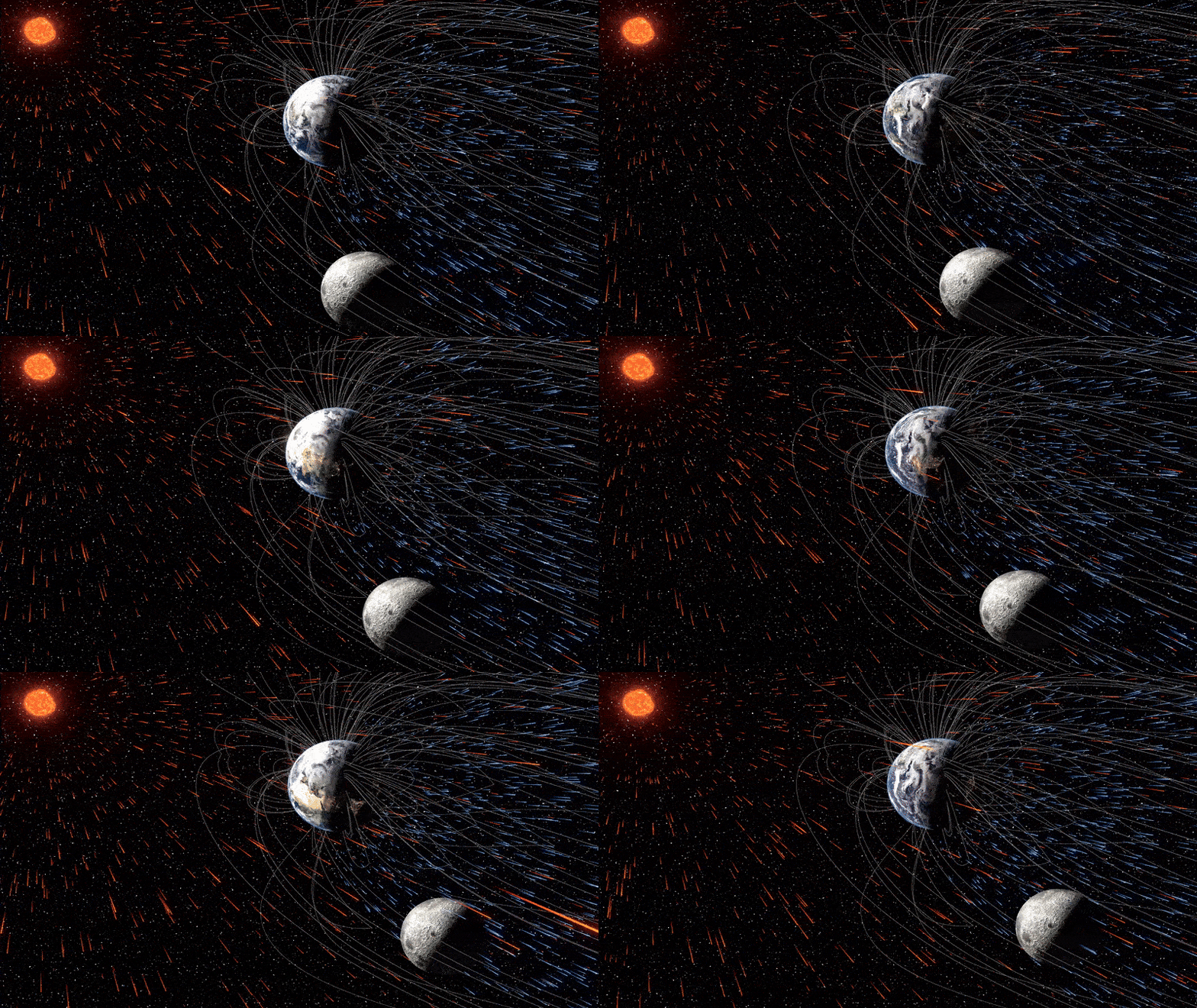
The moon is constantly being bombarded by tiny particles, some of which come from outside the solar system.
(Image credit: University of Rochester illustration / Shubhonkar Paramanick)
To date, no lunar samples have contained any technosignatures. However, the scientists who studied them were likely not looking for such particulates, and the samples were probably too small to yield meaningful results, the study authors argue.
The researchers believe that a sample of lunar regolith with a volume of 35 cubic feet (1 cubic meter) could be enough to find at least one technological fragment. The team also proposed ways of combing through the material using microscopy, industrial materials analysis and AI-assisted imaging.
However, if such a sample does not yield any results, this would not necessarily disprove the researchers’ hypothesis and may instead mean their models are off and a greater sample size would be required, the team wrote.
“Eminently reasonable”

Future missions in NASA’s Artemis II program could bring back more samples of lunar regolith from the moon for future analysis. This photo shows the Artemis II mission lifting off April 1 from the Kennedy Space Center in Florida.
(Image credit: Chip Somodevilla/Getty Images)
Several upcoming space missions will collect fresh samples from the lunar surface, including China’s recently delayed Chang’e-7 mission and future missions in NASA’s Artemis program. These samples could potentially hold technosignatures, although the volume of regolith collected will be far less than what the researchers are proposing.
Therefore, we may have to wait until humans establish a permanent moon base before astronauts can collect enough material to be analyzed properly. This may not be that far off, as both the U.S. and China are planning to construct lunar bases within the next decade. Researchers also think the samples could be analyzed on the moon rather than on Earth.
As a result, the SETI Institute, which leads the international hunt for technosignatures, views the new idea as very promising.
“The concept of searching the lunar regolith for microscopic technosignatures is at once extraordinarily original and eminently reasonable,” Bill Diamond, president and CEO of the SETI Institute, who was not involved in the new study, said in the statement. “This is a novel addition to the search methodologies applied to seeking evidence of technology as a proxy for life and intelligence beyond our solar system and we are excited at the prospect of bringing this to fruition.”
Lewis J. Pinault, Brian C. Lacki, Ian A. Crawford, Andrew P. V. Siemion. (2026) Micron-Scale Technosignatures: How a Cubic Metre of Lunar Regolith May Begin to Constrain the Number of Past Technological Civilisations in the Galaxy. arXiv. https://doi.org/10.48550/arXiv.2606.24028