


Over dinner at a gaming convention around 2010, board game designer James Ernest turned to his friend Eric Harshbarger and asked a question: Could you design a set of dice so that each player in a group — whether two people or any number — could grab one, roll and have a perfectly equal shot at going first? The rule is simple: Roll your dice, and whoever lands the highest number goes first. The hard part is making that outcome truly fair for every player, no matter how many are at the table.
There could be no ties and no rerolls.
Harshbarger, a mathematician at Auburn University in Alabama, didn’t have an answer that night. But the question stuck. Over the next 15 years, he and a loose network of collaborators casually worked to crack what became known as the “go first dice” problem.
Latest Videos FromLive Science
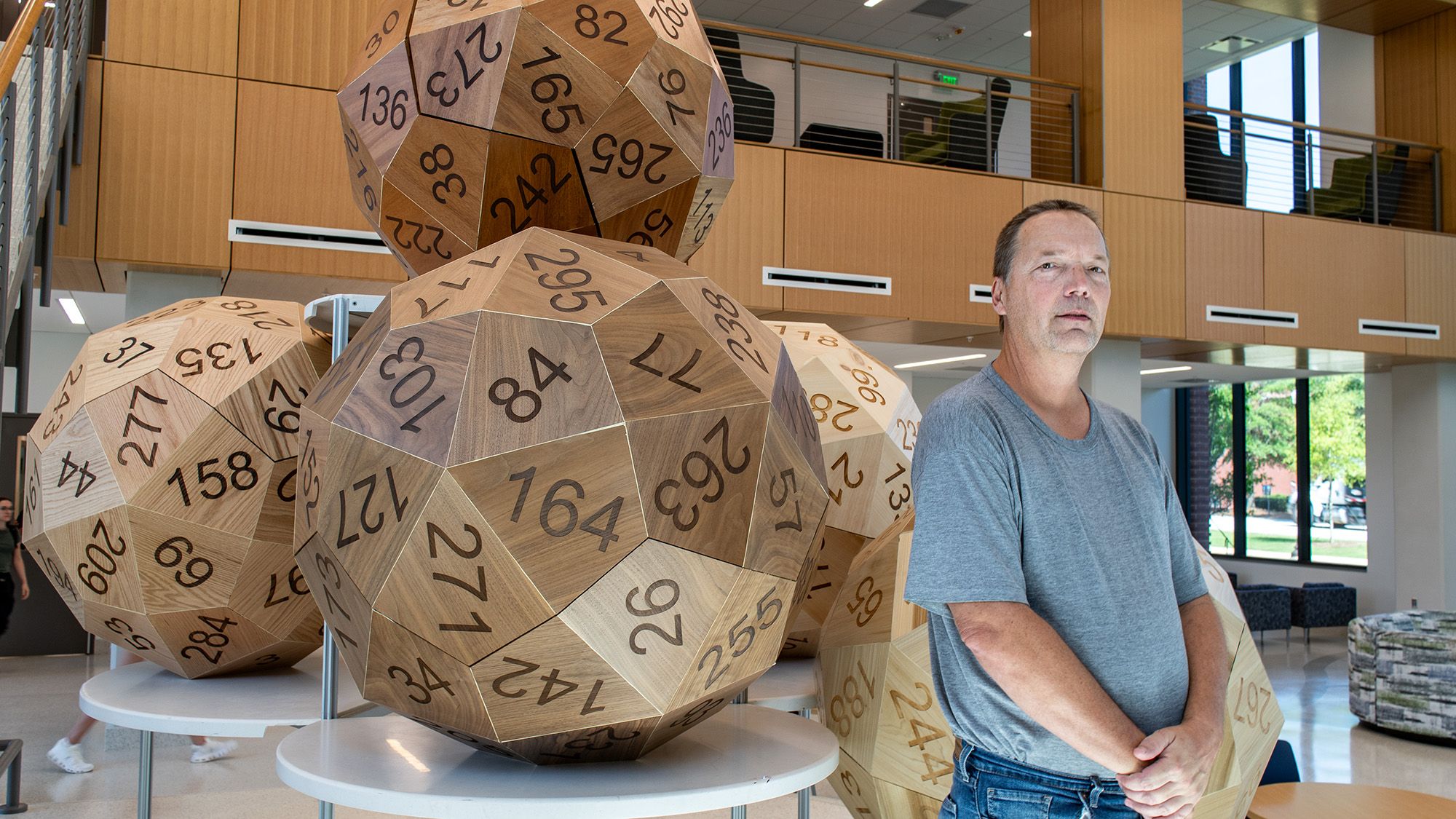
Now, they finally have the answer: a set of five 60-sided dice, collectively engraved with every number between 1 and 300, with no repeats. To mark the achievement, Harshbarger built five giant, wooden replicas of these hexecontahedrons (60-sided 3D shapes), each carved from a different type of wood. They are now on permanent display in Auburn’s new mathematics building.
The problem with dice
To understand why it was so hard to crack the problem, it helps to understand the simple part.
“The easy thing is to avoid ties; you just put different numbers on all the dice,” Harshbarger told Live Science. “The problem comes in how you distribute those different numbers across the dice so that the probability is equal not only for the whole set but for any subset.”
That second condition is what makes the problem devilish. Ernest’s request wasn’t just that eight players could roll fairly; it was that any subset of players could grab any dice from the bag roll and still have equal odds. If five people are playing, each takes a die. Three people? Same thing. The numbers on each die had to be arranged so that the fairness held no matter how many people showed up to play.
Get the world’s most fascinating discoveries delivered straight to your inbox.
Harshbarger looped in his childhood friend Robert Ford, a mathematician at Dalton State College. Within weeks, they had a three-player solution: numbers 1 through 18, spread across three standard six-sided dice in exactly the right arrangement. Four 12-sided dice, Ford later worked out entirely by hand, could accommodate four players fairly.
By 2012, Harshbarger was giving talks about the four-player set at math conferences, and The Guardian covered the story. His inbox erupted. He started selling handmade sets from home — buying blank, 12-sided dice; etching numbers onto each face with a laser cutter in his workshop; and then inking every number by hand. At his peak, he was dropping off 30 envelopes at the post office at a time, several times a week, shipping sets to customers around the world.
But as the team dug deeper into the math, they discovered that the dice were doing something even more remarkable than they’d realized: The configurations determined not only who went first but also the entire turn order, with every possible sequence of players equally likely to come up.
“If four people rolled, the chance that players finished in the order A, B, C, D was just as likely as C, B, D, A, or any of those combinations,” Harshbarger said. “‘Go first dice’ is actually a bit of a misnomer, because they do much more than just determine who goes first; they actually determine the ordering of all the players.”
This property, which the team calls permutation fairness, became the standard they chased for every set of dice from that point on.
More combinations than atoms in the universe
Four players was one thing. Five was another entirely.
Mathematically, the team knew a five-player same-shape set was feasible. But finding it meant searching an incomprehensibly large space of possible number arrangements.
“We’re talking literally more than the number of atoms in the universe — like 10 to the 128th power combinations,” Harshbarger said. “There’s just no way, even if we had a billion billion years and all the computers, all the AI. We still couldn’t do it today.”
They couldn’t brute-force their way to an answer. They needed mathematical shortcuts: symmetries and patterns to shrink the search space. But even then, years passed without a practical solution. Every path they found hit the same wall: dice too large to hold, too many sides to manufacture.
“My goal was a set for five players that can actually be manufactured, that you can hold in your hand, that board gamers could buy and roll,” Harshbarger said. “Even for a problem that is silly and pointless as far as gameplay — just mathematically, can you buy these things and roll them, and they work? You can’t do that with 180-sided dice.”
The five go-first dice, each with 60 sides, are designed so that any subset of players can grab one, roll and have an equal chance of winning. Each of these dice carries a unique set of numbers from 1 to 300.
(Image credit: Eric Hashbarger)
Then, in mid-2023, Canadian software engineer Paul Meyer emailed Harshbarger out of the blue. He had been studying patterns in Harshbarger’s four-player data and had written a program to exploit them. He hadn’t expected it to work right away.
It did. Meyer found a configuration of five 60-sided dice that satisfied every condition.
“I double-checked his work and went, ‘Oh my goodness; we’ve been searching for so long for this. This is amazing,'” Harshbarger said.
From workshop to gallery wall
The four-player set had long since been picked up by retailers — Maths Gear in the U.K. and Math Art Fun in the U.S. — so Harshbarger had stopped hand-making those years earlier. Now, the five-player version was real and small enough to manufacture.
But the story had one more turn. Auburn University was building a new home for its mathematics department and was looking for sculptural ideas to fill it. Harshbarger proposed building giant versions of the five new dice out of wood. The department agreed.
He spent months in his wood shop, constructing five oversize dice. Each is from a different type of wood: pine, poplar, oak, walnut or mahogany. The five sculptures now stand in Auburn’s new math building, which opened this fall.
For Harshbarger, the whole point is making math impossible to walk past.
“When people see giant dice or little dice, they’re fascinated just by the geometry,” he said. “The hope is, they see these things and go, ‘Oh, this is math too, and this is interesting.’ Some of the most fun math problems are ones that are easily understood and not easily answered.”