



Scientists at IBM and partner institutions say they’ve reached “quantum advantage” in a trio of experiments demonstrating quantum computing capabilities that even the fastest classical supercomputers can’t match.
In a purported major milestone for quantum computing, the experiments show how these machines could perform useful computational tasks, such as computing chemical reactions, within minutes. By comparison, a supercomputer would take years.
In a statement, IBM representatives said these experiments show that quantum computers can provide trusted solutions more efficiently, more cheaply or more accurately than any classical computing method.
Latest Videos FromLive Science
Trust and verification
At a July 28 news conference, representatives from IBM, Algorithmiq, Qedma, and the University of Chicago described three experiments demonstrating quantum advantage over classical computers in three different challenges.
Each used IBM’s Quantum Heron R3 superconducting quantum computer system running novel error mitigation techniques. The experiments focused on both demonstrating and verifying quantum advantage.
The first study, conducted in partnership with Qedma, investigated the Floquet transverse-field Ising model, a system physicists use to study how a material’s magnetic properties evolve when rhythmically driven by external pulses. This is an extremely difficult problem for classical computers because the model’s math becomes exponentially more difficult to process as the problem scales. Scientists published the study, which has not been peer-reviewed, on the arXiv preprint server July 27.
But quantum computers can perform deeper computations using the Floquet transverse-field Ising model than their classical counterparts due to quirks of quantum mechanics that allow quantum bits (qubits) to represent not just the 1s and 0s of binary data but also a superposition of the two values, so that calculations can run in parallel.
Get the world’s most fascinating discoveries delivered straight to your inbox.
When physicists use a classical supercomputer to run the model — in this case, the Fugaku supercomputer in Kobe, Japan — they have some trust that the results will be computed correctly and without significant error.
Quantum computers, by contrast, are far more prone to error. They’re extremely sensitive to any form of noise, including interference from Earth’s magnetic field. One of the chief challenges in quantum computing is finding ways to mitigate the errors caused by this noise.
Scientists can compare a classical supercomputer’s results with those of a quantum computer using the Floquet transverse-field Ising model, but only to a certain point. When the classical computer reaches the limit of its ability to compute complex problems, the quantum computer still has plenty of runway left.
But, as IBM principal research scientist Abhinav Kandala explained in an interview with Live Science, the problem lies in trusting the results.
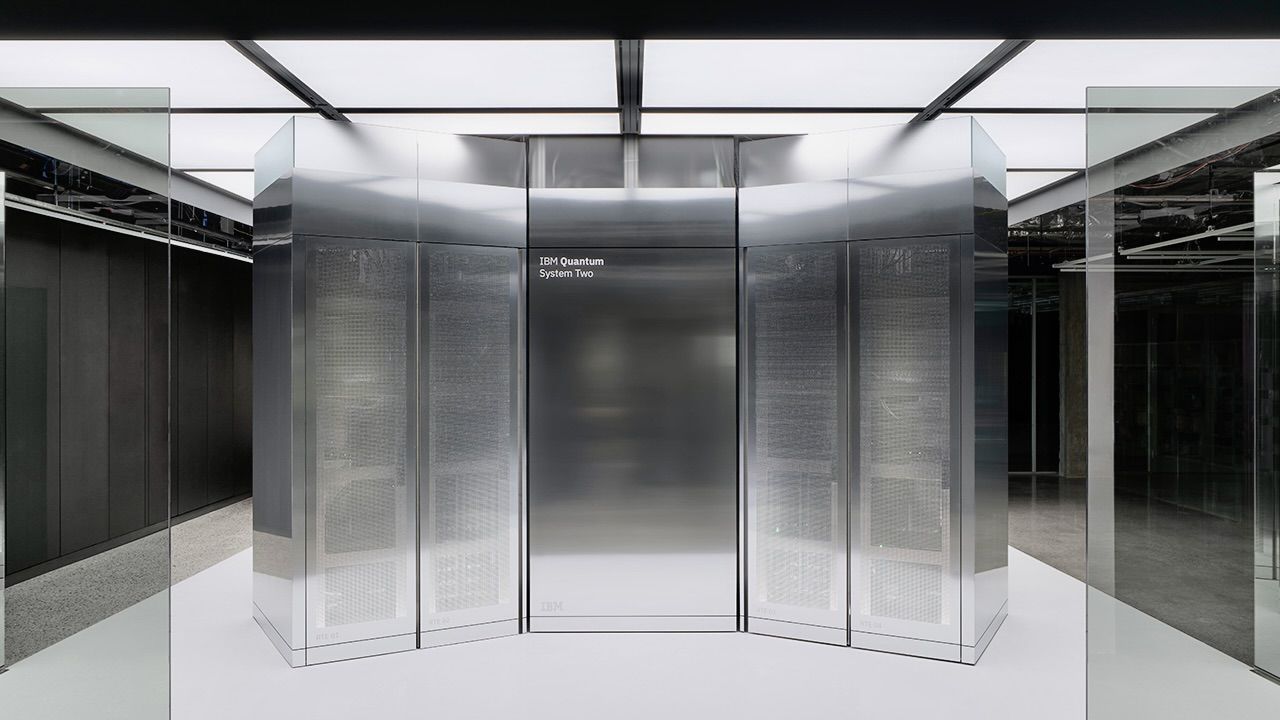
These experiments were powered by IBM’s Quantum Heron R3 superconducting quantum computer system.
(Image credit: IBM)
“You want to perform computations that outperform classical, right? But you’ve relied on classical results for the longest time,” he said. “So when you now begin to outperform, or you go beyond classical, how do you know you had the right result? This is a question that’s independent of application. For any computation that you want to do, you want to [ask], ‘OK, is this really something that I can trust?”
The experiment was designed to create a trusted stack that essentially allowed scientists to verify the quantum computer’s results. They used Qedma’s quantum error suppression and error mitigation (QESEM) software to provide consistent results, and then compared those results against the Fugaku supercomputer’s.
Once the results matched, they cranked up the difficulty until the classical computer could not keep up. Then, to replicate the results, they brought in additional quantum computers.
The team ran the same experiment on multiple quantum computers. To ensure they were getting enough errors to test the error mitigation strategy, Kandala said, they purposely injected each system with different levels of artificial noise and corruption.
“We measured the same circuit on five different quantum computers,” Kandala told Live Science, including a superconducting quantum computer from IBM Boston and another at IBM Pittsburgh.
They also ran the experiments on two of Quantinuum’s quantum computers, using the same error mitigation techniques. In each measurement, the noise and corruption injected into the system was different, but the computational results were consistent.
Quantum building blocks
In the second experiment, conducted by IBM and Algorithmiq, researchers applied the Floquet transverse-field Ising model to a different set of problems and used a different method for error mitigation. As the researchers scaled the problem on both the classical and quantum computers, the classical systems began to produce inconsistent results. The quantum systems, by contrast, maintained consistency at measured intervals, thus demonstrating verifiable outputs, the team reported in a preprint paper posted to arXiv July 28.
The third study, uploaded to arXiv July 28 and conducted in partnership with the University of Chicago, approached quantum advantage from a different angle. Researchers designed a system of “Clifford gates,” a type of circuit that is intentionally easy for classical computers to simulate. Then, they made the circuits progressively harder for classical systems to solve by injecting them with more difficult gates called T gates.
The nature of the experiment allowed physicists to guarantee error mitigation at complexities beyond what a classical supercomputer could handle. Any computations run through the circuit — even those that would be impossible for a classical computer — would be trustworthy by design.
Based on these three technical papers and other press information provided by IBM, it appears that each of the experiments demonstrated a clear quantum advantage over classical computers. Whether it will stay that way, however, remains to be seen.
There have been numerous reports of laboratories achieving “quantum supremacy,” “quantum utility” and “quantum advantage” over the past few years — each, essentially, claiming to have surpassed the abilities of classical computing. However, most of those achievements ended up being topped. It isn’t possible for physicists to imagine every possible mathematical method for conducting classical computations when they test quantum computers against state-of-the-art supercomputers.
IBM and its partners said they expect classical computer scientists to try disproving their claims.
“The classical back-and-forth — that’ll keep going on, I think,” Kandala said. “And that should; that’s how science progresses. And that’s precisely [why we have] the Quantum Advantage Tracker, a benchmark for measuring quantum advantage. “A lot of these problems have been on the tracker for a while now,” Kandala said, “and I’m sure getting the papers out will get more eyes on it.”