Close Menu
  • Home
  • United States
  • World
  • Politics
  • Business
  • Lifestyle
  • Entertainment
  • Health
  • Science
  • Tech
  • Sports
  • More
    • Web Stories
    • Editor’s Picks
    • Press Release

Subscribe to Updates

Get the latest USA news and updates directly to your inbox.

What's On
How to Find the Right Doctor for Testosterone Replacement Therapy and What Questions to Ask

How to Find the Right Doctor for Testosterone Replacement Therapy and What Questions to Ask

July 29, 2026
Taysom Hill says goodbye to Saints after nine-year run with NFL future uncertain

Taysom Hill says goodbye to Saints after nine-year run with NFL future uncertain

July 29, 2026
Boeing takes massive hit as costs for new Air Force One skyrocket to  billion

Boeing takes massive hit as costs for new Air Force One skyrocket to $3 billion

July 29, 2026
Facebook X (Twitter) Instagram
Trending
  • How to Find the Right Doctor for Testosterone Replacement Therapy and What Questions to Ask
  • Taysom Hill says goodbye to Saints after nine-year run with NFL future uncertain
  • Boeing takes massive hit as costs for new Air Force One skyrocket to $3 billion
  • WNBA yanks Paige Bueckers, Angel Reese betting post after fans blast league hypocrisy online
  • Bianca Censori Wears Completely Sheer Nude Bodysuit, Bares All During Ibiza Nightclub Appearance
  • Myles Garrett refuses to recruit Aaron Donald but would be ‘excited to be his partner in crime’
  •  Xavier Becerra ignored minors exposed to trafficking, claims gubernatorial rival Steve Hilton
  • High school employee faces new charges as secret recording case expands
  • Privacy
  • Terms
  • Advertise
  • Contact Us
Join Us
USA TimesUSA Times
Newsletter Login
  • Home
  • United States
  • World
  • Politics
  • Business
  • Lifestyle
  • Entertainment
  • Health
  • Science
  • Tech
  • Sports
  • More
    • Web Stories
    • Editor’s Picks
    • Press Release
USA TimesUSA Times
Home » Hubble telescope spots ‘impossible’ light from a galaxy that shouldn’t have been visible
Hubble telescope spots ‘impossible’ light from a galaxy that shouldn’t have been visible
Science

Hubble telescope spots ‘impossible’ light from a galaxy that shouldn’t have been visible

News RoomBy News RoomJuly 2, 20260 ViewsNo Comments

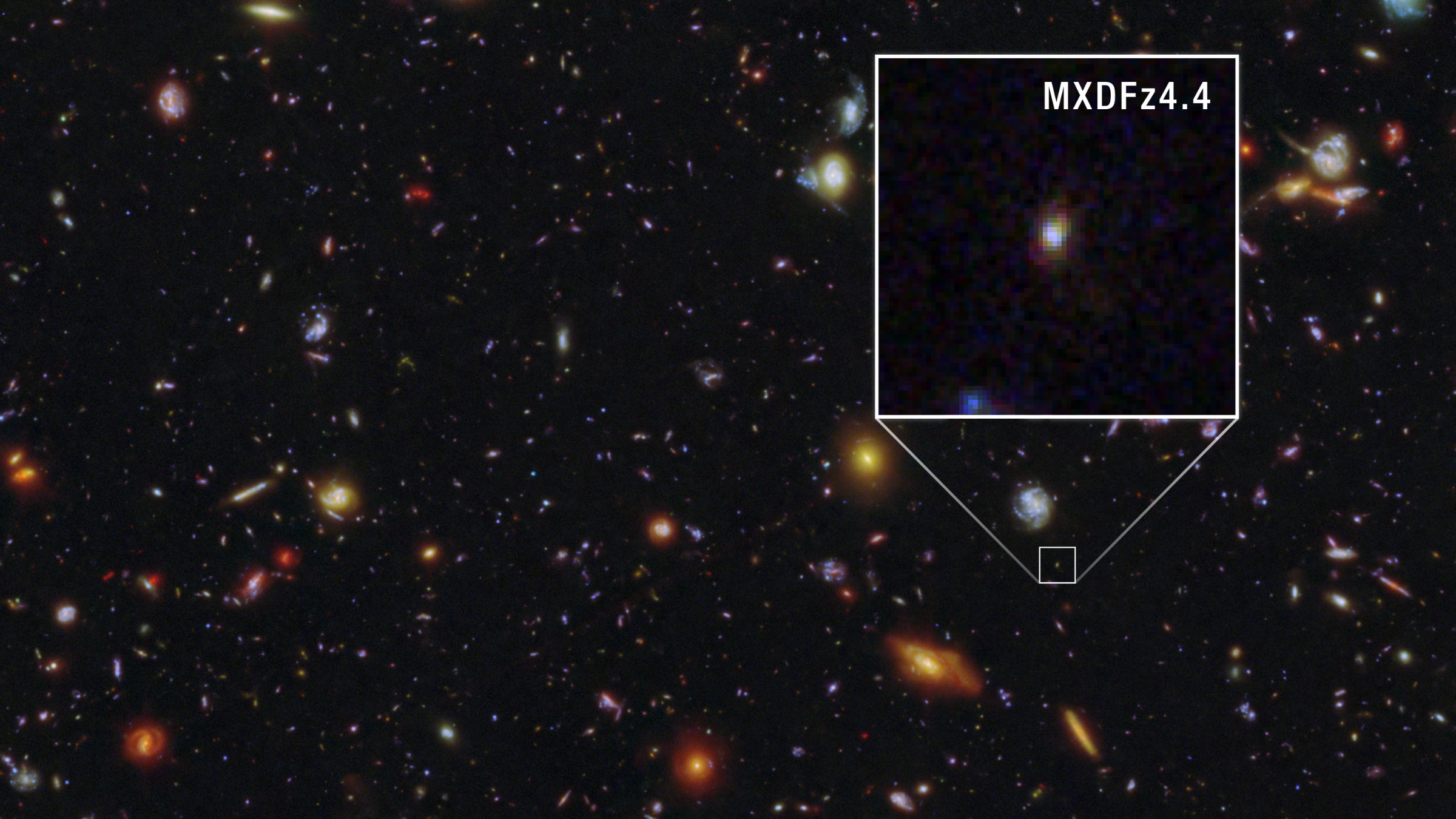
Astronomers have spotted an ancient galaxy shining through the cosmic fog of the early universe, revealing a detailed view that was thought to be impossible.

Using NASA’s Hubble Space Telescope, along with data from the James Webb Space Telescope (JWST) and the European Southern Observatory’s Very Large Telescope (VLT), researchers detected “ionizing” ultraviolet photons — energetic light capable of stripping electrons from hydrogen atoms — coming from the galaxy, called MXDFz4.4. It’s the earliest such detection on record, arriving only around 250 million years after the end of a major cosmic transition called the Epoch of Reionization, the researchers explained in a study published June 23 in The Astrophysical Journal.

For hundreds of millions of years after the Big Bang, the space between galaxies was filled with a fog of neutral hydrogen gas that blocked this kind of light. Over time, radiation from the first stars and galaxies ionized that gas, clearing the fog and letting light travel freely across the universe — a process astronomers are still working to fully understand.

“This was thought to be impossible,” Ilias Goovaerts, a postdoctoral fellow at the Space Telescope Science Institute (STScI) in Baltimore and first author of the new study, said to Live Science. “What’s really special about this galaxy is that it’s getting through so much of the intergalactic medium [the ionized plasma between galaxies]. It’s the furthest away so it has the most intergalactic medium to get through.”

What makes MXDFz4.4 unusual is its combination of size and star-formation rate. The galaxy is roughly 100 times smaller by area than the Milky Way, yet it forms stars around 10 times faster, packing a large number of massive young stars into a compact space. According to Goovaerts, that crowding effect helps the galaxy punch clear channels through its surrounding gas, letting ionizing light escape both the galaxy and, eventually, the murky space between galaxies. The team estimates that somewhere between half and all of the galaxy’s ionizing light is escaping.

The discovery, made in October, came about somewhat by chance. While preparing an unrelated funding proposal just days before a major deadline, Goovaerts examined an existing, deep Hubble image to check whether anyone had looked for this kind of signal there before. Within a couple of hours, he had a promising signal. “It was very, very quick from us having the idea to me going, okay, there’s something here and this is exciting,” Goovaerts said. “We were excited from day one, but then it took months for it to mature and to extract all the properties about the galaxy.”


You may like

An illustration of the galaxy MXDFz4.4 as it appeared roughly 1.4 billion years after the Big Bang, when the Era of Reionization was drawing to a close.

(Image credit: NASA, ESA, Leah Hustak (STScI))

The finding relied on an unusually rich set of observations: an extremely deep Hubble image taken from 40 hours of observations; JWST imaging across many wavelengths, used to characterize the galaxy’s stars and star-formation history; and one of the deepest spectra ever taken of a single patch of sky, gathered over roughly six days of observing time with the VLT’s Multi-Unit Spectroscopic Explorer instrument. That spectrum confirmed the galaxy’s distance through its Lyman-alpha emission line — which serves as a “hydrogen fingerprint,” or a glow given off by excited hydrogen gas, that astronomers can use to measure cosmic distance and time.

No other galaxy from this early period had previously shown detectable ionizing light, making MXDFz4.4 one of a kind so far, study co-author Marc Rafelski, deputy mission head for the Hubble Space Telescope at STScI, noted in the statement. .

Get the world’s most fascinating discoveries delivered straight to your inbox.

Researchers say bursts of vigorous star formation like the one seen in MXDFz4.4 may have played an important role in clearing the early universe’s hydrogen fog and that more galaxies like it are likely still waiting to be found.

Goovaerts, I., et al (2026). MXDFz4.4: A LyC Emitter 250 Myr after the Epoch of Reionization and a First Test of Ly α Morphology as a Tracer of LyC Escape at High Redshift. The Astrophysical Journal, 1005(1), 34. https://doi.org/10.3847/1538-4357/ae75b0


James Webb Space Telescope quiz: How well do you know the world’s most powerful telescope?

TOPICS

James Webb Space Telescope

Share. Facebook Twitter LinkedIn Telegram WhatsApp Email

Keep Reading

Scientists warn of biological ‘superspreader’ event as ships continue to idle in Strait of Hormuz

Scientists warn of biological ‘superspreader’ event as ships continue to idle in Strait of Hormuz

Antarctica just experienced minus 119 F, Earth’s coldest temperature since 2012 — here’s why

Antarctica just experienced minus 119 F, Earth’s coldest temperature since 2012 — here’s why

A new lidar survey of dense Amazonian rainforest has revealed hundreds of earthworks made by a mysterious civilization two millennia ago.

A new lidar survey of dense Amazonian rainforest has revealed hundreds of earthworks made by a mysterious civilization two millennia ago.

Chinese rocket hit by rare midair lightning strike moments after launch as onlookers gasp in horror (video)

Chinese rocket hit by rare midair lightning strike moments after launch as onlookers gasp in horror (video)

New telescope images provide best evidence yet that the bright red star Betelgeuse is actually 2 stars in disguise

New telescope images provide best evidence yet that the bright red star Betelgeuse is actually 2 stars in disguise

Monkeys have a basic intuition for geometry, study suggests

Monkeys have a basic intuition for geometry, study suggests

High-powered lasers can wirelessly charge drones mid-flight

High-powered lasers can wirelessly charge drones mid-flight

Diagnostic dilemma: Rare ‘spinal stroke’ struck an 8-year-old and temporarily paralyzed her

Diagnostic dilemma: Rare ‘spinal stroke’ struck an 8-year-old and temporarily paralyzed her

How to watch ‘Expedition X: Atomic Sharks’ from anywhere

How to watch ‘Expedition X: Atomic Sharks’ from anywhere

Add A Comment
Leave A Reply Cancel Reply

Editors Picks

Taysom Hill says goodbye to Saints after nine-year run with NFL future uncertain

Taysom Hill says goodbye to Saints after nine-year run with NFL future uncertain

July 29, 2026
Boeing takes massive hit as costs for new Air Force One skyrocket to  billion

Boeing takes massive hit as costs for new Air Force One skyrocket to $3 billion

July 29, 2026
WNBA yanks Paige Bueckers, Angel Reese betting post after fans blast league hypocrisy online

WNBA yanks Paige Bueckers, Angel Reese betting post after fans blast league hypocrisy online

July 29, 2026
Bianca Censori Wears Completely Sheer Nude Bodysuit, Bares All During Ibiza Nightclub Appearance

Bianca Censori Wears Completely Sheer Nude Bodysuit, Bares All During Ibiza Nightclub Appearance

July 29, 2026

Subscribe to News

Get the latest USA news and updates directly to your inbox.

Latest News
Myles Garrett refuses to recruit Aaron Donald but would be ‘excited to be his partner in crime’

Myles Garrett refuses to recruit Aaron Donald but would be ‘excited to be his partner in crime’

July 29, 2026
 Xavier Becerra ignored minors exposed to trafficking, claims gubernatorial rival Steve Hilton

 Xavier Becerra ignored minors exposed to trafficking, claims gubernatorial rival Steve Hilton

July 29, 2026
High school employee faces new charges as secret recording case expands

High school employee faces new charges as secret recording case expands

July 29, 2026
Facebook X (Twitter) Pinterest WhatsApp TikTok Instagram
© 2026 USA Times. All Rights Reserved.
  • Privacy Policy
  • Terms
  • Advertise
  • Contact

Type above and press Enter to search. Press Esc to cancel.