



Ancient Roman transportation engineers built a vast network of roads that stretched across Europe, North Africa and parts of the Middle East. This complex road system was a key to travel and trade in the Roman Empire, and many of the centuries-old streets had a reputation for being extremely straight, although not all of them were.
For instance, Via Appia (Appian Way), which connected Rome to the port of Brundisium in southern Italy, was more than 300 miles (500 kilometers) long, and sizable parts of it were straight. Another Roman road, Stane Street in southern England, was built to connect London to Chichester. Much of the road, which stretches roughly 57 miles (92 km), is straight. The Middle East also had straight Roman roads, including a coastal avenue from Antioch, Turkey, to what is now Gaza.
A recent mapping project was able to map about 186,400 miles (300,000 km) of roads and more are probably undiscovered. But how did the Romans avoid unnecessary twists and turns to ensure straight streets? The answer may lie in three surveying instruments the Romans used.
Surveying roads
In some instances, the Romans built on top of older roads that existed before they conquered an area. Their “road network incorporated older roads from a broad range of different societies and polities,” Marion Kruse, an associate professor of classics at the University of Cincinnati, told Live Science in an email.
But when the Romans built new roads, they used a few different tools to help plan them.
“Three instruments were used consistently by Roman road builders: the dioptra, the groma, and the chorobatus [or chorobates],” Adriana Panaite, a researcher at the Vasile Pârvan Institute of Archaeology in Romania who has studied Roman roads extensively, told Live Science in an email.
Sign up for our newsletter
(Image credit: Marilyn Perkins / Future)
Sign up for our weekly Life’s Little Mysteries newsletter to get the latest mysteries before they appear online.
While the dioptra is known from ancient texts, no example of it has ever been found in an archaeological dig, according to M.J.T. Lewis, who was a historian at the University of Hull in the U.K. In his book “Surveying Instruments of Greece and Rome” (Cambridge University Press, 2001), Lewis noted that the design of the dioptra varied considerably. The different designs tended to include a stand and a disc-shaped base with a tube-shaped sighting instrument attached. An ancient surveyor could look through the tube and see a distant object without extraneous light interfering, allowing for a better view.
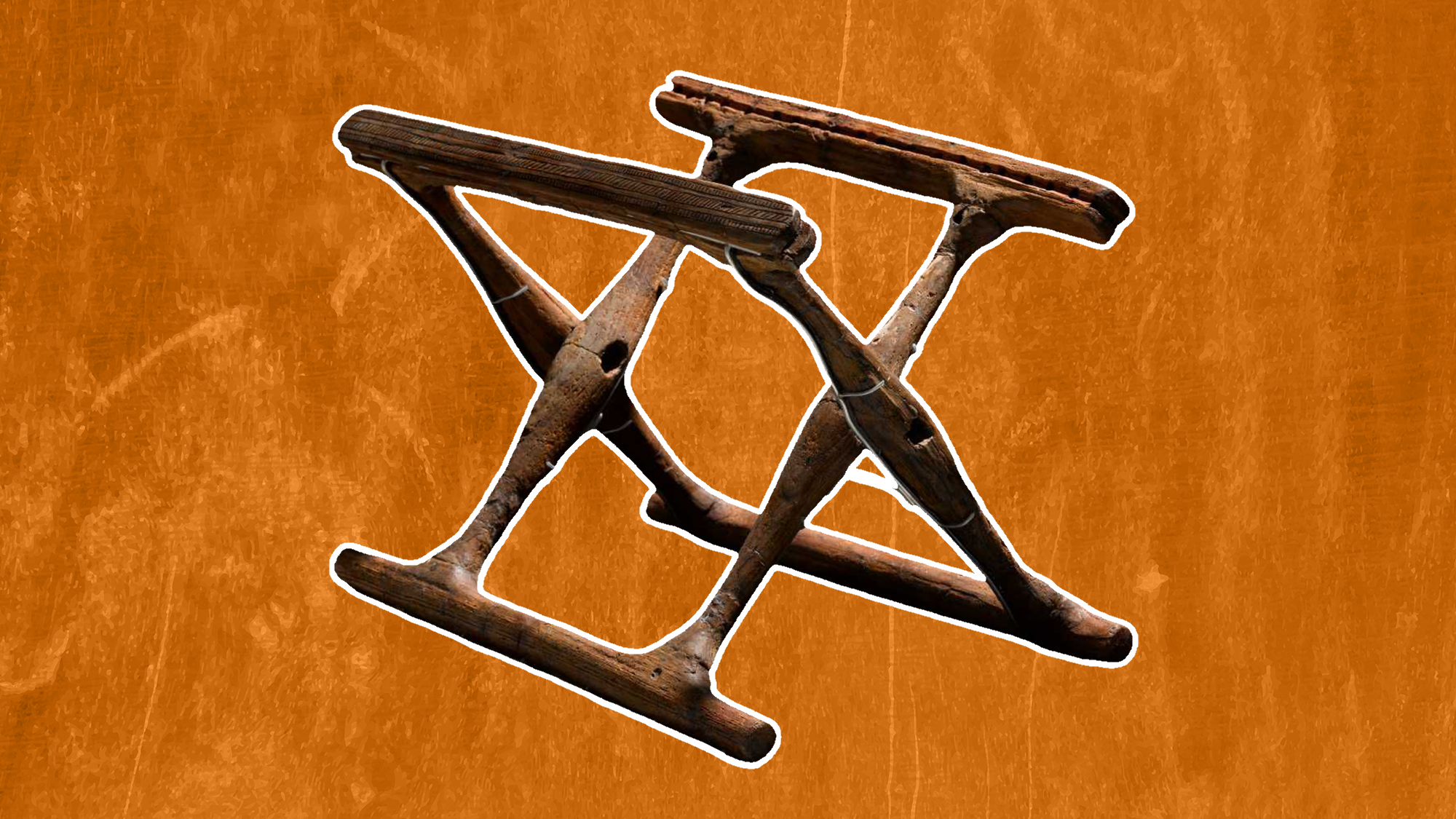
The chorobatus was used to measure horizontal planes. Around 20 feet (6 meters) long, the chorobatus was a beam of wood on legs and looked like a small table, Lewis wrote. It likely had small weights hanging from it to show that the beam was level. No ancient example of the chorobatus has survived, and the exact design and way it was used are unclear. Ancient texts indicate that it acted as a builder’s level that could help set up level points and determine elevations.
But the most important tool Roman surveyors used was the groma, Joseph Lewis, an archaeologist at the University of Cambridge who has conducted extensive research on Roman roads, told Live Science in an email. The “groma was the principal tool of the mensor — the land surveyor — when planning long, straight alignments,” he noted. “These alignments were then often used when constructing roads across gentle terrain.”

A cross section of a Roman road.
(Image credit: DEA PICTURE LIBRARY via Getty Images)
The groma, also called a gruma or croma, consisted of a vertical pole with a horizontal X-shaped cross on top and four small weights hanging down from strings at the ends of the crossbeams, Lewis said. The groma was most useful for establishing right angles.
Multiple Roman surveyors could use the weights on their poles to ensure any road they were building was going in the right direction.
“A surveyor at one end will direct other surveyors to move their poles until they are in line with one another,” Lewis explained. “Once the direction had been established, Roman surveyors observed the landscape and adjusted the course of a road to accommodate/avoid obstacles such as steep sections which would have posed difficulties for wheeled vehicles, locations to ford rivers, or to connect pre-existing settlements.”
However, the techniques used to build roads throughout the Roman Empire probably varied somewhat, meaning experts “should be cautious about assuming that there was a single ‘Roman’ technique for road building,” Kruse said. He noted that the Roman Empire covered a vast area and lasted for a long period of time.
“It seems safe to assume that practices varied across time and space,” Kruse explained.
Not all roads were straight
One reason for the variation in Roman roads was likely the diversity of the laborers who built them. “In all likelihood, road-building work was done by a mix of soldiers, slaves — especially prisoners — and free locals called upon to help as part of a ‘corvee’ obligation imposed by their local community on Rome’s instructions,” Richard Talbert, a professor emeritus of history at the University of North Carolina at Chapel Hill, told Live Science in an email. But paid laborers were probably used for some skilled tasks, such as building bridges, Talbert said.
While Roman roads have a reputation for being precisely laid out and straight, not all of them were.
“It is commonly mentioned that Roman roads were exceptionally straight. This is partially true: The Romans had engineers and a large labor force that in some cases managed to modify the landscape to enable straight roads,” Tom Brughmans, a classical archaeologist at Aarhus University in Denmark who is part of a team that helped create an updated map of the Roman road system, told Live Science in an email.
“We believe that the Romans preferred relatively straight roads in places where there was very little friction offered by the topography,” such as flatland areas, Brughmans said. But in areas with more difficult terrain, such as mountainous regions, the roads would often not run straight.
Brughmans said he expects “future research will show that, in general, [Roman roads] are less straight than modern roads, given the need for motorized vehicles to avoid sharp turns when driving at speed.”
From Augustus to Nero, see how much you know about ancient Rome’s famous leaders with our Roman emperor quiz!
TOPICS