


Close Menu
  • Home
  • United States
  • World
  • Politics
  • Business
  • Lifestyle
  • Entertainment
  • Health
  • Science
  • Tech
  • Sports
  • More
    • Web Stories
    • Editor’s Picks
    • Press Release

Subscribe to Updates

Get the latest USA news and updates directly to your inbox.

What's On
Ariana Madix and Tom Sandoval Sell Los Angeles Home 3 Years After Split, Cheating Scandal

Ariana Madix and Tom Sandoval Sell Los Angeles Home 3 Years After Split, Cheating Scandal

May 9, 2026
Mets’ Carson Benge gets clutch hit in 10th after being moved up to No. 5 hole

Mets’ Carson Benge gets clutch hit in 10th after being moved up to No. 5 hole

May 9, 2026
‘Feuding tech bros’ go head to head in legal showdown. But what does it mean for the future of AI?

‘Feuding tech bros’ go head to head in legal showdown. But what does it mean for the future of AI?

May 9, 2026
Facebook X (Twitter) Instagram
Trending
  • Ariana Madix and Tom Sandoval Sell Los Angeles Home 3 Years After Split, Cheating Scandal
  • Mets’ Carson Benge gets clutch hit in 10th after being moved up to No. 5 hole
  • ‘Feuding tech bros’ go head to head in legal showdown. But what does it mean for the future of AI?
  • Apollo 17 crew reported seeing unidentified bright sparks that lit up space like ‘Fourth of July’: UFO files
  • Cohutta police force reinstated by town council days after mass firing by mayor
  • Selling the O.C.’s Tyler Stanaland and Wife Hannah Morrissey’s Relationship Timeline
  • Victor Wembanyama comes up big again to propel Spurs to key Game 3 win over Timberwolves
  • If humans are getting smarter, why are our brains shrinking?
  • Privacy
  • Terms
  • Advertise
  • Contact Us
Join Us
USA TimesUSA Times
Newsletter Login
  • Home
  • United States
  • World
  • Politics
  • Business
  • Lifestyle
  • Entertainment
  • Health
  • Science
  • Tech
  • Sports
  • More
    • Web Stories
    • Editor’s Picks
    • Press Release
USA TimesUSA Times
Home » Exotic prime numbers could be hiding inside black holes
Exotic prime numbers could be hiding inside black holes
Science

Exotic prime numbers could be hiding inside black holes

News RoomBy News RoomMarch 9, 20260 ViewsNo Comments

Like physics, math has its own set of “fundamental particles” — the prime numbers, which can’t be broken down into smaller natural numbers. They can only be divided by themselves and 1.

And in a new development, it turns out these mathematical “particles” are offering new ways to tackle some of physics’ deepest mysteries. Over the past year, researchers have found that formulas based on the prime numbers can describe features of black holes. Number theorists have spent hundreds of years deriving theorems and conjectures based on the primes. These new connections suggest that the mathematical truths that govern prime numbers may also govern some fundamental laws of the universe. So can physics be expressed in terms of primes?

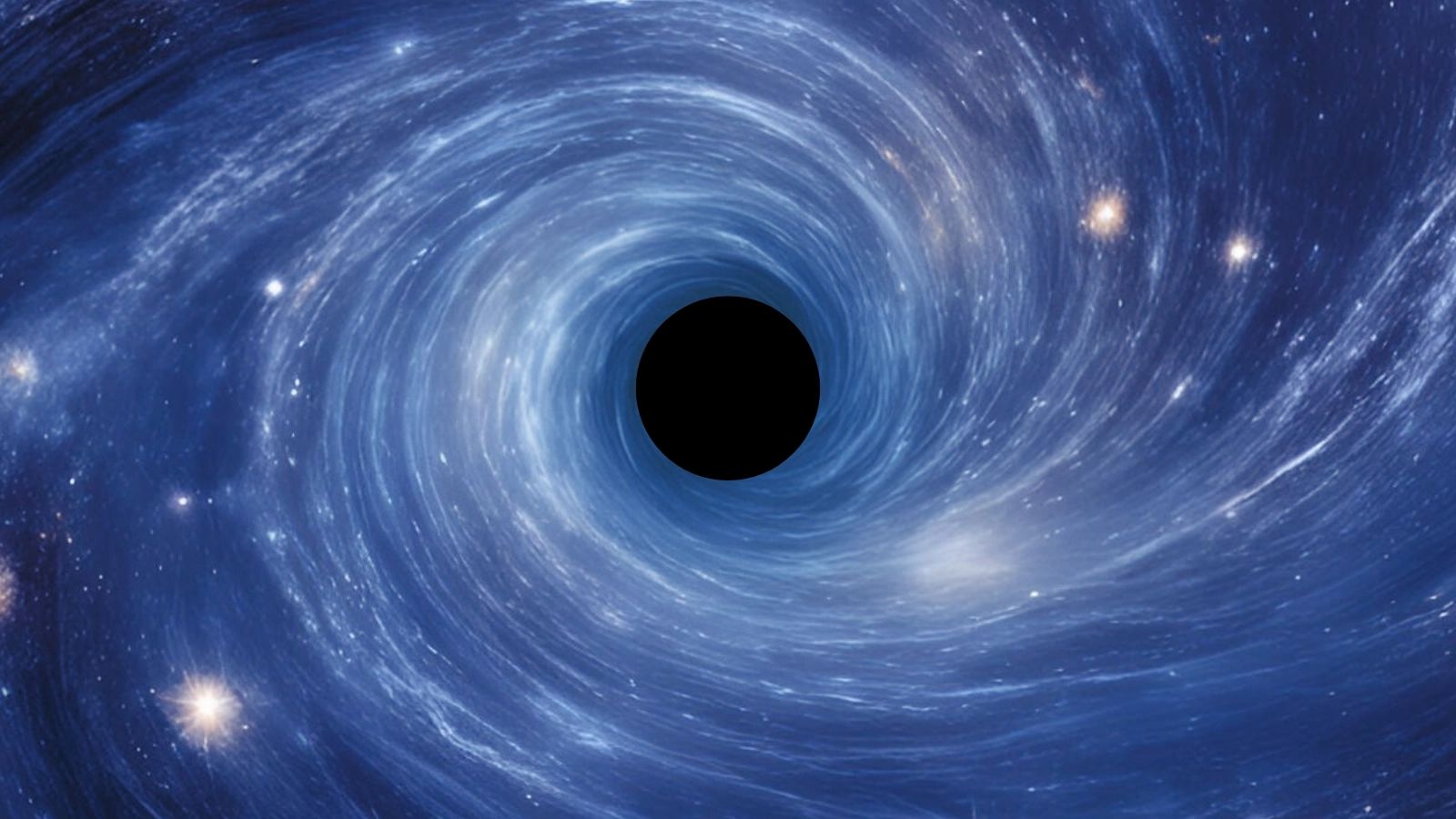
Black holes are the sites of the universe’s most crushing gravitational force. At their centers lie single points called singularities, where classical physics predicts that gravity must be infinite, causing our understanding of space and time to break down. But in the 1960s, physicists found that, immediately surrounding the singularity, a type of chaos emerges — and it looks remarkably similar to a kind of chaos recently found in the primes.

Article continues below


You may like

Physicists hope to make use of the connection. “I’d say many high-energy physicists don’t actually know much about that side of number theory,” says Eric Perlmutter of the Institute of Theoretical Physics, Saclay.

Number theory’s foundational conjecture on primes is the 1859 Riemann hypothesis. In a hand-written paper, German mathematician Bernhard Riemann provided a formula with two main terms. The first offered a startlingly close estimate for how many prime numbers exist that are smaller than a given number. The second term is the zeta function, whose zeros (the places where the function is equal to zero) tune up the original estimate. The mysterious way in which the zeta zeros always improve the estimate is the subject of the Riemann hypothesis. The hypothesis is so crucial to number theory that anyone who can prove it will earn a $1-million Clay Mathematics Institute prize.

In the late 1980s physicists started to wonder if there was a physical system whose energy levels might be based on the prime numbers. Physicist Bernard Julia of the École Normale Supérieure in France was challenged by a colleague to find a physics analogue described by the zeta function. His solution was to propose a hypothetical kind of particle with energy levels given by the logarithms of prime numbers. Julia called these particles “primons” and a group of them a “primon gas.” The partition function — a census of a system’s possible states — of this gas is exactly the Riemann zeta function.

At the time, Julia’s concept was a thought experiment — most scientists doubted that primons actually existed. But deep inside black holes, a mathematical link awaited discovery. A little more than two decades later, physicists Yan Fyodorov of King’s College London, Ghaith Hiary of Ohio State University and Jon Keating of the University of Oxford saw hints that fractal chaos emerges from the fluctuations of the zeta function’s zeros, an idea that was conclusively proven in 2025.

Get the world’s most fascinating discoveries delivered straight to your inbox.

Einstein’s general theory of relativity shows that the same chaos also arises near a singularity.

Einstein’s theory of relativity deals with the chaos around a singularity. (Image credit: Keystone-France/Getty Images)

In a February 2025 preprint, University of Cambridge physicist Sean Hartnoll and graduate student Ming Yang brought Julia’s work into the real world. Inside the chaos close to a singularity, they found that a “conformal” symmetry emerges. Hartnoll likens conformal symmetry to Dutch artist M. C. Escher’s famous drawings of bats — the same structure repeats on different scales. This scaling symmetry, together with a bit of math, revealed a quantum system near the singularity whose spectrum organizes into prime numbers — a conformal primon gas cloud.

Five months later, they uploaded a preprint with a new twist. The team, which now included University of Cambridge University physicist Marine De Clerck, expanded their analysis to a five-dimensional universe instead of the usual four. They found that the extra dimension forced a new feature: keeping track of the singularity’s dynamics now required a “complex” prime number, known as a Gaussian prime, that includes an imaginary component (a number multiplied by the square root of –1). Gaussian primes can’t be divided any further by other complex numbers. The authors dubbed this system a “complex primon gas.”


What to read next

an image of a grid of numbers against a blue background, with prime numbers highlighted

While prime numbers can only be divided by themselves and 1, Gaussian prime numbers are even more complex, including an imaginary component. (Image credit: ROBERT BROOK/SCIENCE PHOTO LIBRARY via Getty Images)

“We don’t know yet whether the appearance of prime number randomness close to a singularity has a deeper meaning,” Hartnoll says. “However, to my mind, it is very intriguing that the connection extends to higher dimensional theories of gravity,” including some candidates for a fully quantum mechanical theory of gravity.

And in a late 2025 preprint, Perlmutter proposed a new framework involving the zeta zeros. He relaxed the restrictions on the zeta function so it could rely not just on integers but on all real numbers, including irrationals. Doing so opened up even more powerful zeta function techniques to understand quantum gravity. Physicist Jon Keating of the University of Oxford, who was not involved in the new research, says that broader perspectives such as this can reveal new ways to tackle long-standing problems. “It’s only when you step back and look at the whole mountain that you think, ‘Ah, there’s a much better way to get up over there,'” he says.

Perlmutter cautiously hopes the flurry of prime physics will hasten new discoveries, but the approach is one of many fighting for acceptance. “The kinds of things we’re trying to understand, black holes in quantum gravity, are surely governed by some beautiful structures,” he says. “And number theory seems to be a natural language.”

This article was first published at Scientific American. © ScientificAmerican.com. All rights reserved. Follow on TikTok and Instagram, X and Facebook.
Albert Einstein quiz: What do you know about the life of the famous theoretical physicist?

Share. Facebook Twitter LinkedIn Telegram WhatsApp Email

Keep Reading

‘Feuding tech bros’ go head to head in legal showdown. But what does it mean for the future of AI?

‘Feuding tech bros’ go head to head in legal showdown. But what does it mean for the future of AI?

If humans are getting smarter, why are our brains shrinking?

If humans are getting smarter, why are our brains shrinking?

US government declassifies nearly 200 UAP files, including strange sightings from Apollo astronauts

US government declassifies nearly 200 UAP files, including strange sightings from Apollo astronauts

Some gene therapies no longer require clinical trials, thanks to new FDA rule. Is this safe, and who will it help?

Some gene therapies no longer require clinical trials, thanks to new FDA rule. Is this safe, and who will it help?

Flowering plants transformed into ‘hopeful monsters’ in 9 dire bursts across evolutionary time, study finds

Flowering plants transformed into ‘hopeful monsters’ in 9 dire bursts across evolutionary time, study finds

Hantavirus cruise LIVE: Cruise passengers monitored in several US states as CDC sets lowest emergency response

Hantavirus cruise LIVE: Cruise passengers monitored in several US states as CDC sets lowest emergency response

500-year-old gold dental bridge is earliest known oral care of its kind in Scotland — and it likely held a fake tooth

500-year-old gold dental bridge is earliest known oral care of its kind in Scotland — and it likely held a fake tooth

Live quantum network test in New York overcomes 2 key hurdles in creating an ‘unhackable’ internet

Live quantum network test in New York overcomes 2 key hurdles in creating an ‘unhackable’ internet

Mangroves clean up .7 billion of nitrogen pollution every year, study finds

Mangroves clean up $8.7 billion of nitrogen pollution every year, study finds

Add A Comment
Leave A Reply Cancel Reply

Editors Picks

Mets’ Carson Benge gets clutch hit in 10th after being moved up to No. 5 hole

Mets’ Carson Benge gets clutch hit in 10th after being moved up to No. 5 hole

May 9, 2026
‘Feuding tech bros’ go head to head in legal showdown. But what does it mean for the future of AI?

‘Feuding tech bros’ go head to head in legal showdown. But what does it mean for the future of AI?

May 9, 2026
Apollo 17 crew reported seeing unidentified bright sparks that lit up space like ‘Fourth of July’: UFO files

Apollo 17 crew reported seeing unidentified bright sparks that lit up space like ‘Fourth of July’: UFO files

May 9, 2026
Cohutta police force reinstated by town council days after mass firing by mayor

Cohutta police force reinstated by town council days after mass firing by mayor

May 9, 2026

Subscribe to News

Get the latest USA news and updates directly to your inbox.

Latest News
Selling the O.C.’s Tyler Stanaland and Wife Hannah Morrissey’s Relationship Timeline

Selling the O.C.’s Tyler Stanaland and Wife Hannah Morrissey’s Relationship Timeline

May 9, 2026
Victor Wembanyama comes up big again to propel Spurs to key Game 3 win over Timberwolves

Victor Wembanyama comes up big again to propel Spurs to key Game 3 win over Timberwolves

May 9, 2026
If humans are getting smarter, why are our brains shrinking?

If humans are getting smarter, why are our brains shrinking?

May 9, 2026
Facebook X (Twitter) Pinterest WhatsApp TikTok Instagram
© 2026 USA Times. All Rights Reserved.
  • Privacy Policy
  • Terms
  • Advertise
  • Contact

Type above and press Enter to search. Press Esc to cancel.