



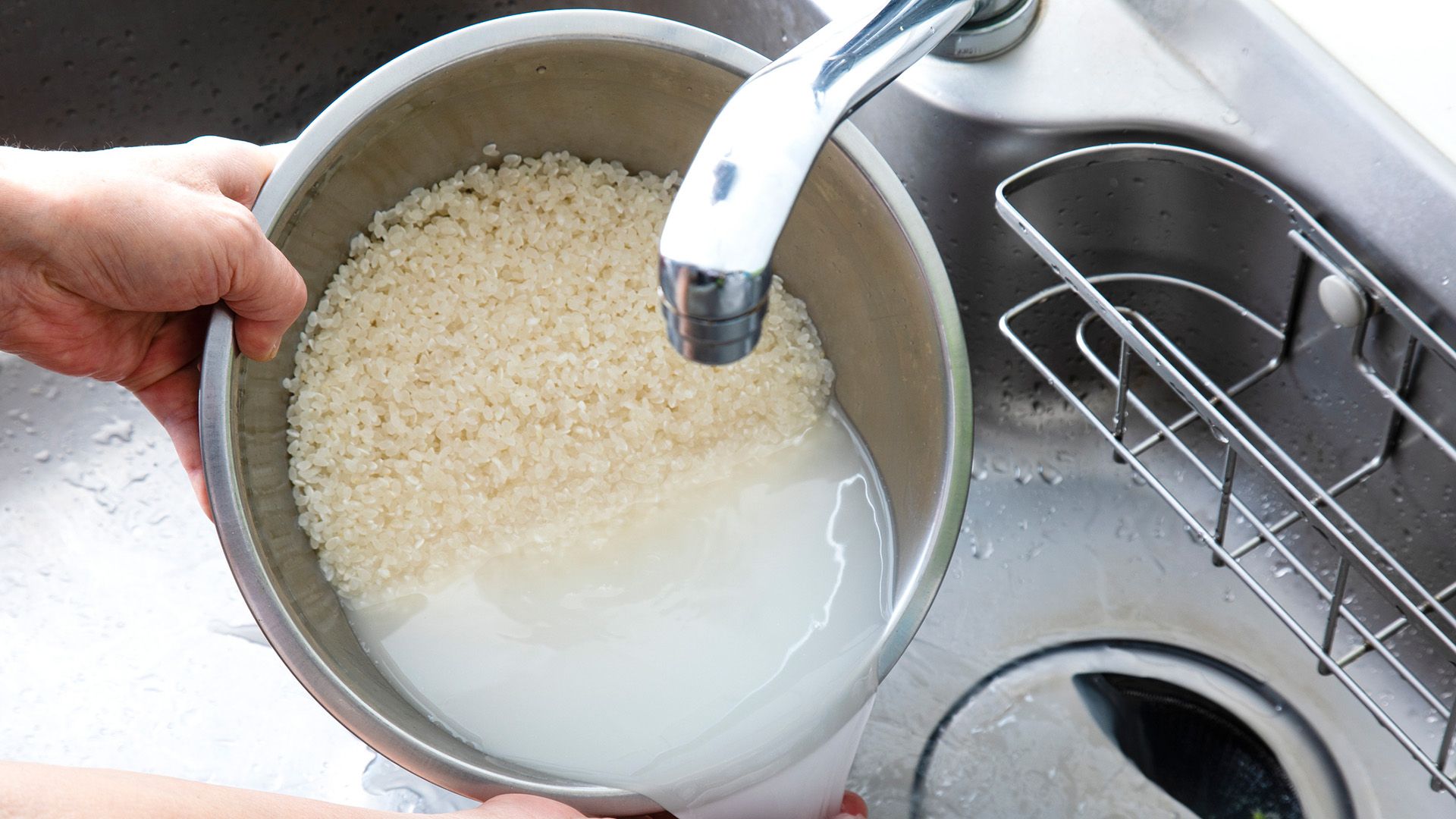

If you’ve ever washed uncooked rice, you’ve seen the pale, milky-white water that rinses away. Billions of people across the world eat rice every day. So should everybody who cooks rice wash it beforehand?
This question has been the subject of a number of scientific studies, which have looked at how washing rice affects its texture, nutrition and how well it removes unwanted substances, such as dust, arsenic and microplastics.
Rice is traditionally grown in shallowly flooded fields, as it requires constant irrigation to grow. When the grains are ready, they are harvested and milled to remove the inedible hulls, yielding brown rice, which can be further milled to remove the bran layer, producing white rice.
Sign up for our newsletter
(Image credit: Marilyn Perkins / Future)
Sign up for our weekly Life’s Little Mysteries newsletter to get the latest mysteries before they appear online.
The act of milling can damage rice kernels, leaving a layer of starch (the substance that makes up much of rice, potatoes and wheat) on the outside. When rice is rinsed, some of this starch is washed away.
In a 2017 study, scientists had speculated that washing rice might change the texture of cooked rice by rinsing off starch that would make grains stick together.
However, subsequent research found that “washing rice makes no difference to the stickiness of the cooked rice,” Evangeline Mantzioris, an accredited practicing dietitian at Adelaide University in Australia, told Live Science.
Specifically, a 2019 study showed that “the stickiness of rice is not from the surface starch, amylose, but from another starch within the grain called amylopectin,” Mantzioris said. “This is what leaches out during cooking and impacts the stickiness.”
The 2019 study found the amount of amylopectin that leaches out of rice during cooking does not depend on whether it is washed. “It is the variety of rice that is important,” Mantzioris said. In tests with 10-gram (0.4 ounces) samples of three kinds of rice that were all washed the same amount of time with increasing amounts of water and cooked for 30 minutes, the scientists found that “if you want sticky rice for your dish, you are best using glutinous rice. Medium-grain and jasmine rice are less sticky.”

Rice is initially brown before the bran is removed.
(Image credit: skaman306 via Getty Images)
Traditionally, rice was washed for health and safety reasons, “to rinse off dust, insects, little stones and small parts of the husk,” Mantzioris said.
However, nowadays, “rice sold in supermarkets and reputable retailers is generally produced under strict quality standards,” Bo Wang, a food scientist at Adelaide University, told Live Science. “It is typically cleaned [with machines, such as sifters and blowers], dried, dehusked, milled, graded and packaged before reaching consumers. The drying step particularly reduces moisture content, helping maintain quality and limiting microbial growth during storage. As a result, rice is already a relatively safe product, and washing is generally not required to make it safe for consumption.”
Still, “one additional consideration is that some rice may contain naturally occurring inorganic arsenic absorbed from soil and water,” Permal Deo, a food scientist with a background in molecular biology at Adelaide University, told Live Science. “Rinsing may help remove some arsenic on the grain surface.”
Rinsing rice can also rinse off microplastics, Mantzioris said. A 2021 study found that washing rice before cooking it reduced the amount of plastic contaminating it by 20 to 40%. (It remains uncertain what effect microplastics have on our health, although evidence is growing that microplastics could be harmful.)
Mantzioris noted that washing rice does reduce levels of some important nutrients that naturally dissolve in water, such as copper, iron, zinc and vanadium. However, rice at best offers only a small percentage of one’s daily intake of these nutrients. Washing rice, therefore, “is unlikely to affect you nutritionally,” she said.
“Long story short, for most consumers, a gentle rinse once or twice before cooking is usually sufficient,” Wang said.
This article is for informational purposes only and is not meant to offer medical advice.
Do you know where pumpkins and blueberries come from? Find out with our fruits and vegetables quiz!
TOPICS