




Every person you know has a name, and you’ve likely given one to your pets, too. But are names a uniquely human feature, or do other animals also call each other by name?
Research suggests that some mammals and birds use vocal labels for other individuals, but not all scientists agree on how to interpret the evidence.
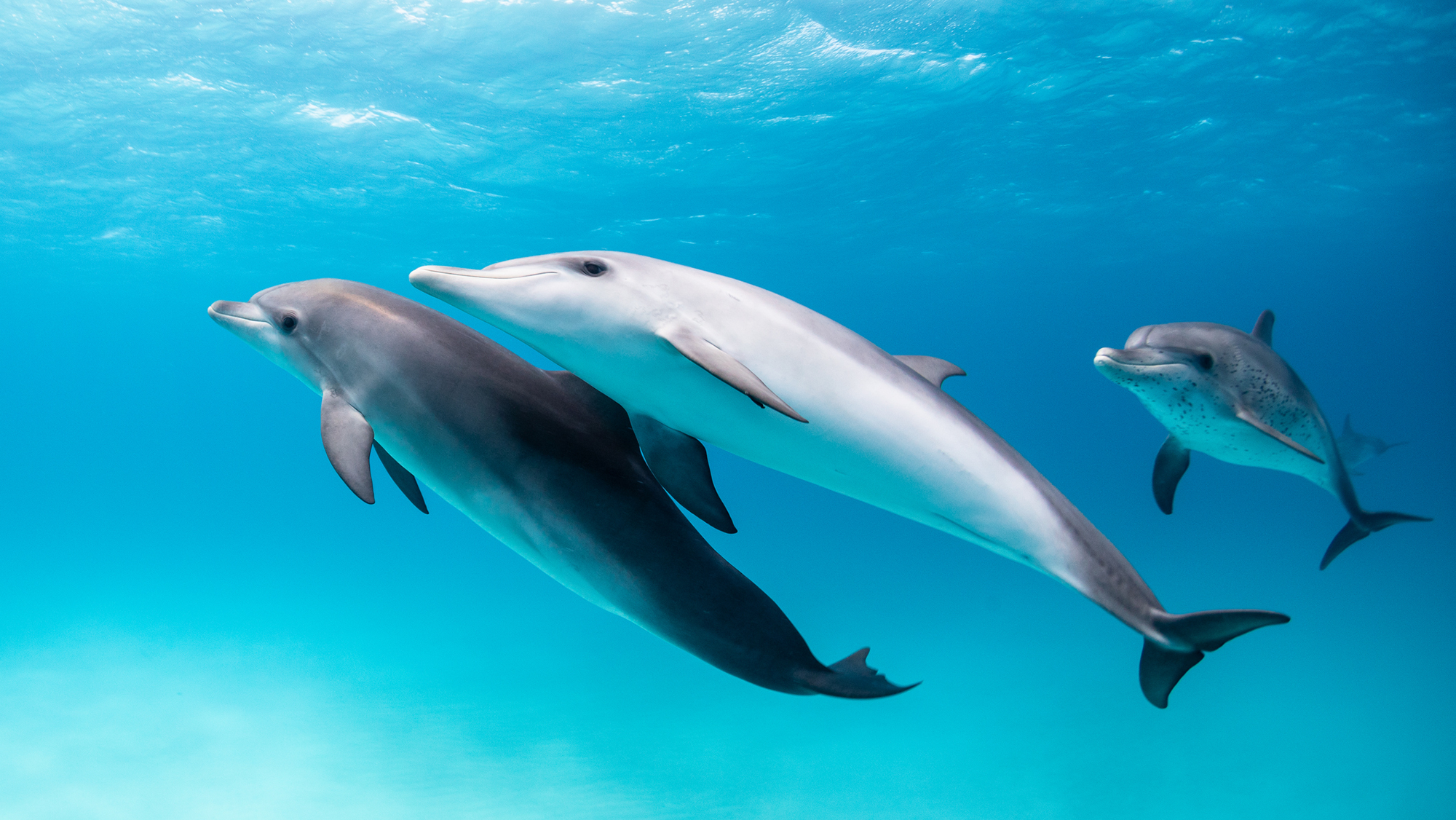
In the 1960s, scientists discovered that young bottlenose dolphins (Tursiops) create individually distinctive whistles, called signature whistles. Researchers in the years since have conducted experiments in which they played the whistles through an underwater speaker and observed how the dolphins responded. Dolphins copy the signature whistles of other dolphins to initiate contact, similarly to how we use names, and can recognize other individual dolphins based on the frequency and “shape” of the whistle, regardless of the voice of the dolphin whistling.
Latest Videos FromLive Science
Dolphins do seem to assign these whistles to other individuals and to match the whistles to others in a more symbolic way, Kelly Jaakkola, a cognitive psychologist at the Dolphin Research Center in Florida, told Live Science. Research shows that dolphins whistle to identify each other within complex social systems and while cooperating on tasks.
Through playback experiments, researchers also found that wild African elephants (Loxodonta) address one another with specific vocalizations — low rumbling sounds that are unique to each individual. The team published their findings in a 2023 preprint study, but it has not been peer-reviewed yet.
“They sound a little bit like a giant cat purring,” Michael Pardo, a behavioral ecologist at Colorado State University and first author of the study, told Live Science. Elephants tended to approach speakers more quickly, and vocalize more in response, when their “name” was played.
Sign up for our newsletter
(Image credit: Marilyn Perkins / Future)
Sign up for our weekly Life’s Little Mysteries newsletter to get the latest mysteries before they appear online.
Playback experiments have also suggested that spectacled parrotlets (Forpus conspicillatus), small parrots native to parts of South and Central America, use vocal labels for other parrotlets.
Studies of birds in captivity can shed light on their capacity to learn vocal labels. In a survey of parrot owners, about half of the 800 birds used vocal labels for individual people and animals that they had learned from the people around them.
“Parrots certainly pick up a lot of things from humans — they don’t necessarily know what it means in a human linguistic context, but they know when to say it,” Lauryn Benedict, a biologist at the University of Northern Colorado and first author of the study that surveyed parrot owners, told Live Science.
One survey participant said their parrot corrects people when called by the wrong name; others said their parrots correctly used the names of all humans and dogs in the household. However, these behaviors look different from those in wild parrots, and further research is needed to dig into whether spectacled parrotlets understand the concept of names and actually give names to their fellow birds.

Elephants, like these at the Samburu National Reserve in Kenya, may use low rumbling sounds that are unique to each individual.
(Image credit: Michael Pardo)
How do you define a name?
Claiming an animal noise is a name, as humans define it –– a specific, symbolic vocal label attached to an individual –– is complicated.
One study in marmosets suggests that they use vocal labels. Using playback experiments, the researchers discovered that the marmosets directed certain vocalizations at specific individuals and that they learned these vocalizations from family members. However, in a published response to that study, Jaakkola argued that the calls may not be name-like, since they were correctly identified only 16% to 61% of the time. Jaakkola proposed that the marmosets may have been imitating each other’s vocalizations.
However, she noted that we can’t generalize any one interpretation to all species.
“The elephant case is very different from the marmoset case and the spectacled parrotlet case,” Jaakkola said. “It can be really hard to have a cohesive discussion [across species] … to all talk about the same thing.”
In a July 2026 paper, Jaakkola and colleagues proposed three minimum criteria to apply across species: individual reference, meaning the call is designated for one particular individual; symbolic representation, meaning the name stands for a specific individual in the user’s mind; and shared meaning, where at least two individuals associate the name with that individual.
When applying these criteria to the current evidence, Jaakkola said bottlenose dolphins show the strongest evidence for the use of animal names. Elephants, parrots and marmosets, on the other hand, require more research about symbolic representation to prove naming behavior.
“It is a big claim when you call something a name,” Jaakkola said. “Our goal here was to create a unified framework … to start looking at this question more systematically.”
Why are names useful?
Species that may use name-like calls have a couple traits in common: They can learn new sounds, and they’re extremely social. Names might be useful in animal groups in which the community breaks into smaller subgroups and individuals are often out of their companions’ sight, Pardo said.
The behavior seems present in very different lineages, so it may have evolved separately multiple times, which can tell scientists about the evolution of language among complex social pressures, Pardo said.
By studying whether animals use names, scientists can learn about the cognitive abilities necessary for abstract mental representation of other individuals. “For humans, names are such a part of our individuality and our sense of self, that if animals have names and respond to those names, that suggests they could have a sense of self … and of other individuals and their individuality,” Benedict said.
Jaakkola clarified that although it’s difficult to demonstrate naming behavior in nature, she’s not ruling out that nonhuman animals have name-like calls. Rather, the evidence is not yet sufficient to say they do, she said.
Pardo agrees that more evidence would confirm these behaviors in more species, but he suspects a lot of animals may be calling each other by name.
A lot of other animals, such as baboons, giraffes, and crows, have communities that break into smaller groups. While there isn’t evidence for names in species like these, and this social structure would need to be paired with vocal learning abilities, “I think it might be more common than we currently realize,” Pardo said.
What do you know about the animal kingdom? Test your knowledge with our animal quiz!
TOPICS


