




Among the many risks astronauts face during long-haul spaceflight, an extended stay in microgravity is one of the most consequential for long-term health, with effects on vision, bones, muscles and many other aspects of the body.
One solution might be artificial gravity — some way to create forces similar to Earth’s gravity on a spaceship, akin to the giant rotating ring from Stanley Kubrick’s 1968 film “2001: A Space Odyssey.”
But is that technology ever coming, or will it remain science fiction?
Latest Videos FromLive Science
“There’s really no reason it couldn’t happen,” Torin Clark, an associate professor of aerospace engineering at the University of Colorado Boulder, told Live Science. “From a technical perspective, this is something that could happen in the very near future.”
In fact, artificial gravity has almost made its way to space before. The Centrifuge Accommodation Module was a planned 8.2-foot-wide (2.5 meters) centrifuge for the International Space Station (ISS), but the project was canceled in 2005 for budgetary reasons.
“[Artificial gravity] is one of those things — like all of a sudden, it’s super popular, and then all of the scientists at NASA and everybody … have a lot of funding to understand how to actually implement this, and then it just dies,” Ana Diaz Artiles, an associate professor of aerospace engineering at Texas A&M University, told Live Science. “And then it comes back, and dies, and comes back. I’ve been going through a couple of these cycles in the time that I’ve been doing this.”
Besides budgetary concerns, there are questions about how such a solution would be implemented.
Feed your curiosity with an exclusive mystery every week, solved with science and delivered direct to your inbox before it’s seen anywhere else.
“Everybody agrees it’s a good thing to do. The problem is that we don’t know how to implement it,” Diaz Artiles said. “How much gravity do you need? How big does [the device] have to be? How long do you need it to be? And how long do you have to use this? Should we use continuous gravity or a short-radius centrifuge, something where you go in and out?”
Researchers have three main approaches for creating artificial gravity. One is the classic sci-fi idea: a giant ring that rotates passengers’ entire living quarters so they live and work under forces similar to Earth’s gravity.
“You have a relatively long radius, which means you don’t have to spin very fast to create gravity,” Diaz Artiles said. “But this is massive. You can’t get all the parts up there in the same spacecraft — you need multiple spacecraft and to assemble everything. So, of course, you can see what a big endeavor this is.”
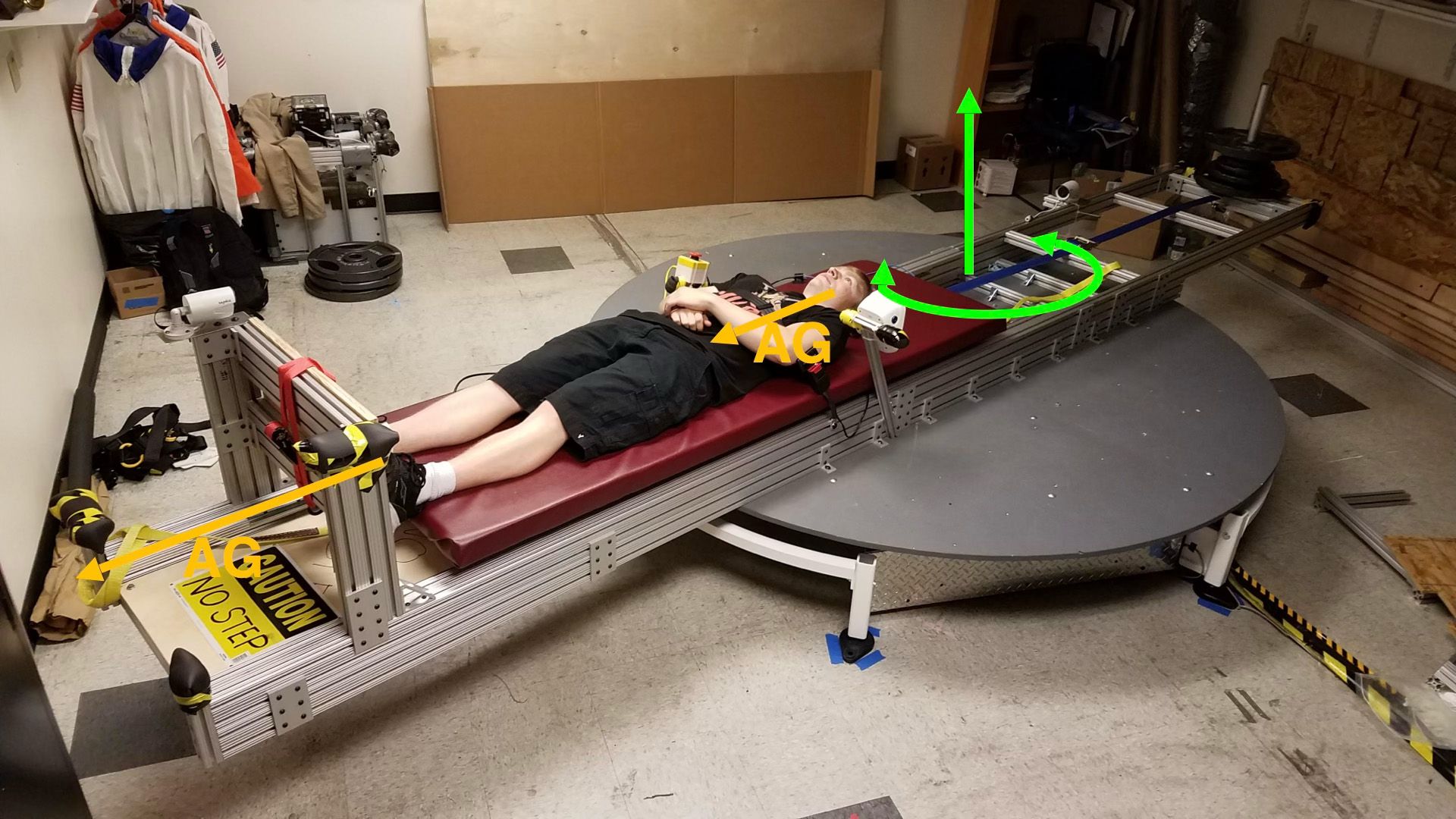
A short-radius centrifuge is a more feasible option. It’s essentially a tube with a radius of 6 to 10 feet (1.8 to 3 m) that spins to simulate gravity. A passenger sits or stands inside, with their head closest to the center of rotation, so the spin generates the strongest pull down toward their feet.
Astronaut Sunita Williams, equipped with a bungee harness, exercises on the Treadmill Vibration Isolation System (TVIS) in the Zvezda Service Module of the International Space Station in 2006.
(Image credit: NASA/Crew of Expedition 14, Public domain, via Wikimedia Commons)
Instead of allowing passengers to live in artificial gravity, this smaller device would be used in short daily sessions. “It’s kind of like an exercise device,” Diaz Artiles said. “In the ISS, you have a treadmill, you have this resistive exercise machine, so you go there for 30 minutes to do your exercise, and then you get out.”
The final option is for spacecraft to create gravity via linear acceleration. This works in the same way that an accelerating car pushes passengers back into their seats, except the spacecraft would be oriented to push an astronaut’s feet into the floor. To slow down, the spacecraft would turn around, firing its thrusters in the opposite direction to decelerate smoothly while maintaining a roughly similar gravity for its occupants.
“But then you need something like an engine that is able to accelerate all the time,” Diaz Artiles said. “And propulsion-wise, I think we’re not there yet.”
Although a short-radius centrifuge is the most feasible approach in terms of both cost and engineering, it does have some drawbacks. For one, its fast spin can induce the Coriolis cross-coupled illusion — a sensation of tilting or tumbling that happens when you tilt your head off-axis while rotating.
This is the effect that causes motion sickness, Clark said.
However, Clark and his team have found that people can build a tolerance to the sensation with training, simply by being in a slowly spinning centrifuge and gradually increasing the speed when they no longer feel the sensation.
“If you very slowly, incrementally increase the spin rate … and do that not just over one session but over multiple sessions across multiple days, as far as we could tell, anyone can be made to incrementally acclimate to the rotating environment [of] up to 20 to 30 rotations per minute,” Clark said.
Would artificial gravity prevent harmful effects on the body?
But researchers still don’t know how fast the centrifuge would need to rotate, or how long someone needs to spend inside it, to benefit. Long periods in microgravity can lead to bone and muscle loss, loss of aerobic fitness, blood clots, and visual issues from fluid shifts in the eyes. The hope is that artificial gravity could prevent those effects, but exactly how much gravity is necessary remains an open question.
Studies of people on head-down tilt bed rest — the standard research method for simulating spaceflight deconditioning — have found that 30 minutes a day in a centrifuge did prevent some loss of muscle function.
“Thirty minutes a day … maybe is not enough,” Clark said. “Maybe an hour or even two hours a day, and maybe at higher G levels, would be beneficial.”
But these studies are expensive and time-consuming. “It’s very difficult,” Diaz Artiles said. “I think people are interested in this concept, but we just don’t have a good answer.”
In the end, it’s not a technological challenge that’s keeping artificial gravity from being used in space; it’s knowing the best way to employ it and securing the budget for it.
“We know how to do this. As humans, we have done more difficult things,” Diaz Artiles said. “We need the money, but we also need to better understand the need.”
See how much you know about human exploration into space with our spaceflight quiz!
TOPICS