

Close Menu
  • Home
  • United States
  • World
  • Politics
  • Business
  • Lifestyle
  • Entertainment
  • Health
  • Science
  • Tech
  • Sports
  • More
    • Web Stories
    • Editor’s Picks
    • Press Release

Subscribe to Updates

Get the latest USA news and updates directly to your inbox.

What's On
‘Tinder Swindler’ plans dating app with identity verification feature

‘Tinder Swindler’ plans dating app with identity verification feature

October 3, 2026
Regina King Calls This Aluminum-Free Deodorant Her ‘Latest and Greatest’ — Shop the On-Sale Essential

Regina King Calls This Aluminum-Free Deodorant Her ‘Latest and Greatest’ — Shop the On-Sale Essential

October 3, 2026
Frustrated Red Wings fans in Detroit only benefit Rangers in road win

Frustrated Red Wings fans in Detroit only benefit Rangers in road win

October 3, 2026
Facebook X (Twitter) Instagram
Trending
  • ‘Tinder Swindler’ plans dating app with identity verification feature
  • Regina King Calls This Aluminum-Free Deodorant Her ‘Latest and Greatest’ — Shop the On-Sale Essential
  • Frustrated Red Wings fans in Detroit only benefit Rangers in road win
  • ‘There’s a lot of potential there’: Neuroscientist explains early research that psilocybin might help repair the brain after injury
  • Christa Pike survives execution and is hospitalized in critical condition
  • Ken Urker’s Sister Accuses Gypsy Rose Blanchard of ‘Lies’ After His Sudden Death on 34th Birthday
  • The Post’s experts Dodgers-Braves, Padres-Brewers NLDS predictions
  • Could we ever create artificial gravity on a spaceship?
  • Privacy
  • Terms
  • Advertise
  • Contact Us
Join Us
USA TimesUSA Times
Newsletter Login
  • Home
  • United States
  • World
  • Politics
  • Business
  • Lifestyle
  • Entertainment
  • Health
  • Science
  • Tech
  • Sports
  • More
    • Web Stories
    • Editor’s Picks
    • Press Release
USA TimesUSA Times
Home » See the face and hair of an Indigenous man who lived in Ecuador 3,000 years ago
See the face and hair of an Indigenous man who lived in Ecuador 3,000 years ago
Science

See the face and hair of an Indigenous man who lived in Ecuador 3,000 years ago

News RoomBy News RoomOctober 2, 20261 ViewsNo Comments

An international team has reconstructed the face of a man who lived in what’s now Ecuador more than 3,000 years ago and whose skull featured in one of history’s great anthropological debates.

The facial reconstruction is based on the Punin-2 skull, which a farmer discovered in a ravine near the town of Punín in the Chimborazo region of Ecuador’s central Andes in the 1970s.

A similar skull, Punin-1, had been found in the same ravine in 1923 during an expedition led by the American Museum of Natural History. Some scientists at that time suggested its physical features were archaic, especially its prominent brow.

Latest Videos FromLive Science

As a result, scientists proposed in 1925 that the first Punin skull was evidence of Oceanic ancestry, possibly through ancient contact with people from Australia or the Pacific Islands.

The ancient sediment layer where it was found — and where the Punin-2 skull was also discovered about 50 years later — predated modern humans (Homo sapiens), prompting some to wonder if they came from a now-extinct relative, such as Homo erectus or the Neanderthals.


You may like

But later studies challenged these ideas, and the new facial reconstruction indicates the Punin-2 skull belonged to a modern human man with purely Native American ancestry.

Christopher Rynn, a forensic craniofacial anthropologist at the University of Dundee in the U.K., said there’s no question that the Punin-2 skull was an Indigenous American who originally had descended from an ancestral group of North Siberians and East Asians during the last ice age. “Punín-2 resembles an East Asian skull from the front, but not at all from the side,” Rynn told Live Science.

Get the world’s most fascinating discoveries delivered straight to your inbox.

Rynn’s colleagues in Ecuador shared their access to the skull, and he started working on its reconstruction last year. The Punin-1 skull is now at the American Museum of Natural History in New York City.

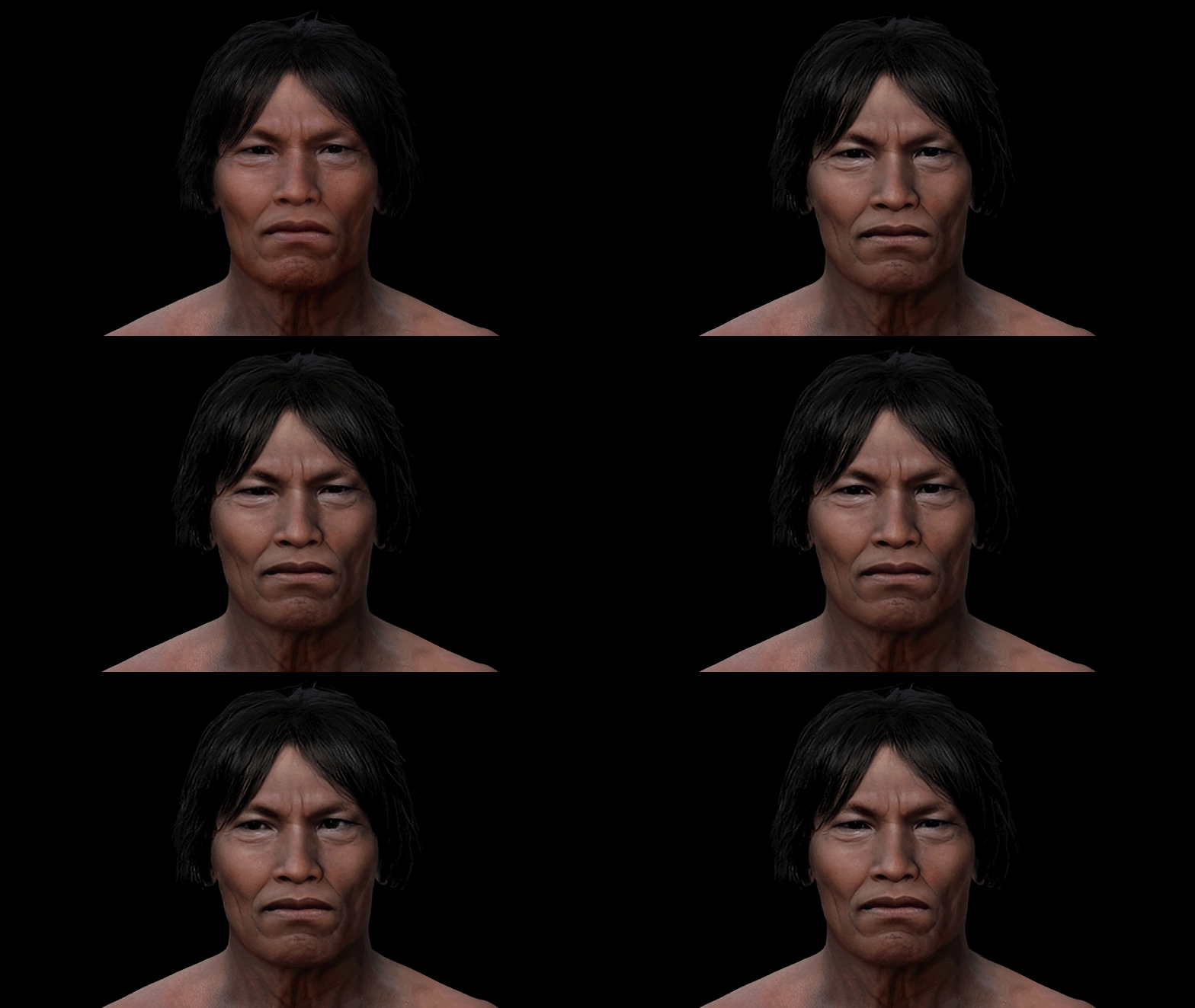
The facial reconstruction from the Punin-2 skull shows an Indigenous American man, roughly in his 50s, who died more than 3,000 years ago.

(Image credit: Dr Chris Rynn, University of Dundee)

Rynn and his colleagues, led by the sculptor Hector Flores Franco from the University of Chimborazo in Ecuador, are raising funds for further investigations, which will include a reconstruction of the Punin-1 skull and attempt an ancient DNA analysis of both. “DNA will tell us the true genetic lineage,” Rynn said.

Disputed dating

When the Punin-2 skull was discovered, researchers suggested it might be the same age as fossils of extinct ice age animals found in the ravine, including mastodons and giant sloths, that were dated to the Pleistocene epoch (2.6 million to 11,700 years ago). Similar claims were made about the Punin-1 skull.


What to read next

But geological studies of the ravine have since disproved this idea, suggesting instead that erosion and soil movements had mixed the much younger human remains with the Pleistocene fossils.

Rather, it appears the Punin-2 individual lived as a hunter-gatherer in the Chimborazo region between 3,000 and 4,000 years ago. According to recent anthropological and osteological studies, the man was aged about 50 when he died.

Rynn said he had purposefully learned as little about the skull’s origin as possible so the face would be based solely on the skull’s shape, rather than on his assumptions. But he did follow local guidance about the hairstyle shown on the reconstruction, which was unique to particular tribal groups in the Chimborazo region where the skull was found. The hair is black in color and parted in the middle; real hair will be used in a physical bust of the reconstruction due to be completed in 2027.

An illustration of a man's face against a dark background

Image credit: Dr Chris Rynn, University of Dundee

Details of the man’s hairstyle were not preserved with the skull, so the scientist who made the reconstruction consulted local people about it.

An illustration of a man's face with a skull superimposed on the top.

Image credit: Dr Chris Rynn, University of Dundee

The facial reconstruction overlaid with the bones from the Punin-2 skull it was based on.


“The hairstyle is very specific,” Rynn said. “If it’s wrong, it looks like a different tribe.”

In addition, some of Rynn’s early reconstructions made the eyes too protrusive, as they would be in a skull of East Asian origin, so he followed local advice to make them deeper set. The result is a face that looks distinctly Indigenous American. “It explains a lot to me about the broader nature of skull and face shape differences between Native Americans and East Asians,” Rynn said.
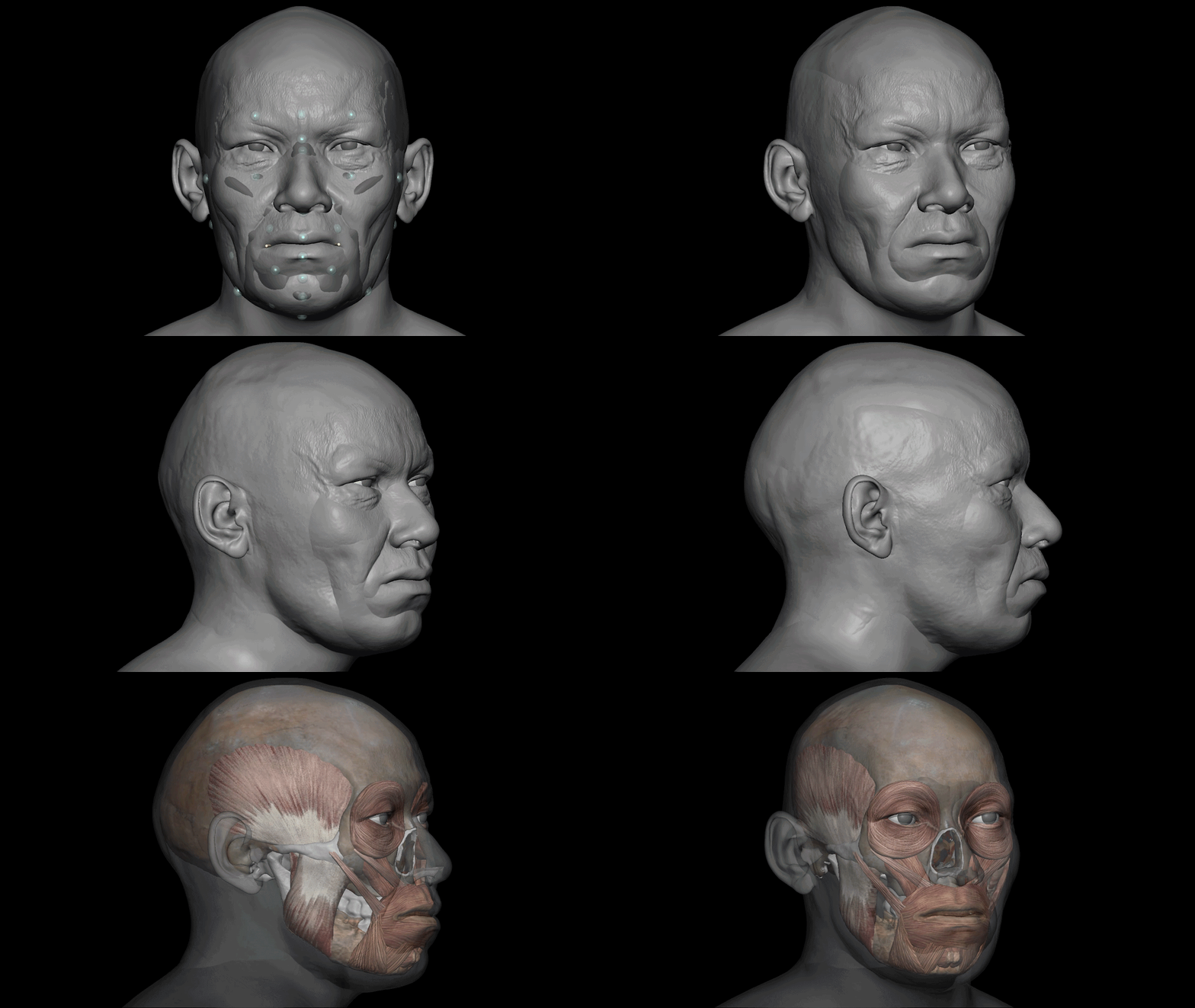
An illustration of a man's face as it rotates, showing the different layers of his muscles and skin.

Although this reconstruction is digital, it shows the muscles and tissues of the man who lived as a hunter-gatherer more than 3,000 years ago.

(Image credit: Dr Chris Rynn, University of Dundee)

Faces from the past

Facial reconstructions have been carried out from the remains of hundreds of ancient humans, because archaeologists think these faces provide an important connection to people who might otherwise exist only as old bones.

Rynn has also worked on the reconstruction of a Neanderthal face from about 50,000 years ago. He uses techniques developed at the University of Manchester in the 1970s that are now known as the “Manchester Method,” although they are actually a combination of techniques from all around the world, he said.

For the Punin-2 skull reconstruction, Rynn combined digital techniques and partial physical reconstructions with wax to create the face, using libraries of data to determine the right thickness of tissues in particular places.

The digital face has been presented to a select group of people from the Chimborazo region who are likely to be the man’s descendants. “It’s a portrait of their actual ancestor,” Rynn said. “They seem to like it!”


Share. Facebook Twitter LinkedIn Telegram WhatsApp Email

Keep Reading

‘There’s a lot of potential there’: Neuroscientist explains early research that psilocybin might help repair the brain after injury

‘There’s a lot of potential there’: Neuroscientist explains early research that psilocybin might help repair the brain after injury

Could we ever create artificial gravity on a spaceship?

Could we ever create artificial gravity on a spaceship?

Colorful wildflowers bloom across Chile’s Atacama Desert in wake of ‘super’ El Niño

Colorful wildflowers bloom across Chile’s Atacama Desert in wake of ‘super’ El Niño

Rare two-headed turtle hatchling discovered on Cape Cod

Rare two-headed turtle hatchling discovered on Cape Cod

Animals may have evolved 200 million years earlier than previously thought, new study suggests

Animals may have evolved 200 million years earlier than previously thought, new study suggests

How prepared are you for a disaster?

How prepared are you for a disaster?

‘A kind of Rosetta Stone’: AI decodes 217-year-old secret letter ordered by Napoleon

‘A kind of Rosetta Stone’: AI decodes 217-year-old secret letter ordered by Napoleon

The ancestors of today’s Indigenous people arrived in the Americas during the coldest part of the last ice age, study suggests

The ancestors of today’s Indigenous people arrived in the Americas during the coldest part of the last ice age, study suggests

Adversity shaped our evolution as a species. People raised in it may have underrecognized strengths because of it.

Adversity shaped our evolution as a species. People raised in it may have underrecognized strengths because of it.

Add A Comment
Leave A Reply Cancel Reply

Editors Picks

Regina King Calls This Aluminum-Free Deodorant Her ‘Latest and Greatest’ — Shop the On-Sale Essential

Regina King Calls This Aluminum-Free Deodorant Her ‘Latest and Greatest’ — Shop the On-Sale Essential

October 3, 2026
Frustrated Red Wings fans in Detroit only benefit Rangers in road win

Frustrated Red Wings fans in Detroit only benefit Rangers in road win

October 3, 2026
‘There’s a lot of potential there’: Neuroscientist explains early research that psilocybin might help repair the brain after injury

‘There’s a lot of potential there’: Neuroscientist explains early research that psilocybin might help repair the brain after injury

October 3, 2026
Christa Pike survives execution and is hospitalized in critical condition

Christa Pike survives execution and is hospitalized in critical condition

October 3, 2026

Subscribe to News

Get the latest USA news and updates directly to your inbox.

Latest News
Ken Urker’s Sister Accuses Gypsy Rose Blanchard of ‘Lies’ After His Sudden Death on 34th Birthday

Ken Urker’s Sister Accuses Gypsy Rose Blanchard of ‘Lies’ After His Sudden Death on 34th Birthday

October 3, 2026
The Post’s experts Dodgers-Braves, Padres-Brewers NLDS predictions

The Post’s experts Dodgers-Braves, Padres-Brewers NLDS predictions

October 3, 2026
Could we ever create artificial gravity on a spaceship?

Could we ever create artificial gravity on a spaceship?

October 3, 2026
Facebook X (Twitter) Pinterest WhatsApp TikTok Instagram
© 2026 USA Times. All Rights Reserved.
  • Privacy Policy
  • Terms
  • Advertise
  • Contact

Type above and press Enter to search. Press Esc to cancel.