


Close Menu
  • Home
  • United States
  • World
  • Politics
  • Business
  • Lifestyle
  • Entertainment
  • Health
  • Science
  • Tech
  • Sports
  • More
    • Web Stories
    • Editor’s Picks
    • Press Release

Subscribe to Updates

Get the latest USA news and updates directly to your inbox.

What's On
Victoria Beckham’s 0 Sandals Are Peak Rich-Girl Vacation Energy — Get the Look for

Victoria Beckham’s $900 Sandals Are Peak Rich-Girl Vacation Energy — Get the Look for $25

May 31, 2026
Bettor wins .7M parlay after Spurs Game 7 victory: ‘All you gotta do is believe’

Bettor wins $1.7M parlay after Spurs Game 7 victory: ‘All you gotta do is believe’

May 31, 2026
Fertility problems? Surprising issue in your mouth could be to blame

Fertility problems? Surprising issue in your mouth could be to blame

May 31, 2026
Facebook X (Twitter) Instagram
Trending
  • Victoria Beckham’s $900 Sandals Are Peak Rich-Girl Vacation Energy — Get the Look for $25
  • Bettor wins $1.7M parlay after Spurs Game 7 victory: ‘All you gotta do is believe’
  • Fertility problems? Surprising issue in your mouth could be to blame
  • Exclusive | Bitter California Republican feud turns toxic as congressman claims rival will ‘betray’ President Trump
  • Scott Peterson attorney says new evidence bombshells are yet to come
  • I’m 5’2″ — And I’m Seriously Impressed by Quince’s Petite-Friendly Summer Dresses
  • How to watch Cubs vs. Cardinals on Sunday Night Baseball: Start time, livestream
  • Mamdani spin doctor accused of threatening Graham Platner’s ex-staffer before she blew whistle on sexting scandal
  • Privacy
  • Terms
  • Advertise
  • Contact Us
Join Us
USA TimesUSA Times
Newsletter Login
  • Home
  • United States
  • World
  • Politics
  • Business
  • Lifestyle
  • Entertainment
  • Health
  • Science
  • Tech
  • Sports
  • More
    • Web Stories
    • Editor’s Picks
    • Press Release
USA TimesUSA Times
Home » Breakthrough in experimental light-powered quantum computers could mean scaling them up is now far more viable
Breakthrough in experimental light-powered quantum computers could mean scaling them up is now far more viable
Science

Breakthrough in experimental light-powered quantum computers could mean scaling them up is now far more viable

News RoomBy News RoomApril 29, 20263 ViewsNo Comments

Researchers have demonstrated a breakthrough method for preventing errors in light-powered quantum computers before they even occur.

The milestone, which was achieved using a new technique called photon distillation, means physicists are one step closer to developing light-based “photonic” quantum computers capable of achieving quantum advantage over classical supercomputers.

In a study uploaded Jan. 9 to the arXiv preprint database, scientists detailed a “net-positive” method for mitigating errors in photonic quantum computers.


You may like

The research tackles what is arguably the biggest hurdle in the path to developing fault-tolerant universal quantum computers, the presence of noisy errors that can cause computations to fail.

Unlike superconducting quantum computers, which leverage electronic circuits to create qubits — the quantum equivalent of computer bits — photonic quantum computers are powered by light. Scientists shoot beams of photons (units of light) through specifically engineered fields of mirrors and beam splitters. The photons themselves are then manipulated into complex quantum states that allow computations to be performed.

One of the key benefits of this quantum computing paradigm is that it works at room temperature. The underlying reason this is possible is also the culprit behind photonic quantum computing’s biggest problem: photonic quantum computers can operate without generating much excess heat because light is in constant motion. This motion allows computations to occur through the interactions between photons as they move. But it also produces significantly more errors.

The fault tolerance problem

Superconducting quantum computers have to energize circuits to create qubits ‪—‬ a process that generates heat. Although photons don’t suffer from this problem, there’s a trade-off: photonic quantum computers are very brittle. Photons are, by their very nature, imperfect, which means there’s typically a significant percentage of “bad” photons bouncing around that can ruin a given computation.

Get the world’s most fascinating discoveries delivered straight to your inbox.

“Because photons are moving at the speed of light, you have qubits that are constantly moving through the system,” Jelmer Renema, chief scientist and co-founder of QuiX Quantum, told Live Science. “And the way that computations work is by interactions between these photons when they encounter each other on the chip.”

“Errors occur when one of the photons doesn’t play nice,” Renema said. “Every once in a while, there’s sort of a maverick photon that decides to not play by the rules of the other photons.”

This “rogue” photon will work its way through the system without ever interacting with the other photons, producing a distinct error. Because this happens before the photon is even turned into a qubit for processing, this problem is difficult to address through conventional quantum error correction, which typically involves techniques to address qubit errors after they’ve occurred.


What to read next

Because qubits can exist in a state of superposition, they can be susceptible to errors. (Image credit: Jorg Greuel/Getty Images)

The amount of qubits that you need to expend in order to make a single good qubit is so enormous that the cost of the computer just blows up enormously.

Jelmer Renema, chief scientist and co-founder of QuiX Quantum

Using a technique called quantum photonic distillation, QuiX employed error mitigation to tackle the root cause of these errors before they could happen.

“You set up the interference in such a way that the probability that your rogue photon makes it to the output … is lower than the probability that the photons that are playing nice make it to that output,” Renema said.

This probability lies at the heart of photonic quantum computing. As Renema put it, “Everything in photonics is probabilistic.” When researchers shoot beams of photons through a series of mirrors and beam splitters, there’s a certain probability that each photon will do what it wants, and if nothing is done to mitigate errors, they’re essentially relying on luck to produce viable computations.

The odds of success get even worse for each photon as engineers add more quantum computing gates to the system.

Below the threshold

With a superconducting quantum computer, you can add “logical” qubits to perform fault tolerance on physical qubits to compensate for errors. These are collections of physical qubits that share the same data, so that if one or more qubits fail, the data is available elsewhere in the cluster and calculations are not disrupted. But with quantum computing, adding overhead tends to produce more errors than it fixes.

Photonic distillation also exhibits “below threshold error mitigation” — a metric the study authors used to indicate that their technique reduces the number of errors that occur as the system scales, as opposed to adding more, which is normally the case as you make a quantum computer bigger, the QuiX scientists wrote in the study.

Similar fault tolerance milestones have been achieved in superconducting and neutral-atom quantum computers. Google achieved below-threshold error correction in its Willow quantum processing unit (QPU) in December 2024, for example. But the new study represents the first time this has been achieved in light-powered systems.

“The amount of qubits that you need to expend in order to make a single good qubit is so enormous that the cost of the computer just blows up enormously,” Renema said. “So there’s this trade-off.”

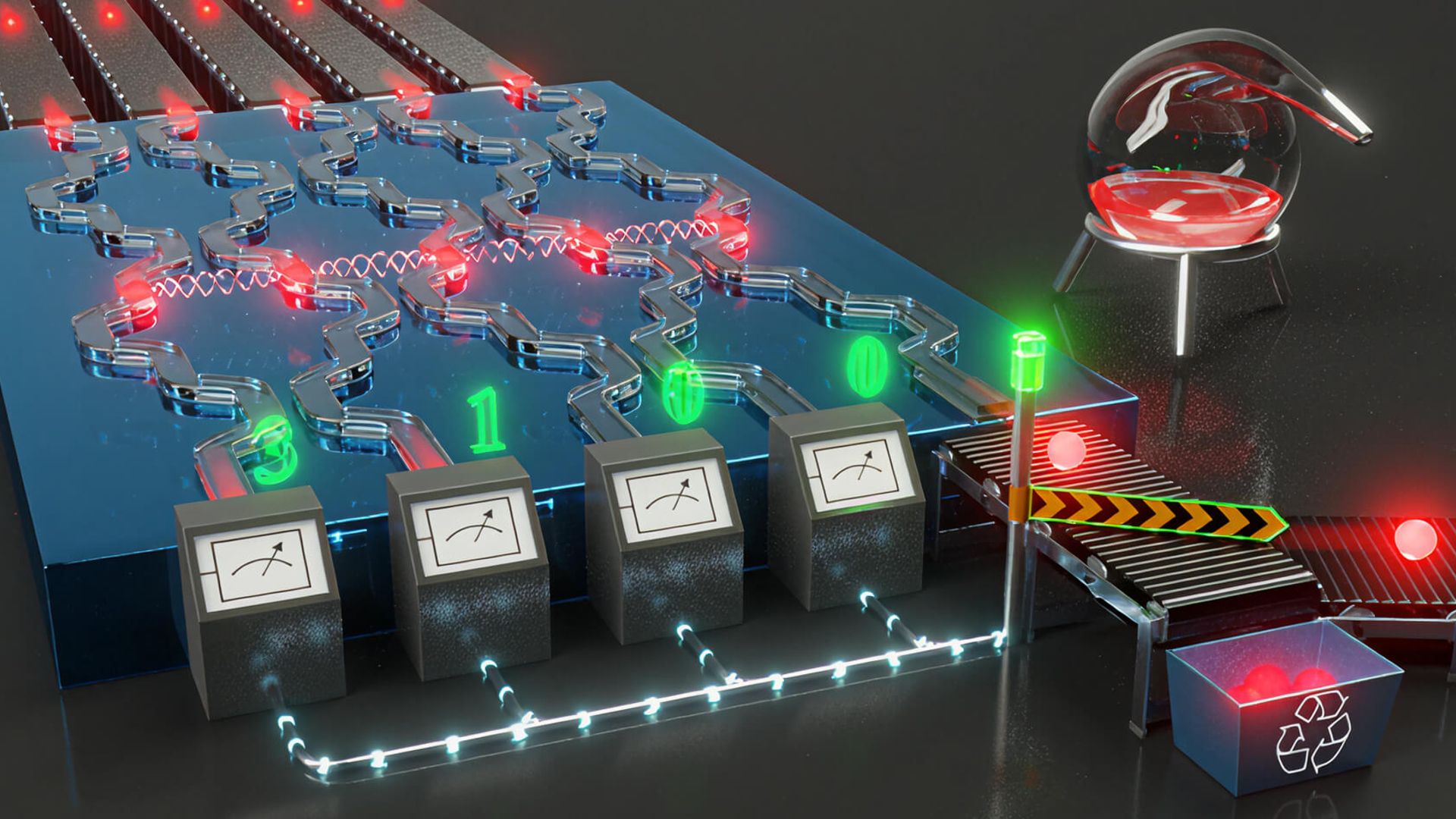
Photonic distillation sends imperfect photons through a specialized optical circuit that uses “quantum interference” — a strange feature of quantum mechanics wherein the probability amplitudes of quantum states combine — to filter out physical inconsistencies and output a single, high-quality photon. All of this happens before the photons are turned into qubits.

These high-quality photons are then sent through the system with a much lower probability of going rogue. This quality increase provides a net gain in error correction even when taking into account all the errors introduced when the photons are used as qubits.

Because photonic computers are probabilistic, this experimental work demonstrates a scalable approach to error mitigation that should provide below-threshold performance at scales great enough to produce useful quantum computations, the study authors said.


Can you match these ancient devices to their pictures? Find out with our computing quiz!

Share. Facebook Twitter LinkedIn Telegram WhatsApp Email

Keep Reading

‘We were being bullied in our own home’: How ‘authoritarian’ HOAs are contributing to the insect apocalypse

‘We were being bullied in our own home’: How ‘authoritarian’ HOAs are contributing to the insect apocalypse

Bronze Age 5-year-old’s skull found in Uzbekistan is the oldest known evidence of surgery in Central Asia

Bronze Age 5-year-old’s skull found in Uzbekistan is the oldest known evidence of surgery in Central Asia

‘Astonishing’: James Webb telescope spots the most chemically primitive galaxy in the ancient universe

‘Astonishing’: James Webb telescope spots the most chemically primitive galaxy in the ancient universe

Astronomers gaze into the ‘Crystal Ball Nebula’ and see a vision of our dying sun — Space photo of the week

Astronomers gaze into the ‘Crystal Ball Nebula’ and see a vision of our dying sun — Space photo of the week

How many generations of humans have there been?

How many generations of humans have there been?

Are some people wired to see ghosts? A psychologist explains what makes paranormal experiences more likely

Are some people wired to see ghosts? A psychologist explains what makes paranormal experiences more likely

Scientists got mouse eyes to perform photosynthesis ‪—‬ and no, they didn’t turn green

Scientists got mouse eyes to perform photosynthesis ‪—‬ and no, they didn’t turn green

New device could make processors run 1,000 times faster without additional waste heat — scientists say it could reduce data center energy demands

New device could make processors run 1,000 times faster without additional waste heat — scientists say it could reduce data center energy demands

Science news this week: Exploding rocket overshadows NASA’s next steps to the moon, ‘Doomsday Glacier’ faces big loss, quantum computer AI hybrid shows impressive results, and war deepens Iran’s water crisis

Science news this week: Exploding rocket overshadows NASA’s next steps to the moon, ‘Doomsday Glacier’ faces big loss, quantum computer AI hybrid shows impressive results, and war deepens Iran’s water crisis

Add A Comment
Leave A Reply Cancel Reply

Editors Picks

Bettor wins .7M parlay after Spurs Game 7 victory: ‘All you gotta do is believe’

Bettor wins $1.7M parlay after Spurs Game 7 victory: ‘All you gotta do is believe’

May 31, 2026
Fertility problems? Surprising issue in your mouth could be to blame

Fertility problems? Surprising issue in your mouth could be to blame

May 31, 2026
Exclusive | Bitter California Republican feud turns toxic as congressman claims rival will ‘betray’ President Trump

Exclusive | Bitter California Republican feud turns toxic as congressman claims rival will ‘betray’ President Trump

May 31, 2026
Scott Peterson attorney says new evidence bombshells are yet to come

Scott Peterson attorney says new evidence bombshells are yet to come

May 31, 2026

Subscribe to News

Get the latest USA news and updates directly to your inbox.

Latest News
I’m 5’2″ — And I’m Seriously Impressed by Quince’s Petite-Friendly Summer Dresses

I’m 5’2″ — And I’m Seriously Impressed by Quince’s Petite-Friendly Summer Dresses

May 31, 2026
How to watch Cubs vs. Cardinals on Sunday Night Baseball: Start time, livestream

How to watch Cubs vs. Cardinals on Sunday Night Baseball: Start time, livestream

May 31, 2026
Mamdani spin doctor accused of threatening Graham Platner’s ex-staffer before she blew whistle on sexting scandal

Mamdani spin doctor accused of threatening Graham Platner’s ex-staffer before she blew whistle on sexting scandal

May 31, 2026
Facebook X (Twitter) Pinterest WhatsApp TikTok Instagram
© 2026 USA Times. All Rights Reserved.
  • Privacy Policy
  • Terms
  • Advertise
  • Contact

Type above and press Enter to search. Press Esc to cancel.