Close Menu
  • Home
  • United States
  • World
  • Politics
  • Business
  • Lifestyle
  • Entertainment
  • Health
  • Science
  • Tech
  • Sports
  • More
    • Web Stories
    • Editor’s Picks
    • Press Release

Subscribe to Updates

Get the latest USA news and updates directly to your inbox.

What's On
Florida board votes to bar illegal immigrants from public colleges

Florida board votes to bar illegal immigrants from public colleges

July 2, 2026
Why Was Sully Written Out of ‘Sullivan’s Crossing’ in Season 4? Scott Patterson’s Exit Explained

Why Was Sully Written Out of ‘Sullivan’s Crossing’ in Season 4? Scott Patterson’s Exit Explained

July 2, 2026
76ers agree to two-year deal with Anfernee Simons in latest NBA free agency splash

76ers agree to two-year deal with Anfernee Simons in latest NBA free agency splash

July 2, 2026
Facebook X (Twitter) Instagram
Trending
  • Florida board votes to bar illegal immigrants from public colleges
  • Why Was Sully Written Out of ‘Sullivan’s Crossing’ in Season 4? Scott Patterson’s Exit Explained
  • 76ers agree to two-year deal with Anfernee Simons in latest NBA free agency splash
  • Your period blood is trying to tell you something — the biggest red flags to look out for
  • JPMorgan ordered to keep paying Charlie Javice’s legal bills, topping $70M
  • AOC throws her weight behind progressive Abdul El-Sayed in Michigan Senate race
  • Letitia James faces heat as feds suspend Medicaid fraud unit funds
  • Is grey hair reversible? Scientists are putting color back into strands
  • Privacy
  • Terms
  • Advertise
  • Contact Us
Join Us
USA TimesUSA Times
Newsletter Login
  • Home
  • United States
  • World
  • Politics
  • Business
  • Lifestyle
  • Entertainment
  • Health
  • Science
  • Tech
  • Sports
  • More
    • Web Stories
    • Editor’s Picks
    • Press Release
USA TimesUSA Times
Home » Hubble telescope spots ‘impossible’ light from a galaxy that shouldn’t have been visible
Hubble telescope spots ‘impossible’ light from a galaxy that shouldn’t have been visible
Science

Hubble telescope spots ‘impossible’ light from a galaxy that shouldn’t have been visible

News RoomBy News RoomJuly 2, 20260 ViewsNo Comments

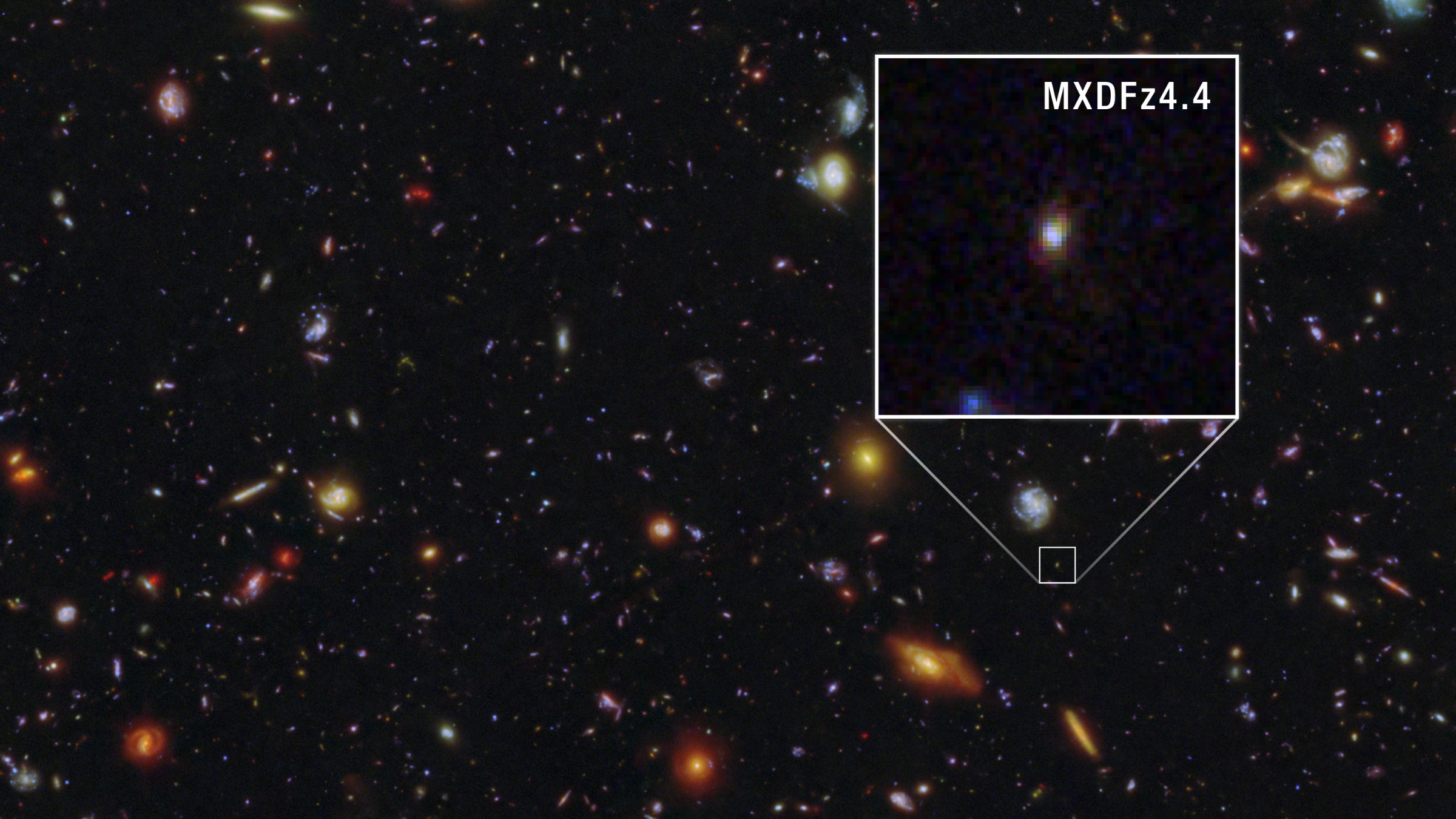
Astronomers have spotted an ancient galaxy shining through the cosmic fog of the early universe, revealing a detailed view that was thought to be impossible.

Using NASA’s Hubble Space Telescope, along with data from the James Webb Space Telescope (JWST) and the European Southern Observatory’s Very Large Telescope (VLT), researchers detected “ionizing” ultraviolet photons — energetic light capable of stripping electrons from hydrogen atoms — coming from the galaxy, called MXDFz4.4. It’s the earliest such detection on record, arriving only around 250 million years after the end of a major cosmic transition called the Epoch of Reionization, the researchers explained in a study published June 23 in The Astrophysical Journal.

For hundreds of millions of years after the Big Bang, the space between galaxies was filled with a fog of neutral hydrogen gas that blocked this kind of light. Over time, radiation from the first stars and galaxies ionized that gas, clearing the fog and letting light travel freely across the universe — a process astronomers are still working to fully understand.

“This was thought to be impossible,” Ilias Goovaerts, a postdoctoral fellow at the Space Telescope Science Institute (STScI) in Baltimore and first author of the new study, said to Live Science. “What’s really special about this galaxy is that it’s getting through so much of the intergalactic medium [the ionized plasma between galaxies]. It’s the furthest away so it has the most intergalactic medium to get through.”

What makes MXDFz4.4 unusual is its combination of size and star-formation rate. The galaxy is roughly 100 times smaller by area than the Milky Way, yet it forms stars around 10 times faster, packing a large number of massive young stars into a compact space. According to Goovaerts, that crowding effect helps the galaxy punch clear channels through its surrounding gas, letting ionizing light escape both the galaxy and, eventually, the murky space between galaxies. The team estimates that somewhere between half and all of the galaxy’s ionizing light is escaping.

The discovery, made in October, came about somewhat by chance. While preparing an unrelated funding proposal just days before a major deadline, Goovaerts examined an existing, deep Hubble image to check whether anyone had looked for this kind of signal there before. Within a couple of hours, he had a promising signal. “It was very, very quick from us having the idea to me going, okay, there’s something here and this is exciting,” Goovaerts said. “We were excited from day one, but then it took months for it to mature and to extract all the properties about the galaxy.”


You may like

An illustration of the galaxy MXDFz4.4 as it appeared roughly 1.4 billion years after the Big Bang, when the Era of Reionization was drawing to a close.

(Image credit: NASA, ESA, Leah Hustak (STScI))

The finding relied on an unusually rich set of observations: an extremely deep Hubble image taken from 40 hours of observations; JWST imaging across many wavelengths, used to characterize the galaxy’s stars and star-formation history; and one of the deepest spectra ever taken of a single patch of sky, gathered over roughly six days of observing time with the VLT’s Multi-Unit Spectroscopic Explorer instrument. That spectrum confirmed the galaxy’s distance through its Lyman-alpha emission line — which serves as a “hydrogen fingerprint,” or a glow given off by excited hydrogen gas, that astronomers can use to measure cosmic distance and time.

No other galaxy from this early period had previously shown detectable ionizing light, making MXDFz4.4 one of a kind so far, study co-author Marc Rafelski, deputy mission head for the Hubble Space Telescope at STScI, noted in the statement. .

Get the world’s most fascinating discoveries delivered straight to your inbox.

Researchers say bursts of vigorous star formation like the one seen in MXDFz4.4 may have played an important role in clearing the early universe’s hydrogen fog and that more galaxies like it are likely still waiting to be found.

Goovaerts, I., et al (2026). MXDFz4.4: A LyC Emitter 250 Myr after the Epoch of Reionization and a First Test of Ly α Morphology as a Tracer of LyC Escape at High Redshift. The Astrophysical Journal, 1005(1), 34. https://doi.org/10.3847/1538-4357/ae75b0


James Webb Space Telescope quiz: How well do you know the world’s most powerful telescope?

TOPICS

James Webb Space Telescope

Share. Facebook Twitter LinkedIn Telegram WhatsApp Email

Keep Reading

The hantavirus outbreak is over, with a toll of 13 cases and three deaths

The hantavirus outbreak is over, with a toll of 13 cases and three deaths

‘Uncharted territory’: Record high ocean temperatures confirmed for June as El Niño strengthens its grip

‘Uncharted territory’: Record high ocean temperatures confirmed for June as El Niño strengthens its grip

11-year-old boy in Canada dies from rabies after waking up with a bat on his face

11-year-old boy in Canada dies from rabies after waking up with a bat on his face

James Webb telescope may have discovered a mysterious, never-before-seen substance on Pluto and Titan

James Webb telescope may have discovered a mysterious, never-before-seen substance on Pluto and Titan

Subterranean ring discovered on Scottish isle could be a Stonehenge-like monument

Subterranean ring discovered on Scottish isle could be a Stonehenge-like monument

NASA launches bold mission to rescue Swift space telescope before it falls to Earth

NASA launches bold mission to rescue Swift space telescope before it falls to Earth

Ancient-DNA analysis solves 500-year-old mystery of what killed 2 Medici brothers

Ancient-DNA analysis solves 500-year-old mystery of what killed 2 Medici brothers

Antarctica’s first dinosaur fossil belonged to a group of the largest land animals ever

Antarctica’s first dinosaur fossil belonged to a group of the largest land animals ever

Study suggests life on Earth has around 1.8 billion years left — but the biosphere might evolve to survive even longer

Study suggests life on Earth has around 1.8 billion years left — but the biosphere might evolve to survive even longer

Add A Comment
Leave A Reply Cancel Reply

Editors Picks

Why Was Sully Written Out of ‘Sullivan’s Crossing’ in Season 4? Scott Patterson’s Exit Explained

Why Was Sully Written Out of ‘Sullivan’s Crossing’ in Season 4? Scott Patterson’s Exit Explained

July 2, 2026
76ers agree to two-year deal with Anfernee Simons in latest NBA free agency splash

76ers agree to two-year deal with Anfernee Simons in latest NBA free agency splash

July 2, 2026
Your period blood is trying to tell you something — the biggest red flags to look out for

Your period blood is trying to tell you something — the biggest red flags to look out for

July 2, 2026
JPMorgan ordered to keep paying Charlie Javice’s legal bills, topping M

JPMorgan ordered to keep paying Charlie Javice’s legal bills, topping $70M

July 2, 2026

Subscribe to News

Get the latest USA news and updates directly to your inbox.

Latest News
AOC throws her weight behind progressive Abdul El-Sayed in Michigan Senate race

AOC throws her weight behind progressive Abdul El-Sayed in Michigan Senate race

July 2, 2026
Letitia James faces heat as feds suspend Medicaid fraud unit funds

Letitia James faces heat as feds suspend Medicaid fraud unit funds

July 2, 2026
Is grey hair reversible? Scientists are putting color back into strands

Is grey hair reversible? Scientists are putting color back into strands

July 2, 2026
Facebook X (Twitter) Pinterest WhatsApp TikTok Instagram
© 2026 USA Times. All Rights Reserved.
  • Privacy Policy
  • Terms
  • Advertise
  • Contact

Type above and press Enter to search. Press Esc to cancel.