
Octopuses are known to smack fish when they get too close. But while it might seem unsporting for an animal with eight arms to start a boxing match with an animal that has none, new research shows that octopuses don’t just lash out indiscriminately; instead, they slap certain fish species that “jab” and “swipe” at the octopuses in a squabble over territory.
These marine fight clubs show that octopuses’ aggressive behavior is part of a more complicated set of responses than previously thought, the scientists said in the new study.
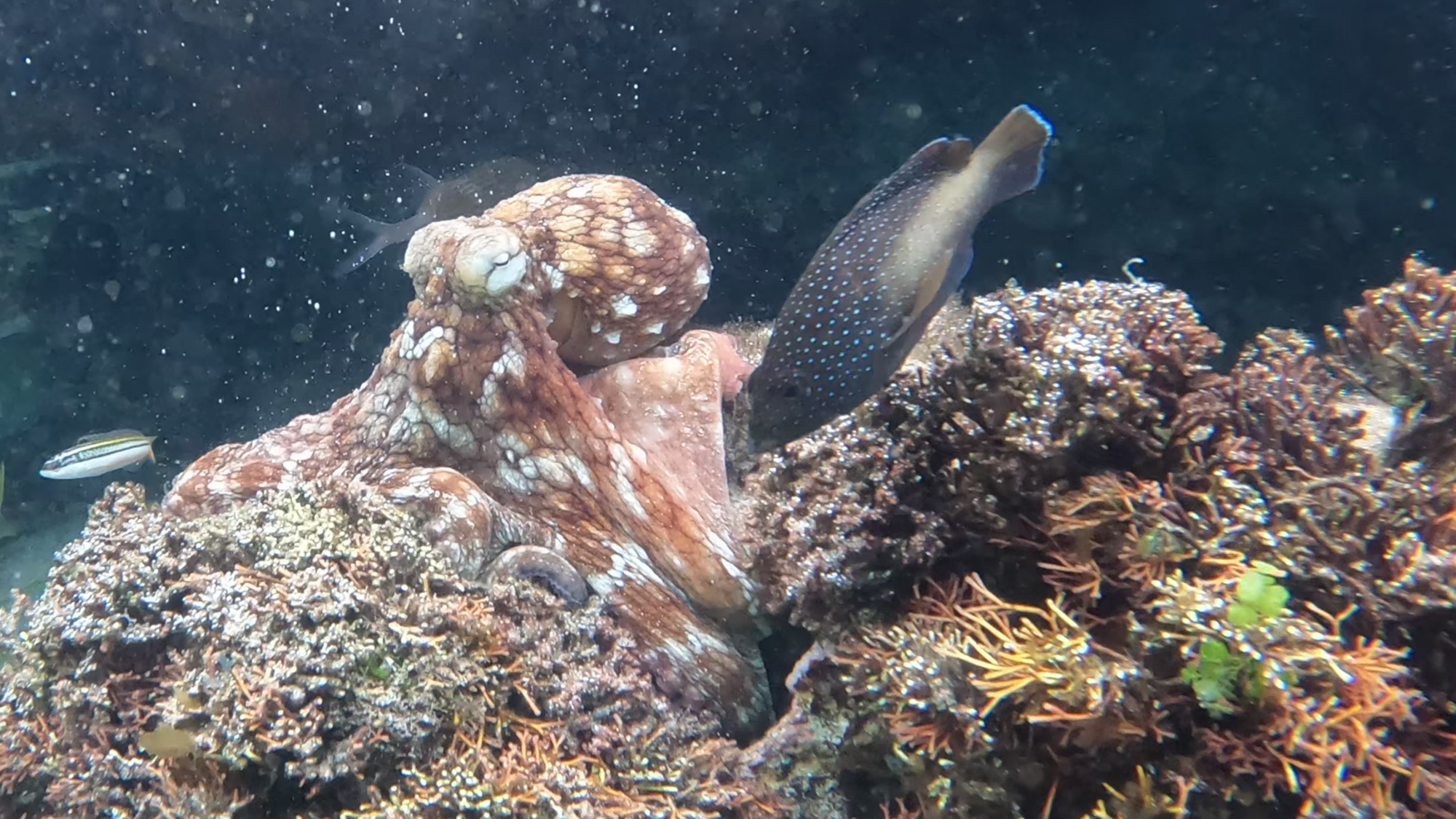
The researchers observed 101 interactions between juvenile Brazilian reef octopuses (Octopus insularis) and 10 species of reef fish in shallow waters along the northeastern coast of Brazil and on oceanic islands. The encounters revealed that the young octopuses didn’t respond to every fish in the same way. Territorial fish that appeared to defend their territory from the octopuses triggered rapid, defensive reactions, including the “slap” arm movement.
Latest Videos FromLive Science
But nonterritorial fish that followed the octopuses as they hunted tended to produce longer, less-confrontational encounters in which the octopuses simply continued foraging.
The findings, published July 31 in the journal Behavioural Processes, add to decades of observations of interactions between octopuses and fish by showing how juvenile O. insularis adjust their actions depending on the behavior of the fish they encounter.
“Clearly there’s not one way at which they’re interacting,” said study co-author Jennifer Mather, a recently retired octopus behavior researcher at the University of Lethbridge in Alberta. “The territorial fish are really going to do one thing, and the nonterritorial fish are doing other things,” she told Live Science.
Different fish, different response
The researchers recorded 38 juvenile octopuses interacting with fish, splitting the encounters into those involving territorial species, like damselfish (family Pomacentridae) and nonterritorial species, like blue tang (Acanthurus coeruleus).
Get the world’s most fascinating discoveries delivered straight to your inbox.
The difference was striking. Interactions with territorial fish lasted an average of about 14 seconds and tended to involve rapid changes in behavior. The fish performed “jabs” and “swipes” as they tried to attack the octopuses, while the octopuses responded with “flinches” and arm “slaps.”
Interactions with nonterritorial fish lasted much longer, averaging about 46 seconds. These fish were more likely to follow or circle the octopus while the octopus continued hunting.
The researchers used a statistical technique called lag-sequence analysis to determine whether particular behaviors tended to follow one another in predictable sequences. The analysis confirmed distinct behavioral patterns for the two types of encounters. In other words, a territorial fish trying to drive an octopus away would trigger a very different behavior than a fish that merely trailed the octopus.
“Fish territoriality significantly affected the behavior of both fishes and octopuses,” the researchers wrote in the study. “These interactions are adaptive and highly context-dependent.”
A slap is just one part of the story
The arm-slap behavior itself isn’t new to science. Researchers have described octopuses striking or swiping at fish in previous observations. But the new study provides a more systematic look at when the behavior occurs and what happens around it.
To capture the footage, the research team snorkeled in shallow water and filmed juvenile octopuses without disturbing their normal behavior.
The clear water at their study sites sometimes offered visibility of around 66 feet (20 meters), giving the researchers a broad view of the underwater environment.
The team’s analysis of the footage revealed that individual octopuses appeared to have different personalities. Some were noticeably shy, while others were more reactive during interactions. The researchers don’t yet know whether those traits differ by sex or age or whether the behavioral traits remain consistent over time.
A young Octopus insularis hides among the corals.
(Image credit: Michaella Andrade)
The octopuses were also curious about their observers.
“During our field sessions, the octopuses frequently showed interest in our cameras, reaching out to touch them,” said study co-authors Michaella Pereira Andrade, a postdoctoral researcher at the Institute of Biomedical Sciences in the United Kingdom, and Charles Morphy Santos, an associate professor of evolutionary biology at the Federal University of ABC in Brazil. “In fact, one octopus even managed to steal our diving weight and carry it straight into its den,” they told Live Science in an email.
The footage also showed that the octopuses reacted to different fish in other ways.
“One key finding that stood out in this study was that, when observing the octopuses and fish, it was clear that the octopuses would sometimes split their skin patterns into two distinct colorations,” Andrade and Morphy Santos said.
The researchers called this pattern “half-blotch.” The distinctive pattern appeared during interactions with territorial fish, when the fish approached or attacked the octopuses. The octopuses displayed circular white spots on the sides of their bodies facing the fish. Observing the interaction, the researchers noticed that the fish appeared to back away after the octopuses displayed the body pattern.

An octopus displays the “half-blotch” pattern at a nearby fish.
(Image credit: Michaella Andrade)
“We hypothesized it might serve as a form of warning communication,” Andrade and Morphy Santos said.
The researchers don’t yet know exactly what the fish see when they look at the octopuses’ changing skin, or whether the pattern is deliberately produced as a signal.
The findings can help people understand octopuses’ behaviors when they encounter the animals in the wild, the team added.
“One of the interesting things about when we do this is, people can read [this study], go snorkel, and have a guide to what they’re seeing, which I think is really important,” Mather said.
Andrade, M. P., Mather, J., & Santos, C. M. D. (2026). Hunting in a complex neighborhood: Juvenile octopuses’ interactions with territorial and follower fishes. Behavioural Processes, 241, 105413. https://doi.org/10.1016/j.beproc.2026.105413
How much do you know about octopuses? Find out with our octopus quiz!