



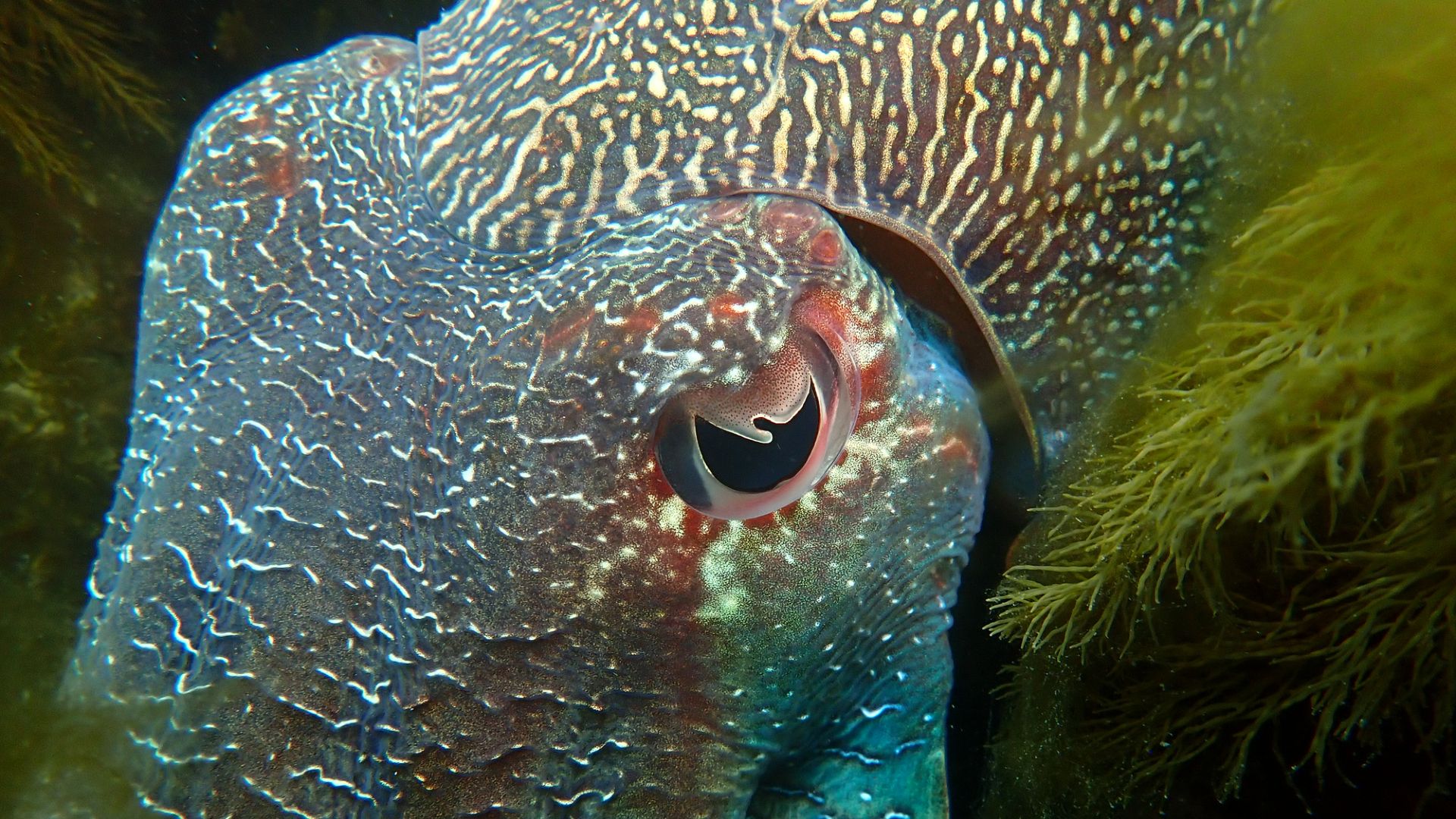

It’s easy to think of pupils as simple holes that widen in the dark and shrink in the light. But if you look across the animal kingdom, you’ll see a variety of pupil shapes: vertical slits in cats and snakes, horizontal rectangles in goats and horses, and W-shaped crescents in cuttlefish, for instance. The shape of an animal’s pupil can reveal a lot about how that animal sees and what it needs to survive.
In a perfect optical system, the shape of the pupil shouldn’t matter much. “In an ideal world, the way optics is generally taught, the pupil’s sort of irrelevant because all the light should be coming to an exact point anyway,” said Jenny Read, a visual neuroscientist at Newcastle University in the U.K.
But real eyes are imperfect — light coming through the pupil creates diffraction and defocus that different pupil shapes resolve in different ways. “It actually turns out to be really complicated,” Read said.
Article continues below
SIGN UP FOR OUR NEWSLETTER
Sign up for our weekly Life’s Little Mysteries newsletter to get the latest mysteries before they appear online.
One important factor is depth of field, Marty Banks, a professor emeritus of optometry at the University of California, Berkeley, told Live Science. His 2015 study in the journal Science Advances was the first to systematically explain why the orientation of an animal’s pupil matters for survival.
Depth of field is most easily illustrated with a camera lens, where the camera’s aperture acts as its pupil. A narrow aperture creates an image where things are in focus both far away from and near to the camera. A wide aperture puts one object in focus and blurs everything in the foreground and background. But when a pupil isn’t perfectly round, it can produce more variation in focus, and some animals’ eyes take advantage of that.
Ambush predators, like cats and snakes, have forward-facing eyes that judge distance by comparing the slight differences between their two views — a process called stereopsis. Because the eyes are side by side, the differences show up most clearly along vertical edges, which means those edges need to be sharp.
“How do you make sure they’re sharp? Well, you [narrow] the pupil, and you increase the depth of field,” Banks said. “But they only need to do it for the vertical contours. So it’s really clever to stop the pupil down horizontally and leave it wide open vertically, because for the other contours where stereopsis is not useful, like for horizontal contour, now they can use blur to estimate the distance.”
That’s why the pupils of ambush predators are shaped like slits: Shrinking the pupil horizontally helps with stereopsis, while widening it vertically helps them estimate depth from blur.
However, this works best for predators close to the ground. Larger predators, like lions and tigers, tend to have round pupils because they look at the ground at a steeper angle that reduces the advantage of blur to estimate distance.

Prey animals have different priorities for survival, and the shapes of their pupils reflect that.
“For prey animals, it’s more about field of view than it is about image sharpness,” Banks said. “They need to be able to see panoramically along the ground because most of the predators that are going to approach them are going to be on the ground.”
In contrast, the eyes of prey animals like goats, sheep and horses tend to be positioned on the sides of their head, and their pupils are shaped like a bar — wide horizontally and short vertically. That wide shape lets in more light from the horizontal plane in front of them and behind them to help them scan their surroundings, while the short vertical opening sharpens horizontal contours — basically the opposite of what predators’ eyes do.

But there’s a problem: A prey animal that’s lowering its head to graze would turn its horizontal pupils sideways and ruin its ability to scan the horizon. However, these animals have evolved a surprising solution, Banks discovered: As the animal’s head changes orientation, its eyes rotate in its sockets to compensate.
“They’ve developed this ability to move their eyes in opposite directions on the two sides of the head to keep the pupil parallel to the ground,” Banks said.
There are other animals with even stranger pupil shapes, especially in the sea. Cuttlefish, for example, have W-shaped pupils. Scientists still don’t have definitive answers for why.
“Some people have argued that it makes them less visible to other animals,” Banks said. “I’m not sure I believe that a W somehow would be harder to see than a circle.”
Other theories suggest that these pupil shapes might help reduce light from above to minimize scattering and improve contrast. One early theory proposed that the shape may help with color perception — cuttlefish have only one photopigment, which should mean they see only in black and white, despite their dazzling colors and knack for camouflage.
Banks’ study focused on land animals, and he acknowledged that many aquatic pupils remain unexplained. Read suspects the unknowns go even further. “It makes you think what other abilities may be out there in animal eyes that we just have no ideas about,” she said.