



The brain’s memory center may come “prewired,” rather than being built from scratch after birth, a new study in mice finds.
The research, published in April in the journal Nature Communications, offers a new perspective on a long-standing question in neuroscience: Does the brain begin as a blank slate and build memories by adding connections through experience, or does it come with built-in wiring? The new research focused on the hippocampus, a seahorse-shaped structure deep in the brain that’s essential for forming memories.
The researchers focused on a region of the hippocampus called cornu ammonis 3 (CA3), which plays a central role in storing and recalling memories. A trait known as plasticity enables neurons within CA3 to continuously strengthen and weaken their connections and thus strengthen or weaken different memories.
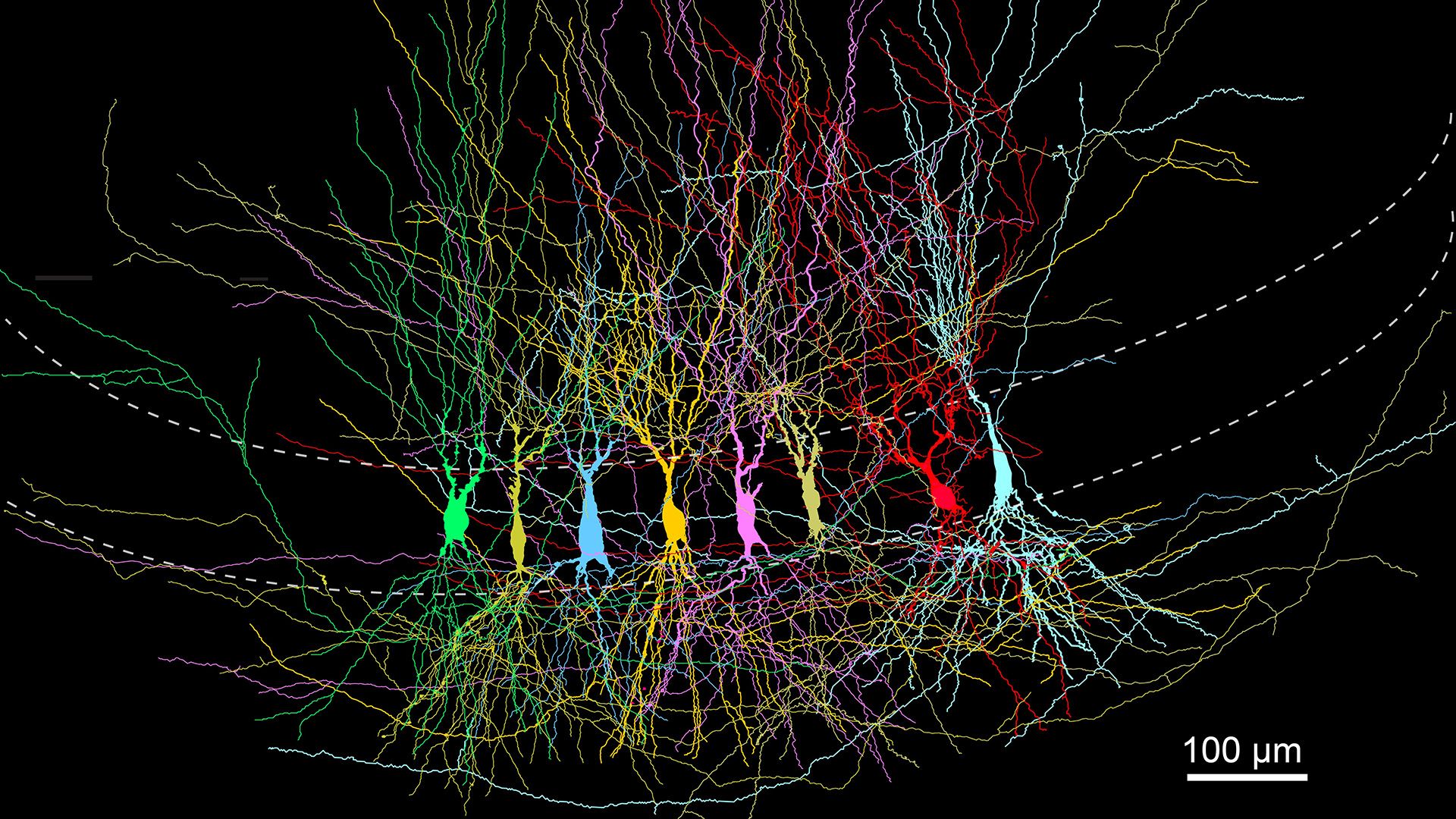
The team examined mouse brain tissue collected shortly after birth, during adolescence or during adulthood. They found that early in life, hippocampal networks are densely wired, with many neurons hyperconnected in a seemingly random pattern. As the brain matures, these haphazard networks become sparser yet more structured as connections are pruned. This pruning begins soon after birth, with significant declines in connectivity by adolescence.
The finding discounts the idea that the hippocampus starts out as a blank slate, or “tabula rasa.”
“We find, in a nutshell, that the system is not a tabula rasa, as we thought originally, where you can just write information and then at some point, this information fills the system,” said study co-author Peter Jonas, a neuroscientist at the Institute of Science and Technology Austria. “Rather, it starts out as a tabula plena [full slate] and then becomes more sparser and specifically connected.”
This pattern may help to explain why we remember so little from infancy.
Memories are thought to be stored within networks of neurons that fire together, representing specific experiences. In a young brain, however, these connections between neurons, called synapses, behave differently, the study suggests. In young brain tissue, a single input could cause a neuron to fire, the team found, while in mature networks, neurons typically require multiple inputs to fire.
In very young mice, neurons in a region of the hippocampus called CA3 form a dense, highly interconnected network (yellow), with connections that are largely random.
(Image credit: Vargas-Barroso et al./Nature Communications)
Jonas said the team was surprised by not only the early pruning of connections but also how strong those early connections were. “You might think that early in development, you have poor synapses and weak synapses, but we found the opposite,” he told Live Science.
This excitability comes at a cost, however: When neurons are activated too easily, different experiences can trigger overlapping patterns of activity. If that overlap is too great, the brain may struggle to distinguish one memory from another. Instead of forming distinct networks, it may generate broader, less-specific memories. In other words, the system is very active but not very precise.
This imprecision may affect behavior, too. For example, rodent studies show that young animals learn to fear an area of a cage where they received a mild shock, freezing when they return to it. But unlike adults, who freeze at that exact location, young animals also have this response in similar environments — so the memory is there, but it’s not precise.
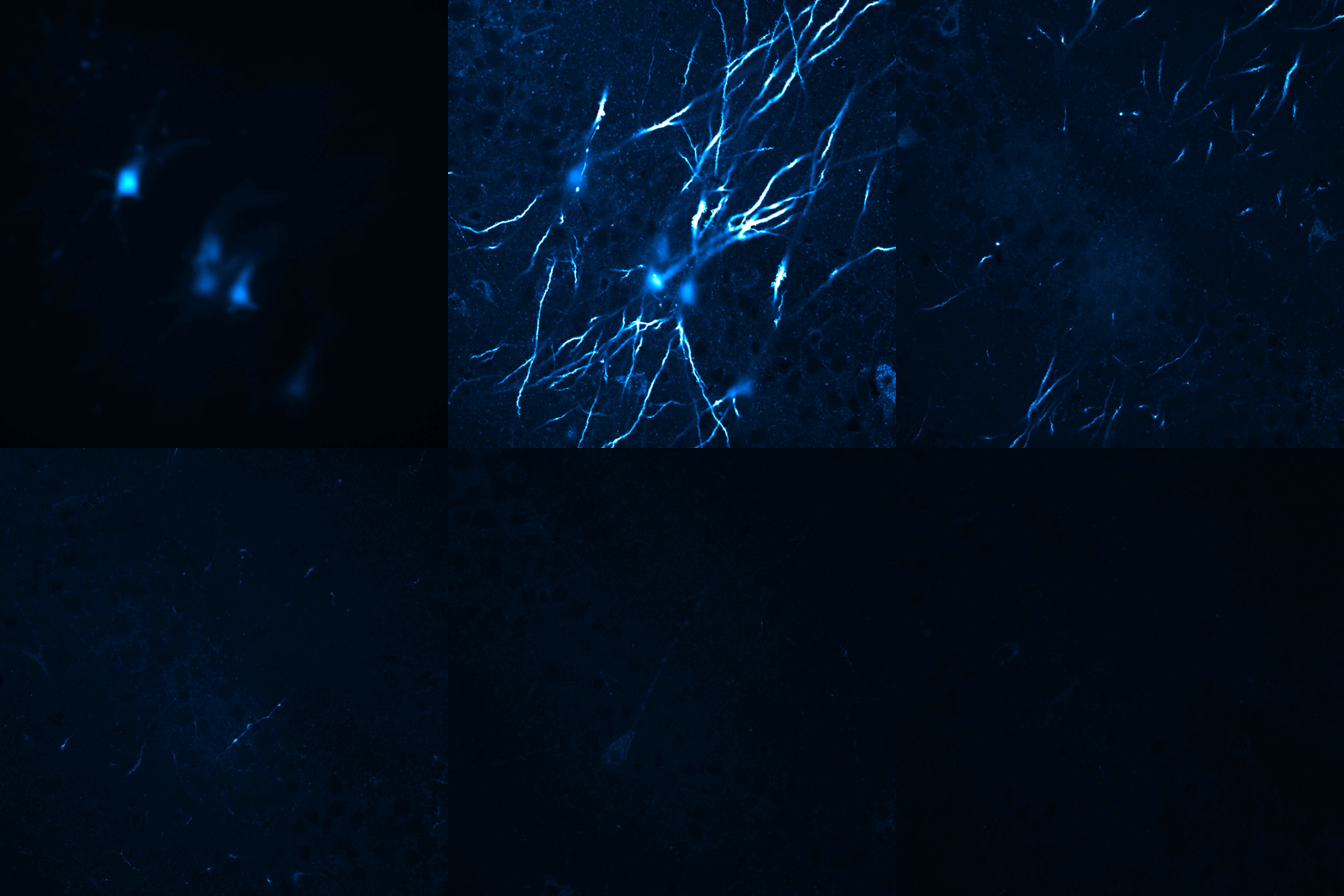
As mice mature, the network within CA3 becomes sparser but more organized (blue) with pruning refining the once-dense web of neural connections.
(Image credit: Vargas-Barroso et al. Nature Communications)
As the brain matures, neurons become more selective and require multiple inputs to fire. The result is more distinct, separate networks that translate to specific and stable memories. So in regard to the inability to recall early childhood, it may be that our earliest memories are too poorly defined to be retained in the long term.
The findings are consistent with a growing body of research on how memory develops, said Hauður Freyja Ólafsdóttir, an assistant professor at the Donders Institute for Brain, Cognition and Behaviour at Radboud University in the Netherlands.
“It’s exciting on multiple fronts,” Ólafsdóttir, who was not involved in the study, told Live Science. “There is plenty of developmental psychology work that suggests that memory becomes more specific with age. And so it’s kind of interesting that now, at the circuit level, we’re also seeing that the connectivity patterns are becoming sparser.”
So what drives brain wiring before birth? That dense, early connectivity may result from a genetically programmed developmental process. Then, after birth, experience refines the wiring, Jonas suggested.
The findings do not rule out the possibility that experiences before birth leave lasting traces in the brain. But Ólafsdóttir thinks those early forms of learning rely on different neural systems than mature hippocampal circuits.
“I’m not disputing that they’re there and that they have influence,” she said, referencing prenatal experiences. “They leave a trace, let’s say, in our brain and probably in our psychology even.” But those traces may not resemble the detailed memories formed later in life.
When asked whether the connections that form before birth represent true memories or are just a byproduct of prenatal development, Jonas said, “The latter is more likely.”
The “full slate” may give the brain a crucial head start by enabling neurons to quickly link different types of information, such as sights, sounds and smells. If the brain began as a blank slate, neurons might be too sparsely connected to find each other, making early communication difficult, the study authors think.
By starting with an overconnected network, the hippocampus may ensure that the necessary wiring is already in place, Jonas theorized.
Vargas-Barroso, V., Watson, J.F., Navas-Olive, A. et al. Developmental emergence of sparse and structured synaptic connectivity in the hippocampal CA3 memory circuit. Nature Communications (2026). https://doi.org/10.1038/s41467-026-71914-x
See how much you know about the most complex organ in the human body with our brain quiz!