




Around 2,400 years ago, more than a dozen Celtic men — possibly warriors — were buried in unusual upright seated positions in what is now Dijon, France, according to a recent discovery of their graves next to a primary school.
The grim find was made by experts with France’s National Institute for Preventive Archaeological Research (Inrap) in 2025 and 2026, the institute announced in a translated statement Wednesday (March 18).
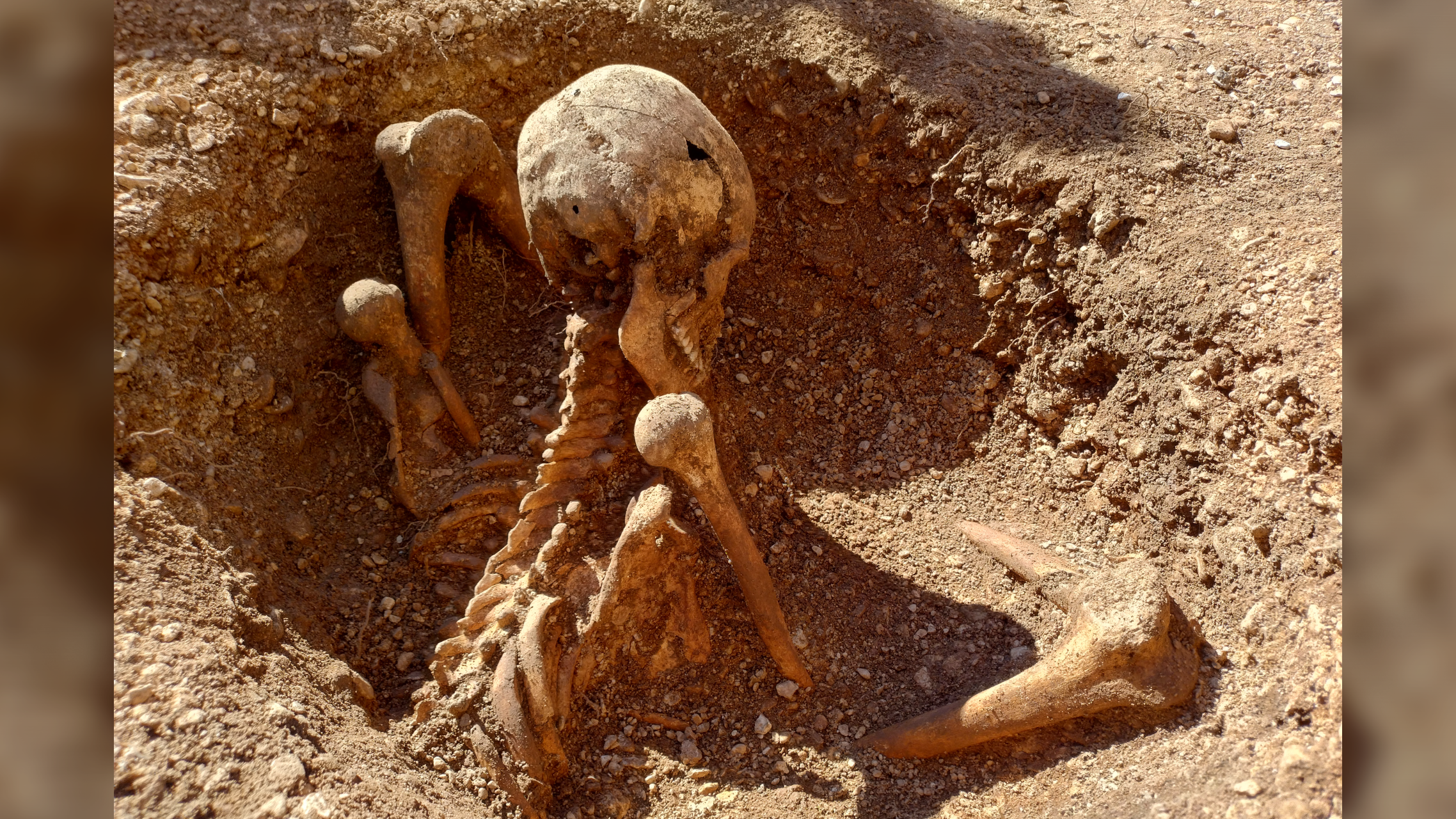
The burials date to the Late Iron Age (450 to 25 B.C.), when the Gauls — a loose association of Celtic tribes — lived in France. Each of the 18 graves had a circular pit approximately 3.3 feet (1 meter) in diameter, and the graves were regularly spaced in two straight lines. The deceased were buried seated on the bottom of the pits, facing west, with their arms resting at their sides and their legs akimbo.
Article continues below
Archaeologists’ initial analysis of the Celtic burials revealed that all of the skeletons were from physically active, healthy men who died at 40 to 60 years old. But unhealed cut marks on several of the skeletons pointed to violent deaths.
One male skeleton was found wearing a black stone armband around his left elbow. The style of the accessory helped archaeologists place his date of death between 300 and 200 B.C. His skull revealed that he had suffered two blows from a sharp object, like a sword. At least five other skeletons had cut marks on their arm bones, possibly meaning they died in some kind of ancient combat.
Seated skeletons are an unusual discovery, according to Inrap. Only about 50 similar burials have been found from a dozen archaeological sites in France and Switzerland, all dated to the Late Iron Age. These burials are often discovered at the edges of settlements and always contain seated or crouching male skeletons, suggesting that only specific people were buried in this way — possibly warriors, important ancestors, or other political or religious elites.
During the same excavation, archaeologists also uncovered a Roman-era cemetery containing 22 infant burials dated to the first century A.D. The children were buried lying on their backs or sides in stone or wooden coffins. Some were given coins or ceramics as grave offerings.
After the Celtic and Roman-era cemeteries were abandoned, farmers used the land for grape growing, and in 1243, the Cordeliers convent was founded there by Franciscan friars. Today, the archaeological site is situated next to a primary school.