



Follow us
Add us as a preferred source on Google
Subscribe to our newsletter
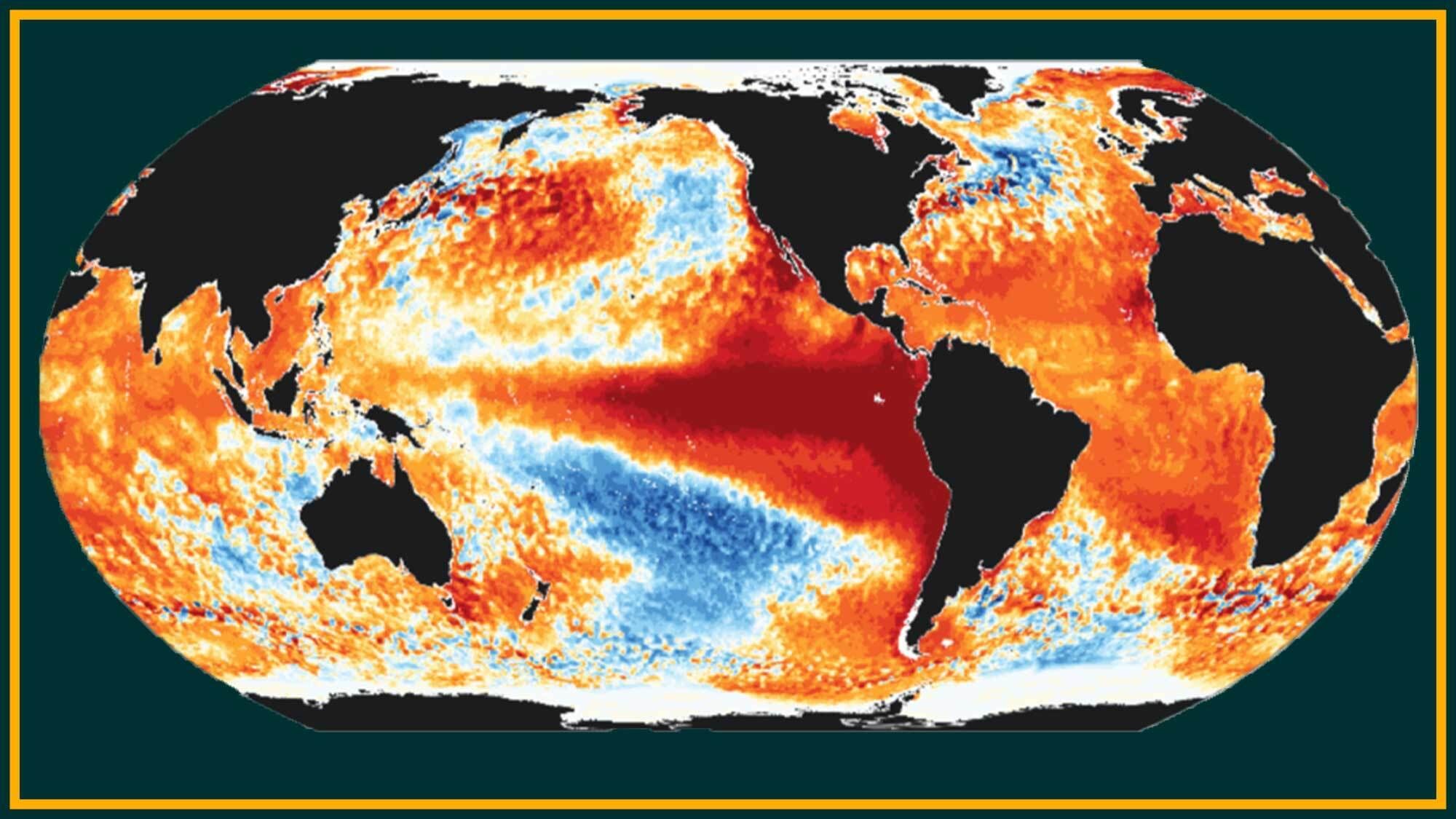
The supercharged El Niño building in the Pacific is likely to make 2027 the warmest year on record, about 3 degrees Fahrenheit (1.7 degrees Celsius) warmer than the late 1800s. At today’s rate of warming, the long-term average will not reach that level until the late 2030s.
We should treat this preview as a test to understand just how big these events can get. That means writing down what we expect now and then learning from what happens, so we can act in time when the next major event hits.
El Niño is a natural swing in the tropical Pacific that’s part of the El Niño-Southern Oscillation (ENSO). During El Niño, trade winds, which normally blow from east to west along the equator, weaken. Warm water spreads east, and heat stored below the ocean surface escapes into the air. The World Meteorological Organization expects the central equatorial Pacific to average about 6.7 F (3.7 C) above normal from October to December this year, against a previous record of about 4.5 F (2.5 C) for a monthly average and 5.4 F (3.0 C) for a single week, both in late 2015.
This is looking to be an extraordinary event with severe impacts. It’s predicted we’ll see widespread extreme weather, including wildfires, droughts and floods in Australia, Africa, Asia and South America. Crop production is expected to fall in major breadbaskets like India and Southeast Asia, disrupting food supplies and driving up prices. One forecast even suggested there could be over 450,000 heat-related deaths by February because of the additional warming from El Niño.
We can use this extreme event to further develop and improve the models we use to forecast strong El Niño events, and to better understand the impacts we’re likely to see. Three findings from one of my ongoing research projects shape how I think we should use this winter.
First, the long-term temperature record we plan with is out of date. Studies have suggested that the Pacific changed in the late 1970s. According to a simple physical model, before 1980, an El Niño that warms the central Pacific above 5.4 F (3 C) was considered a once-in-1,500-year event. From 1980, it became about once in 60 years. This change lies mainly in the ocean, which since 1980 has held on to its extra warmth for about 1.5 years, rather than the 1.1 years it previously did. Plans built on the full historical record may underestimate the next El Niño , so we should be concentrating on models that represent the recent conditions.
Second, El Niño may have a ceiling, and we still need to understand what sets it. Normally the western Pacific is much warmer than the east. That temperature difference is what keeps the trade winds blowing. El Niño grows by weakening those winds, which lets warm water spread east. But as the east warms, the difference shrinks, so El Niño uses up the very thing it feeds on.
You can see this in the chart below. Over the past 76 years, every 1.8 F (1 C) of El Niño warming has shrunk the difference by about the same amount. At that rate, the difference runs out when the central Pacific is about 7 F (4 C) warmer than normal in the autumn months, when El Niño peaks, and as little as 3 F (2 C) in spring. No El Niño on record has gotten there in the season when events still grow. Two events, in 1983 and 1998, did run out of difference, but only in spring, when El Niño fades anyway, and both faded. This year’s event has come closer than any other while still growing: in September it had the least difference left (just 0.6 C or 1.08 F) of any September on record. We will post our prediction before the peak. If El Niño keeps growing after the difference is gone, we are wrong.
The further right a dot is, the stronger the El Niño. The lower it is, the smaller the temperature difference between the warm western and the cooler eastern Pacific. Each grey dot is one month since 1950. As El Niño grows, the dots slide down towards zero, where the difference runs out, at about 6 to 7 F (3.2 to 3.9 C) above normal in autumn and about 3 F (2 C) in spring. No El Niño has gone past that point. This year’s event (red) is the closest yet while still growing.
(Image credit: NOAA ERSSTv5. Figure: Ioana Colfescu, University of St Andrews.)
Third, artificial intelligence (AI) — a tool increasingly used for El Niño forecasts — is not a silver bullet either. In a 2025 study, an AI weather model trained without the strongest hurricanes could not forecast them. We see a similar limit in our El Niño tests. A model that learns only from a record that does not contain a large number of extreme events cannot always say how high El Niño can go. Models that instead build in the physics of an event, such as the east–west difference, are still our best bet for predicting strong El Niño events. The best forecasts this winter are likely to combine the two. So what should we do with this year?
We need to be honest about the limits of our own models. Every forecast of this event — whether a simple physical model, an AI model or a full climate model — is being pushed beyond the range of events it was built and tested on. Where these models disagree, they are telling us where predictability runs out. Ranges of uncertainty are equally important as forecasts, and plans should be made with both in mind.
Crops, rivers, power grids and human bodies respond to the heat they get, whether that heat is caused by an annual fluctuation or a long-term change in climate.
Nations also need to be ready to assess these events, both before and after they occur. In June, the U.K.’s Government Office for Science brought scientists, forecasters and industry experts together. Its findings trace the risks to the U.K. through food, farming and energy, and warn that a very large El Niño “could result in unforeseen effects” on U.K. weather. Assessments like this should be standard for every government. Before the peak, forecasters, health services, utilities and food agencies should publish what they expect, and afterwards assess how the reality compared to the predictions.
Finally, we should improve our models by measuring the event as closely as we can. The buoys, floats and satellites watching the Pacific are recording what may be the largest El Niño of the modern era, and that record will train and test the next generation of models.
None of this works if each group acts alone. National weather services turn forecasts into warnings. People in government, industry and local services know what a failed harvest or a gas shortage costs. Scientists can test where prediction stops working, which is exactly where an event this size sits. These groups should agree before the peak what they will measure and how they will judge the forecasts, and meet again once it has passed.
Exclusive to Live Science Pro
Critics will make two points. The first is that one El Niño year is not a 2030s climate. Its heat, droughts and floods fall in particular places, while long-term warming spreads differently, so the preview does not apply to every region. The second is that the numbers are uncertain. A simple model like ours, an AI model and a full climate model can each give a different ceiling.
Both points are fair, but neither argument weakens the case. Crops, rivers, power grids and human bodies respond to the heat they get, whether that heat is caused by an annual fluctuation or a long-term change in climate. A 3 F annual rise due to El Niño affects those systems in the same way as a 3 F rise due to climate change will, only with less time to adapt. The El Niños of 1982 to 1983 and 1997 to 1998 cost the world economy an estimated $9.8 trillion in lost income between them, according to one study. As for uncertainty, the answer is to run as many simulations with as many different tools as we can, and to treat their spread as the measure of what we do not know. When models disagree, the real event is an excellent test bed to find out which one was most accurate.
This winter, the Pacific will run an experiment we could never run ourselves. Either result will teach us something. If El Niño stops growing where the physics says it should, we gain a way to put an upper limit on the worst case. If it breaks through, the worst case is worse than our records show, and every plan built on those records needs revisiting. By this time next year we will know which model of El Niño came closest — and how well we coped with a year from the 2030s.
Opinion on Live Science gives you insight on the most important issues in science that affect you and the world around you today, written by experts and leading scientists in their field.
Help us improve Live Science Pro: We’re always trying to make our content better. Leave us feedback about Pro here.