




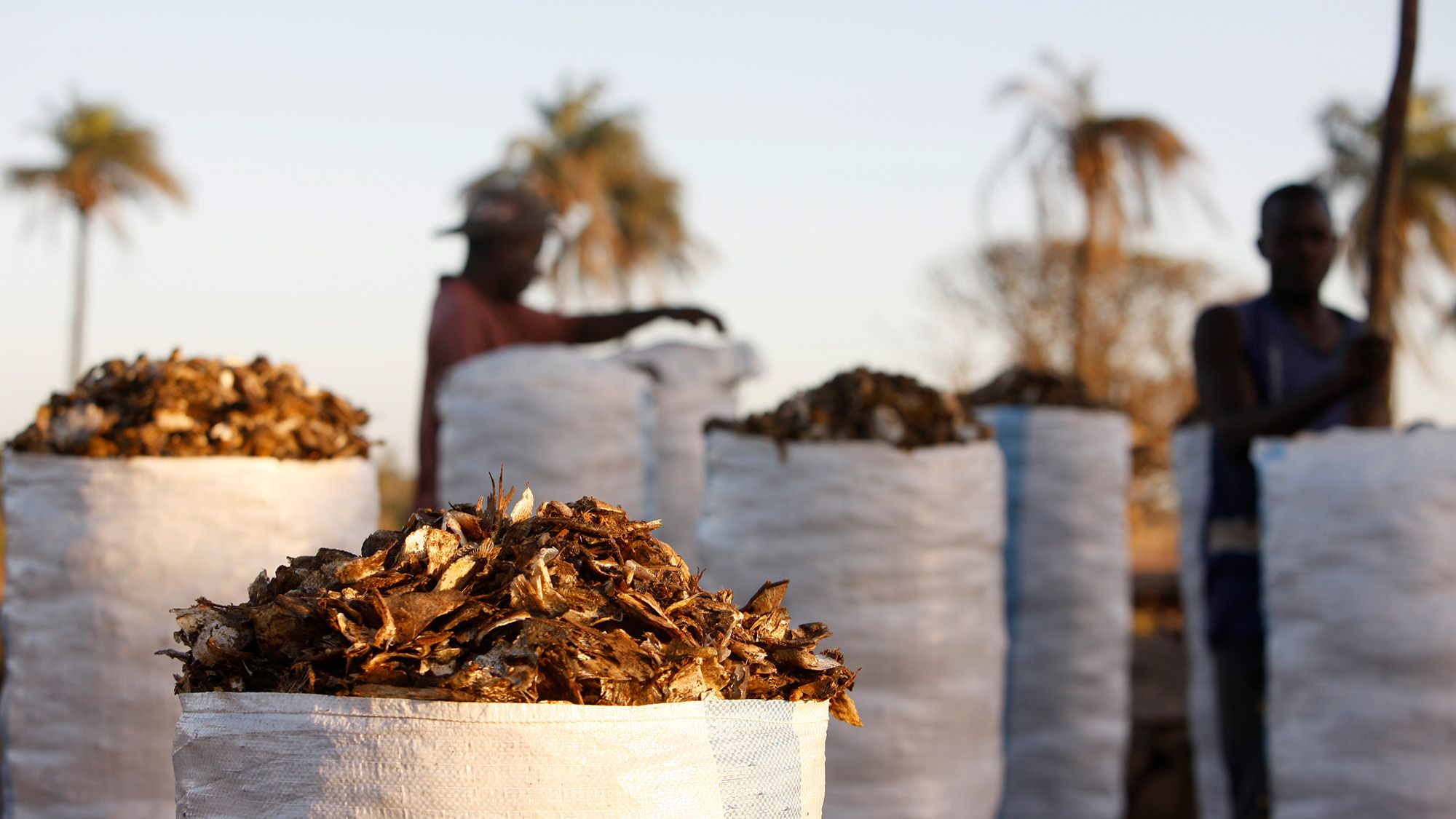

Fish meal is a commercial, protein-rich product created from raw fish and their byproducts, such as the heads and bones. It tends to be made from smaller fish species, including anchovies, sardines and herring. The fish are cooked, dried and ground into a powder, and then used to feed livestock, farmed fish and pets. But it is not a straightforward market.
In this excerpt from “Every Last Fish: A Deep Dive into the World of Fishes and Fishing” (Granta Books, 2025), journalist and author Rose George looks at how vast quantities of staple fish are taken from the sea off West Africa and turned into fishmeal for farming in Europe and China, instead of ending up on the plates of people in Africa.
“Every Last Fish” was short-listed for the 2026 Royal Society Trivedi Science Book Prize.
Rose George interview: ‘If you do want to be a criminal, there is no better place to do it’: Diving into the dark depths of the fishing industry
Take a fish. Eat its flesh if you want, but don’t scorn the rest. It can always be used, one way or another, whether you want fishmeal or face cream.
Products derived from fish turn up everywhere. Guanine, an ingredient produced from fish scales, is found in bath foam, perfume, nail products, shampoo, skincare products, and lipstick. Fishes can become gelatine, glue, and squalene. They can be in your dietary supplements or your glass of wine: isinglass, derived from dried fish air bladders, is used in wine-making.
Futuristic piscigrafts are irrelevant to most people in Senegal, but they still have to deal with the fish by-products industry, because they have to watch as fish they could eat are transformed into the most common and lucrative fish by-products and sent abroad.
Fishmeal is a sandy grubby powder that is worth billions. Minks eat it. Pigs eat it. Cattle eat it. Fishes eat it. It is also an ingredient in fertilizer and pet food. Fishmeal is part of a huge silent industry of fish by-products that used to be known as FMFO (fishmeal and fish oil) and has now been rebranded by the industry association as ‘marine ingredients,’ a vague term that covers a broad range of fish-derived products, most of which are never noticed.
The Food and Agriculture Organization defines fishmeal as ‘the clean, ground, dried tissue of undecomposed whole fish or fish cuttings, either or both, without the extraction of part of the oil.’
Workers loading crates of sardinella into a truck in Senegal.
(Image credit: Bloomberg via Getty Images)
American pets may also find themselves eating fish liver and glandular meal, made from dried complete fish viscera; more general fish by-products, which are ‘non-rendered, clean, undecomposed portions of fish (such as, although not limited to, heads, fins, tails, ends, skin, bone and viscera)’; or condensed fish protein digest, the ‘condensed enzymatic digest of clean undecomposed whole fish or fish cuttings using the enzyme hydrolysis process’.
‘Undecomposed’ is doing a lot of work here, a strange term because unless a fish is caught by a vessel with freezer capacity — which no artisanal fisher has — it will be decomposing for days. In theory, fishmeal is impeccably sustainable. It should be a product made from parts of fishes that would otherwise be discarded. It is because of fishmeal that the term ‘reduction fisheries’ was coined.
Take the meat and the prized flesh, and the rest can be reduced or diverted to other uses. That is the theory. It is not what happens in West Africa.
Each year, half a million tonnes of wild fish are caught in African waters and sent to Europe to feed animals, when they could have fed 33 million Africans instead. That number of people is more than the combined populations of Senegal, Mauritania, and The Gambia. Globally a fifth of wild fishes become fishmeal or fish oil, but 90 per cent of fishmeal fishes are suitable for human consumption.
China uses nearly half of all FMFO, but then China uses most of everything. Europe also takes and takes. Spain imports the most fish oil from Senegal, and France takes 70 per cent of Mauritania’s.
In 2019, Changing Markets Foundation produced a detailed investigative report into the fishmeal industry in India, Vietnam, and The Gambia. In each country, the pattern was similar: first the foreign factories come, then they take the fish, then they pollute the environment, then the fishermen say there are no fish left.

Fishing sustains millions of people in Senegal, yet much of what is caught is exported abroad.
(Image credit: Anadolu via Getty Images)
Although noting ‘a surprising lack of traceability and transparency regarding the origin and supply chain of farmed seafood products,’ the foundation linked plenty of reputable European retailers to FMFO supply chains that may use West African fish. For example: Sainsbury’s, ALDI, Lidl, and Marks & Spencer in the UK; Auchan, Groupe Casino, Monoprix, and Système U in France (that is a full house of big French supermarkets); all the German ALDIs; and Mercadona in Spain. Sainsbury’s, Marks & Spencer, and Mercadona have said they don’t use West African FMFO in their seafood products, but how will they know?
The European Union’s IUU [Illegal, Unreported and Unregulated fishing] regulations, which require a catch certificate or similar to show the fish was legally caught, do not cover fishmeal. In Mauritania, some Chinese-owned fishmeal factories have their own trawler fleets. The fish bypasses human mouths and goes straight to the factory. That is one tactic. The other is to outbid.
Exclusive to Live Science Pro
The fish processors tell me that they cannot compete with the prices that fish factories will pay for sardinella. Fish processors get no subsidies from the government, unlike Chinese fishing companies. In The Gambia, one fishmeal factory used 40 per cent of the country’s entire fish catch in one year. Black and white. White stealing from Black. The villain/victim template seems neat and unassailable.
It is true — Europeans are using fish that West Africans could eat — and yet it is not all the truth. In Senegal, The Gambia, Mauritania, local fishermen supply fishmeal factories because the factories pay better. In Senegal, a fisheries union official tells me that there are too many pirogues. They are chasing smaller and smaller fish to sell to the factories. It is unsustainable.
The website of the IFFO, which used to stand for International Fishmeal and Fish Oil Organization and now somehow is short for the Marine Ingredients Organisation, is plain. Marine ingredients ‘play an essential role in global food security’.
Rubbish, said Francisco Marí of Bread for the World at the CAOPA [African Confederation of Professional Organisations of Artisanal Fisheries] workshop. ‘It’s just for prawns and salmon — they are not necessary foods; it’s a luxury. It’s not enough for us to have 10—15 per cent of fish to feed salmon and prawns. Indirectly, we are eating your fish. It’s not essential for the alimentation of the US or Japan. We are taking your fish to feed a luxury product that we don’t need.’
Every Last Fish: A Deep Dive into the World of Fishes and Fishing by Rose George is published by Granta
Help us improve Live Science Pro: We’re always trying to make our content better. Leave us feedback about Pro here.

Oneworld Publications
Every Last Fish: a Deep Dive Into Everything They Do for Us and We Do to Them
In Every Last Fish, Rose George dives into these questions by exploring the vast industries that support our appetite for fish sticks and salmon burgers, and the colossal illegal fishing trade whose practices and standards are unmonitored and often dangerous. Journeying to the bottom of the ocean and back, she examines the machinations of this $200 billion food system — one that’s growing rapidly even as fish populations disappear.