




Long before Neil Armstrong piloted the first crewed lunar lander onto the moon and uttered his now-famous words “The Eagle has landed,” there were grave concerns that any craft attempting to land on the moon would be swallowed up by an unforgiving ocean of dust.
“It would have been one of the most anticlimactic and horrific moments in history,” radio astronomer Emma Chapman, an astrophysicist at the University of Nottingham in England, told Live Science. “And I doubt the space program would have continued.”
Luckily, radio astronomy existed. By the 1960s, scientists knew the moon was not made of quicksand (or cheese, for that matter) because radio astronomers had been mapping it for decades by bouncing invisible particles of light off of its surface and then studying the slightly altered light that returned to their receivers on Earth. In this way, it was radio astronomers who made “first contact” with the moon, Chapman wrote in her new book, “The Echoing Universe: How Radio Astronomy Helps Us See the Invisible Cosmos” (Basic Books, 2026) — making the dream of the Apollo era possible.
But it’s not just the moon. From probing violent supernovas to sending peaceful messages to (hypothetical) intelligent aliens, radio astronomy touches every murky and mysterious corner of the universe. In her new book, Chapman briefly peels back the dark shroud of the optical universe to give us a rare view of the invisible beauty beneath. Live Science recently spoke with her about her book, the benefits of radio astronomy, and why she’s optimistic that extraterrestrials are waiting for us to answer their call.
Brandon Specktor: If human eyes could see radio light, what would the sky look like by day and by night?
Emma Chapman: If you had radio eyes, the sun would all but disappear. And the moon would always look full.
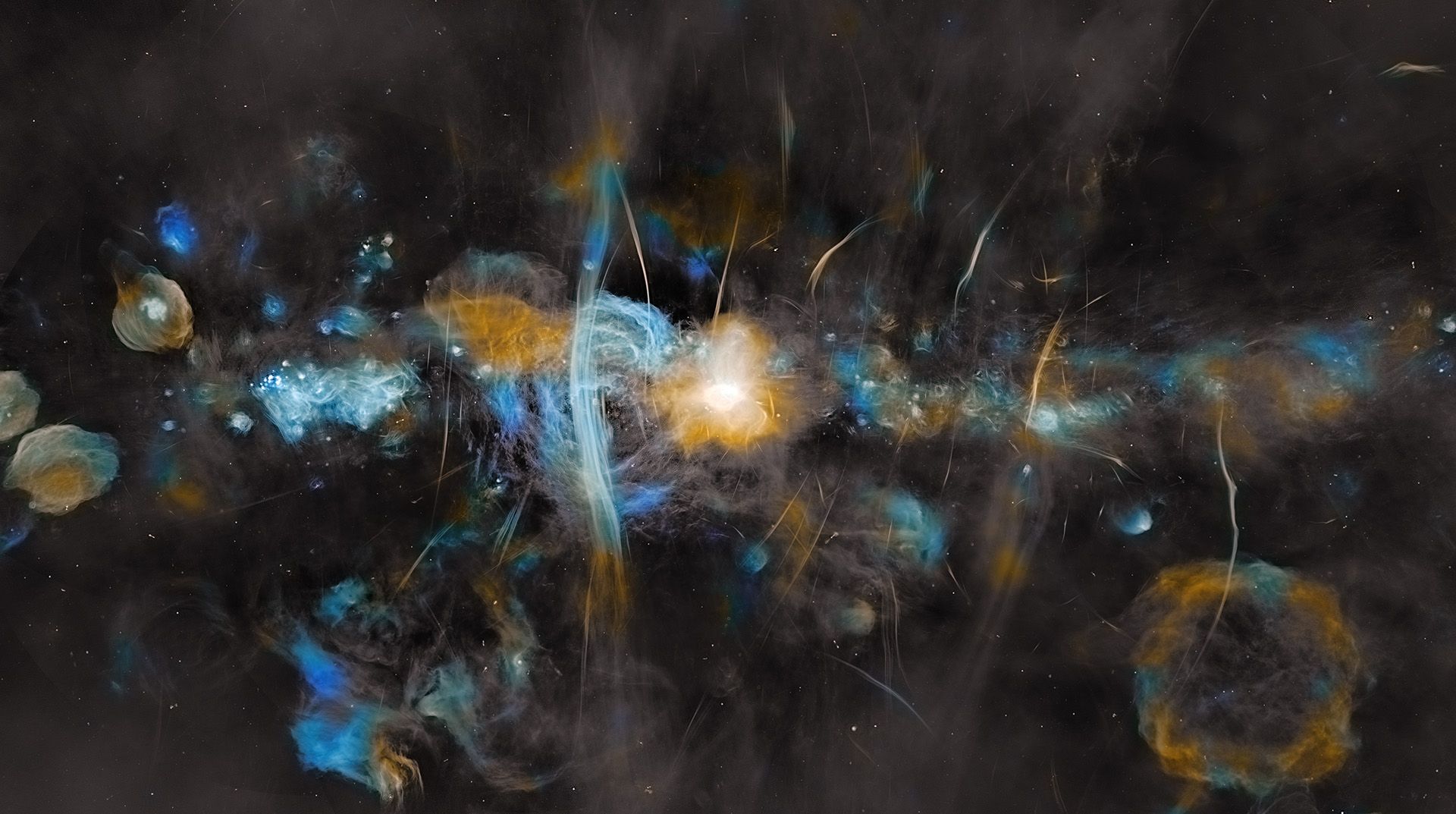
You would just see a swath of galaxy — like the Milky Way at night in a very dark location, but much brighter. You’d be seeing the gas, not the stars. The way I like to think of it is, if you had a black sheet of paper and you had pinpricks letting light in from the other side, that’s kind of what you see with your optical eyes and the pinpricks of the stars. But the radio world is reversed, and you see the scaffolding, all of that gas. And so it’s like seeing in between all of it.
Get the world’s most fascinating discoveries delivered straight to your inbox.
All of that seemingly empty space suddenly fills up, and you see, for example, big lines, which are magnetic-field lines. You see spinning stars that have been kicked out of their own individual solar systems. You see them running; you see their trails. You see supernovae — exploding stars — and you see the shells of those stars kind of expanding very, very slowly.
And at nighttime, you’d see something exactly similar. And that’s the point — because you do not need the sun to go down to do radio astronomy.
BS: It’d probably be a little overwhelming to see all that, all the time.
EC: I mean, can you imagine? Even in this room, I’d be seeing all of the text messages and the Wi-Fi signals and the radio stations. … It would be horrendous. Like, thank God nobody can sense these things in any way. That’s the wonderful thing about radio signals: They just pass straight through, and nobody’s wiser.
BS: In your book, you write that radio astronomers made “first contact” with the moon long before the Apollo astronauts actually landed there. How do radio waves help us explore the moon?
EC: I watched Artemis II launch live, and I was as overwhelmed as every other space fan. I’m a huge proponent of space exploration. I recognize it’s hugely expensive — but it’s worth it. And it’s also quite dangerous. It takes some very brave people to do that.
What you can do with radio astronomy, and what we did in the 1950s, was we can send photons instead. We can use a big antenna to send little packets of radio light to the moon, and it takes about 1.5 seconds for them to get there. They bounce off the surface of the moon, it takes 1.5 seconds to get them back, and we’ve barely had time to blink. And the way in which that light has changed — for example, its intensity or its polarization, which we can think of as the direction that the light is traveling — can tell us something about the surface of the moon, or the shape of it, or what it’s made of.
We can also do an active form of astronomy where we send [radio waves] with a radar. Why this is important now more than in the Apollo era is that this form of astronomy can dig. And it can get into every crevice and cranny and cave on the lunar surface, bounce around, and basically give you an underground scan.
A view of the moon in optical and radio light during a lunar eclipse. Even in the deepest part of Earth’s shadow, the moon still emits a constant glow of radio light.
(Image credit: ALMA)
Now it’s very early days, it’s still quite a crude technology, but you can get underground scans of lava tubes on the lunar surface. That’s important because Artemis IV, and any missions after where humans stay on the moon for any length of time — they need to know where the hell to run if there’s a big solar storm. With just a few seconds of radio astronomy, you can start getting an idea of where are the best places to land and where are the best places to build long-lasting human settlements.
BS: NASA is talking about building a radio telescope on the far side of the moon. Why would that be useful?
EC: I have major skin in the game in this one, so a big personal bias. But the reason that you’d want to put a radio telescope on the far side of the moon is because Earth is getting really noisy with radio waves, and has been for many, many, many, many decades. But with Starlink, it’s gotten really noisy. And radio waves are very, very faint. So we need the quietest place in the solar system to listen, and that is the far side of the moon.
Even on the moon, it’s getting noisier very quickly, which is concerning. But there are plenty of very good, exciting plans. Do you know Arecibo, the big 300-meter [980 feet], beautiful dish set in the Puerto Rican jungle [until it collapsed in 2020]? One idea is to use a moon crater instead of a dish, like Arecibo. So to fly up just a few incredibly lightweight boxes, basically, which autonomously land at the side of the crater, unfurl copper wire, which is like the big antenna that’s going to receive all the light, and the crater acts as a dish, focusing the radio light and gathering huge amounts of it.
Now, that’s just utterly cool. And I think that could easily get funded. I could easily see it happening within a decade, which is very short for a space mission.
BS: You said the moon is getting noisier. How?
EC: Because a lot of people are going up there — for example, Artemis and all of the other national space agencies are sending exploratory probes. China is landing; India is landing. All of these landers and probes need to communicate with their owners on Earth. And to do that, you need a relay satellite orbiting the moon, and then relaying, amplifying and transmitting radio signals back to Earth — and that’s bloody noisy. It’s like having a radio antenna for the national news next to your house.
BS: That’s an unfortunate paradox of space exploration: The more space infrastructure we build, the more noise we introduce into observations.
EC: Yeah, but I think there’s a middle ground. I’m not completely against satellite constellations like Starlink. I think they do wonderful things for equalizing Wi-Fi access across developing countries. I think it’s fabulous for that. My argument is always: OK, but why do we need a million satellites from 10 different companies? Why can’t we work together a little bit more? Because it does cause environmental damage.
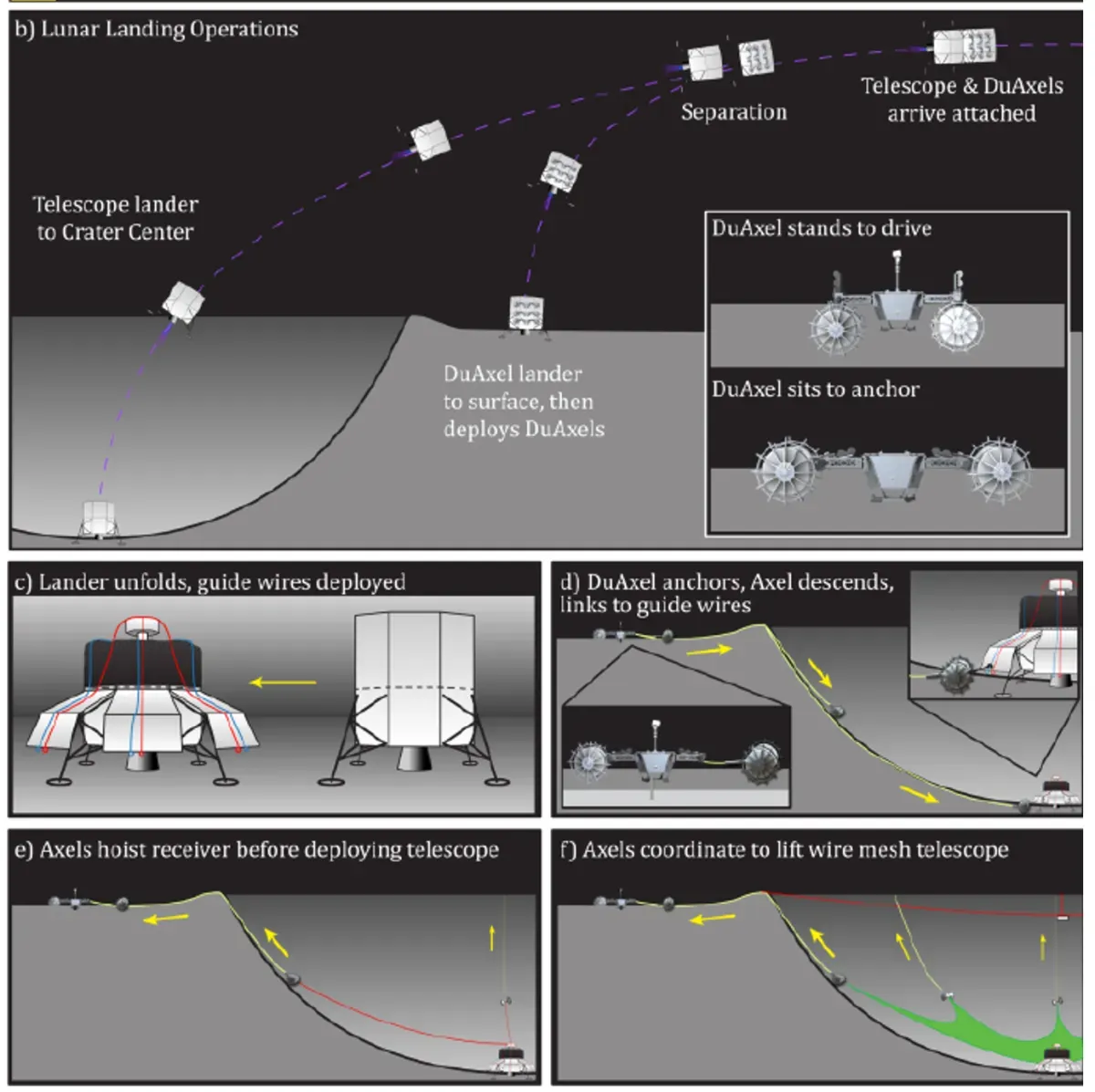
A rendering of one possible plan for a radio telescope on the moon. Using a large crater as a natural dish, the telescope would mimic the now-defunct Arecibo Telescope in Puerto Rico.
(Image credit: Saptarshi Bandyopadhyay)
I wish more people would consider space and the exploration of it as our environment, and we need to do it in a sustainable and ethical fashion. Does that mean profits can’t still be made? No, it means that we’re balancing it, just as we balance profiteering on Earth.
We don’t always get that right — by a long, long, long way — but there are laws. So I’m willing to lose a percentage of my radio data from the far side of the moon in order to further space exploration. But can we just work together to make sure it’s not all of the data, please?
BS: The search for extraterrestrial intelligence (SETI) is arguably the most famous use of radio astronomy. Where does SETI stand today?
EC: I think it’s a very patient search. SETI scientists are some of the most patient and reflective scientists I’ve met. They know very well that this is a very long experiment. This is an experiment where we are relying on an external party to have made that communication and guessing where in the sky that communication has come from and when. That’s very, very difficult.
And the more dishes, the more telescopes, the more wavelengths that you can scan at once, the faster you can create a survey, which really ups the probability of us picking up the phone just as somebody calls. But it’s a numbers game. That’s what fascinates me with this area, is that it could be this afternoon. It could be 6 p.m. this afternoon that this happens, or it could be in 200 years. It depends on us looking at the right place at the right time.
BS: Do you personally think there is extraterrestrial intelligence out there?
EC: Yes, I do. I think more and more now, we’re seeing that almost every star like the sun has multiple planets. We are finding more and more planets that are a whisker away from being within the habitable zone, and we haven’t even got the telescopes that are perfectly tuned for finding those perfect habitable zone planets. Soon, I think we’ll start finding habitable planets everywhere we look when we get those more powerful telescopes.
And then it comes down to the fact that physics is the same everywhere. And so any intelligent life that does form is going to want to communicate over long distances. How do they do that? Radio waves. OK, but radio waves can escape the atmosphere. Brilliant! That means that they don’t even have to want to contact us; they are leaking radio waves, just like we are leaking radio broadcasts. It would take an enormously powerful antenna to pick it up, but it is within the realm of possibility.
But to be very clear, do I believe there has ever been a visitation from an extraterrestrial intelligence? Absolutely not. No respected SETI researcher does.
BS: What if the call does come tomorrow? Say we get a radio signal from a billion light-years away and we’re able to confirm it’s some kind of alien message. Where do we go from there?
EC: Yeah, I don’t know. I mean, there are protocols within individual collaborations of scientists. So first of all, a load of scientists is going to check their answer. So, if they hear something funny, they’re going to check that it’s repeated. They’re going to check that nothing in nature as we know it could create that, and then they’re going to work out whether there is a planet from that area.
“That means that they don’t even have to want to contact us; they are leaking radio waves, just like we are leaking radio broadcasts. It would take an enormously powerful antenna to pick it up, but it is within the realm of possibility.”
Emma Chapman, radio astronomer
But if they’re now at the point where we think this is intelligence, then I’m not sure. Would they have to let the president know first? Would they have to put it on Facebook? Like, can you even imagine if they were like, “You know what? We’re going to really troll the government, and we’re just going to subtly drop an Instagram reel.”
And then the question is, what would we do? Like, what would you do? Would you riot? Would you panic? Would you call your partner? Would you bring your kids home? Would you be like, “Hey, that’s cool,” and get on with your day? I don’t have an answer.
BS: It would change everything — and yet we still have to go on being humans here on Earth.
EC: Yeah, and to be more serious, I think there would be a huge responsibility on every capable science communicator out there. Because anybody without an understanding of this area would quite rightly start to think, “Oh my God, it’s ‘Mars Attacks!’”
But let’s say it comes from one of the closest kinds of habitable planets, 70 light-years away. OK, so they sent that message 70 years ago. And anything that we could send back is going to take 70 years to get there. This is not something which could happen in a human lifetime, and the aliens certainly just can’t rock up suddenly, unannounced — because, again, physics is the same everywhere. We can’t create the kind of technology to have warp drives or the energy required for that. Stars output the same amount of energy everywhere. I don’t want to close my mind off completely to physics that I have not come across yet, but the likelihood is, they’d never visit.
We’d become pen pals at most. That’s a crazy idea: just really long-distance pen pals. It takes like a whole generation to send and receive one message. Imagine if we were like, “Hey, guys, have you worked out nuclear fusion, because we’ve got a really big energy crisis right now,” and it’d be like 70 years along the line, and then we’d get an answer like, “Oh, we hadn’t actually worked it out yet. Thanks!” That would be amazing.
Editor’s note: This interview has been condensed and edited for clarity.

Basic Books
The Echoing Universe
In The Echoing Universe, Emma Chapman tunes us in to the universe and what it is trying to say, through the science of radio astronomy. Everything is sending out signals: the surface of the Moon, distant stars—maybe even extraterrestrials. With radio waves, we can uncover what visible light cannot show us and peer into realms that are otherwise unreachable. Even the hostile surface of Venus, where high temperatures, lethal acid rain, and crushing pressure rapidly annihilate even the hardiest robotic probes, yields its secrets through radio observations.