





Millions of Americans are diagnosed with common conditions like cancer and diabetes — but some 10% of the population live with rare diseases that doctors often struggle to diagnose. On average, those with rare diseases will spend five to seven years searching for answers and see 12 specialists before they arrive at a diagnosis.
In the process, they may be subject to incorrect, ineffective or even harmful treatments.
“Any medicine that you prescribe has a one-third chance of working, a one-third chance of doing nothing, and a one-third chance of hurting you,” said Dr. Ada Hamosh, a geneticist and the center director for the Johns Hopkins Medicine-Kennedy Krieger Institute National Organization for Rare Disorders (NORD) Rare Disease Centers of Excellence Network. “I do not want to understate this: The right diagnosis is unbelievably powerful, even if you can’t do something.”
Danielle Carnival, CEO of the Undiagnosed Diseases Network Foundation, says that thanks to advanced genetic testing we are now understanding much more about rare and ultra-rare diseases.
(Image credit: Danielle Carnival)
Emerging data suggests that genetic testing could speed the diagnosis of rare conditions, which each affect fewer than 200,000 people in the United States. If employed widely, such testing could help diagnose the majority of rare diseases, most of which are genetic in cause, experts told Live Science.
“Now, with the wide availability of vast, somewhat inexpensive, genetic testing and whole genome sequencing available, we’re really at the point of understanding a lot more about these rare and ultra-rare diseases,” said Danielle Carnival, CEO of the Undiagnosed Diseases Network Foundation (UDNF), a nonprofit supporting patients with rare and undiagnosed diseases.
“And then hopefully, that turns into the ability to treat them,” she told Live Science.
Uncommon disorders, many patients
Researchers have documented more than 10,000 rare diseases and less than 5% of them have a treatment approved by the U.S. Food and Drug Administration. On average, 250 new rare diseases are discovered each year, Hamosh said.
Although each individual disease affects relatively few people in the population, collectively, they are not rare. In the U.S. alone, it is estimated that there are more than 30 million people living with a rare or undiagnosed disease.
We joke about this in the undiagnosed disease world: We are the only people who are consistently praying for positive test results.
Kelly Kemper, mother of a child with an undiagnosed disease
“So many people know someone living undiagnosed or with a rare or ultra-rare disease, even if they don’t know it,” Carnival said.
About 80% of rare diseases are genetic in origin, while the other 20% are caused by environmental factors, such as a toxin exposure or viral infection, said Emily Glanton, a genetic counselor and associate director at the Undiagnosed Diseases Network Data Management Coordinating Center, a central hub for the National Institutes of Health’s Undiagnosed Diseases Network.
There’s a lot of overlap between rare and undiagnosed diseases, but they’re not always the same. Some undiagnosed diseases can be unusual manifestations of common conditions, such as long COVID, or alternatively, they may be common conditions that doctors frequently struggle to diagnose, like endometriosis. Still, it’s thought that up to 50% of people with rare diseases are undiagnosed.

Emily Glanton, a genetic counselor and associate director of Undiagnosed Diseases Network Data Management Coordinating Center, estimates that 80% of rare diseases are genetic in origin.
(Image credit: Emily Glanton)
“We certainly don’t have a way to know [exactly] how many people have a disease that we haven’t even discovered the name or cause of,” Dr. Jacqueline Harris, a pediatric neurologist and director of Kennedy Krieger’s Epigenetics Clinic in Baltimore, told Live Science.
Patients sometimes miss out on a diagnosis because clinicians are unable to piece together their symptoms and clearly link them to one condition. Such patients may receive multiple distinct diagnoses over time.
“A lot of times what happens with undiagnosed patients is that they end up with a little bit of a diagnosis. And I always say, it’s like the umbrella is missing. We’ve got lots of little rain hats or visors on, and those are the diagnoses,” said Kelly Kemper, whose son has an undiagnosed disease and who is a member of the UDNF patient advisory council. “But we don’t have something overall that says: ‘Okay, this is what it is.'”
Isolating experience
Searching for a diagnosis can be an isolating, frustrating experience.
Kemper, for instance, has spent the last five years looking for an explanation for her son’s rare form of dystonia, which causes muscle spasms. He still doesn’t have a diagnosis.
“We joke about this in the undiagnosed disease world: We are the only people who are consistently praying for positive test results,” Kemper told Live Science.
Negative test results can be a relief, but it can be frustrating when doctors and specialists can’t explain what’s going on. Hearing the phrase “your labs look normal” often invalidates the symptoms a patient is experiencing, she added.
So often, the answers to diseases that impact more people start with understanding these very specific mutations or environmental impacts or immune responses in very few.
Danielle Carnival, CEO Undiagnosed Diseases Network Foundation
And though this process of elimination rules out conditions her son does not have, it doesn’t always feel like they’re getting closer to something that can be named, she said. There have been specialists who have also refused to see her son because they don’t know what else to try.
“There was, like, a little bit of hope that you’re gonna see the specialist and then they decline the appointment,” Kemper said. “That’s a hard one.”
Between a multitude of doctor appointments and insurance claim denials because no diagnosis has been made, the journey has been isolating, Kemper said.
The promise of genetic testing
The American College of Medical Genetics and Genomics (ACMGG) recommends genetic testing for patients with congenital anomalies — meaning birth defects — before age 1, as well as those who have any developmental delay or intellectual disability that was recognized in childhood. ACMGG recommends both exome sequencing, in which all the genes that code for proteins are examined, amounting to approximately 2% of our DNA, or whole genome sequencing, in which every letter of DNA is sequenced, as first-line genetic testing, Glanton told Live Science.
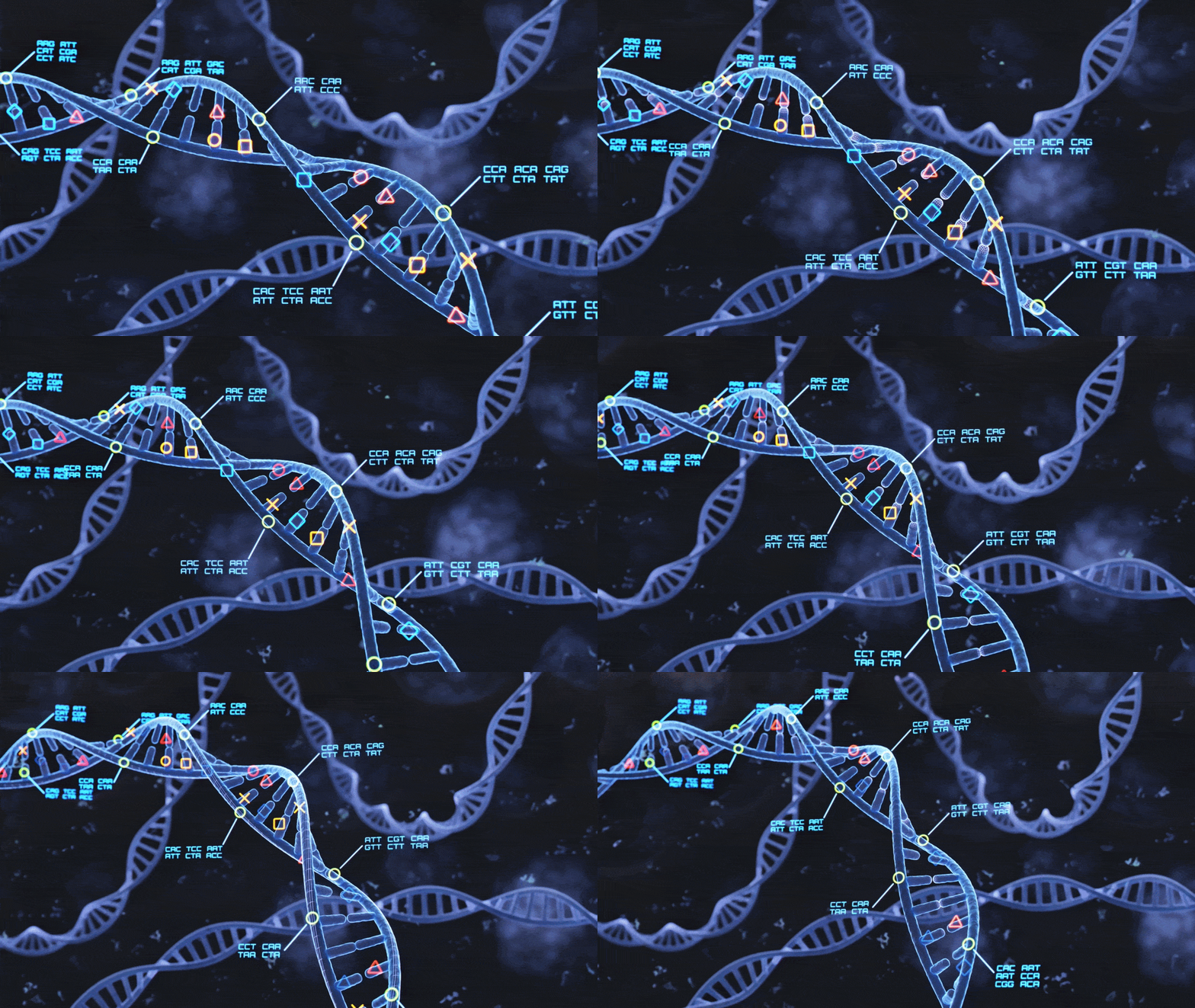
Genome and exome sequencing are recommended as first-line testing for people who have congenital anomalies or who have developmental delays that were first recognized in childhood.
As of yet, there are no clinical guidelines surrounding exome and genome sequencing testing for people with undiagnosed and rare diseases.
To help solve some of these medical mysteries, research groups such as the Undiagnosed Diseases Network have partnered with 24 clinical centers across the country to test new diagnostic technologies.
In late 2025, the network evaluated over 3,000 patients with undiagnosed diseases and ultimately diagnosed 30% of them. Getting to answers involved several strategies: whole genome sequencing; model organisms screening, in which scientists use DNA from flies, worms and zebrafish to find gene variants that might be tied to disease; and RNA sequencing, which reveals which genes are active in different cells.
Additionally, the network also frequently utilized trio genetic testing, in which both patients and their biological parents are tested to see which gene variants they carry.
The findings suggest that at least some of these undiagnosed diseases can be diagnosed with a comprehensive suite of genetic testing.
Limits of testing
But genetic testing isn’t a silver bullet. After all, the network found diagnoses for less than one-third of the patients whose cases they evaluated.
A 2025 study that looked at 400 undiagnosed patients with a range of symptoms found that exome and whole genome sequencing were likelier to help for neurological symptoms, whereas patients with a complex presentation of symptoms are likelier to go undiagnosed despite these tests. Other research suggests that exome or genome sequencing that includes family members has a better success rate than testing only the affected individual.
Exclusive to Live Science Pro
And crucially, diagnosis is just the first step.
“We don’t want to stop at a diagnosis. We really want to build a bridge for folks to be on a pathway to get a treatment that works for them,” Carnival told Live Science. That wouldn’t just benefit the patients themselves, it may also provide benefits for the wider community, she added.
“So often, the answers to diseases that impact more people start with understanding these very specific mutations or environmental impacts or immune responses in very few [people],” Carnival said. “The knowledge that’s generated really tells us a lot about the systems of the body and what goes wrong in even broader diseases.”
Editor’s Note: This article was produced as part of the Dalla Lana Fellowship in Journalism and Health Impact program at the University of Toronto.
Help us improve Live Science Pro: We’re always trying to make our content better. Leave us feedback about Pro here.