

Close Menu
  • Home
  • United States
  • World
  • Politics
  • Business
  • Lifestyle
  • Entertainment
  • Health
  • Science
  • Tech
  • Sports
  • More
    • Web Stories
    • Editor’s Picks
    • Press Release

Subscribe to Updates

Get the latest USA news and updates directly to your inbox.

What's On
13-Year-Old Arizona Girl Missing for Decades Found Alive 30 Years After Disappearance

13-Year-Old Arizona Girl Missing for Decades Found Alive 30 Years After Disappearance

April 2, 2026
Phil Mickelson pulls out of 2026 Masters due to ‘personal health matter’

Phil Mickelson pulls out of 2026 Masters due to ‘personal health matter’

April 2, 2026
Thousands of power strips sold on Amazon recalled due to ‘serious’ fire risk

Thousands of power strips sold on Amazon recalled due to ‘serious’ fire risk

April 2, 2026
Facebook X (Twitter) Instagram
Trending
  • 13-Year-Old Arizona Girl Missing for Decades Found Alive 30 Years After Disappearance
  • Phil Mickelson pulls out of 2026 Masters due to ‘personal health matter’
  • Thousands of power strips sold on Amazon recalled due to ‘serious’ fire risk
  • ChatGPT owner OpenAI acquires technology talk show TBPN in surprise move
  • Eric Swalwell raids retirement, delays tax payments as he runs for California governor
  • Leavitt slams Politico over report previewing Trump’s speech on Iran
  • MGK Shares Glimpse of His and Megan Fox’s Daughter While Celebrating Her 1st Birthday
  • Simply no truth to ‘bogus’ Brandon Nimmo-Francisco Lindor rift rumor
  • Privacy
  • Terms
  • Advertise
  • Contact Us
Join Us
USA TimesUSA Times
Newsletter Login
  • Home
  • United States
  • World
  • Politics
  • Business
  • Lifestyle
  • Entertainment
  • Health
  • Science
  • Tech
  • Sports
  • More
    • Web Stories
    • Editor’s Picks
    • Press Release
USA TimesUSA Times
Home » The remains of children from ancient Vietnam may challenge theories about origin of syphilis
The remains of children from ancient Vietnam may challenge theories about origin of syphilis
Science

The remains of children from ancient Vietnam may challenge theories about origin of syphilis

News RoomBy News RoomApril 2, 20260 ViewsNo Comments

Archaeologists in Vietnam have made a discovery that could rewrite scientists’ understanding of where syphilis originated.

The team found the Stone Age skeletons of three people who had a debilitating bacterial disease that left marks on their bones and teeth. This disease is in the same family as syphilis, and the discovery of it in prehistoric Vietnam could challenge the idea that syphilis-like diseases originated in the Americas.

In a study published March 13 in the International Journal of Osteoarchaeology, the researchers documented three cases of congenital treponematosis at two Neolithic sites in Vietnam dating to around 4,100 to 3,300 years ago. Treponemal diseases are a group of infections caused by the bacterium Treponema pallidum. These diseases, caused by different subspecies of the bacterium, include syphilis, bejel and yaws.


You may like

For decades, researchers believed that of these diseases, only syphilis could be spread through congenital transmission, meaning from parent to child during pregnancy, study first author Melandrie Vlok, a lecturer in anatomy and physiology at the Charles Sturt University, told Live Science in an email. The assumption has been used to back the claim that syphilis originated in the Americas, after previous research found that 5,500-year-old remains of children carried bacteria related to syphilis alongside signs of congenital infection, Vlok said.

But importantly, “none of this DNA is actually syphilis,” she noted. This distinction matters as evidence of congenital infection by the bacteria has long been seen as evidence of syphilis itself.

“Our new research flips the script,” Nicola Czaplinski, a doctoral candidate in health sciences at the University of Notre Dame Australia, said in an email to Live Science. According to their findings, “congenital transmission isn’t unique to syphilis.”

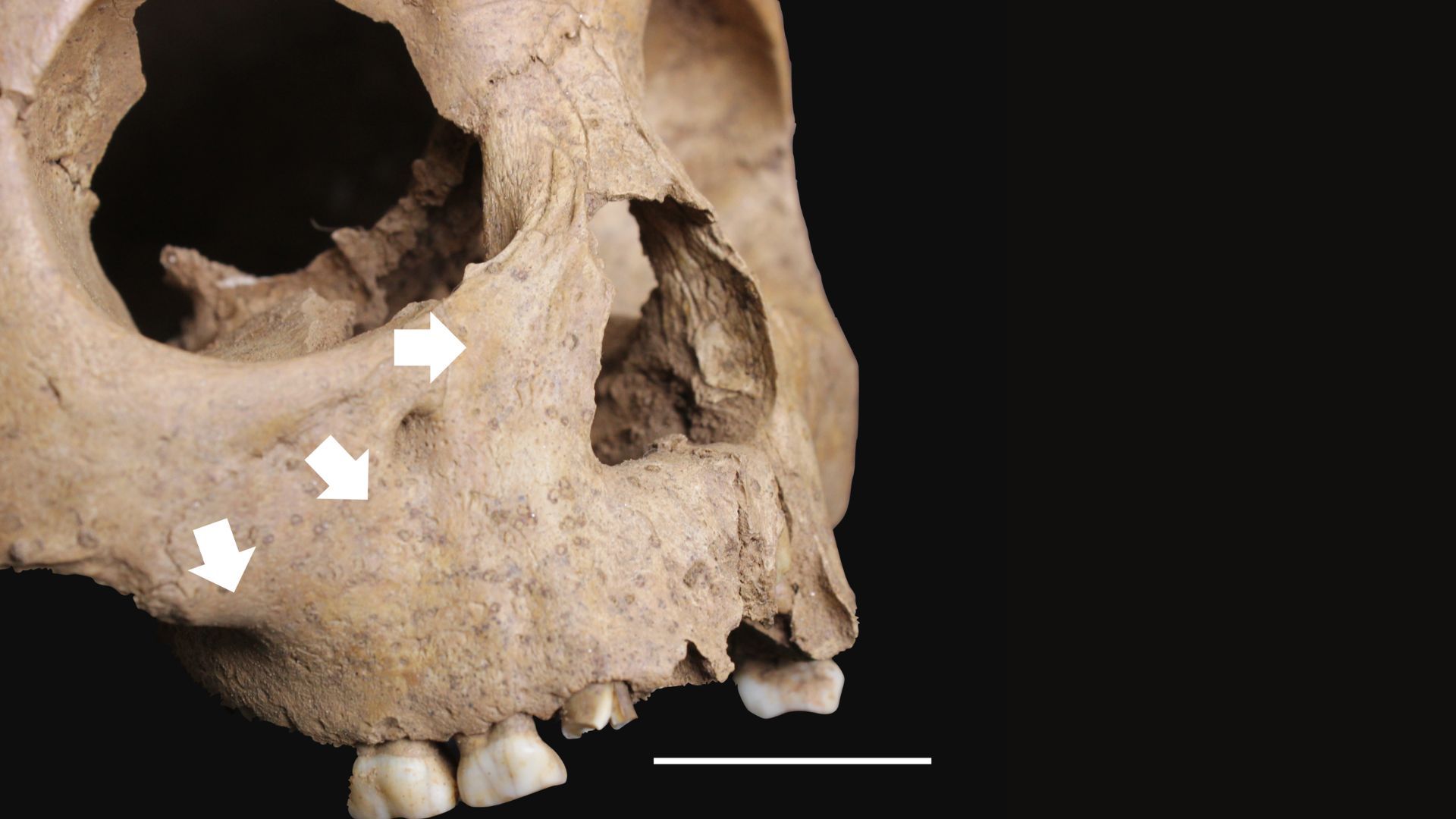
Tooth and skeletal lesions consistent with congenital treponemal disease from an 18-month-old child from Man Bac, Vietnam. (Image credit: Vlok et al. 2026, CC BY-NC 4.0)

Three children from neolithic Vietnam

While scientists have long debated where treponemal diseases originated, only one other study had investigated the question in Vietnam.

Get the world’s most fascinating discoveries delivered straight to your inbox.

That study included cases that dated to the early agricultural transition, around 4,000 to 3,500 years ago. It focused on Man Bac, a site dating to around 4,100 to 3,300 years ago in northern Vietnam, and found that over 10% of the buried people examined had markings on their bones and teeth consistent with treponematosis. Most of those affected were young children and adolescents.

The new study looked at 16 sites across Vietnam, including Man Bac, and examined a total of 304 individuals dating from 10,000 to 1,000 years ago. It found evidence of congenital treponematosis in three children. Two individuals, aged 18 months and 5 years old, were identified at Man Bac, and a third individual from An Son, dating between 3,900 and 3300 years ago, in southern Vietnam and was around 2.5 years old.

A map of Vietnam with various black dots with two letter combinations are marked in the northern part of the country

Map showing site locations across Vietnam, including Man Bac and An Son in red. (Image credit: Vlok et al. 2026, CC BY-NC 4.0)

The children’s teeth bore the most telling signs of congenital treponematosis, with some appearing stunted, malformed, or as though they were “worm-eaten.”


What to read next

The researchers noted that because most of the individuals with treponematosis across both studies were children and adolescents, the disease was likely not transmitted sexually. But the existence of congenital cases complicates the assumption that mother-to-child transmission was exclusive to syphilis, a cornerstone to the “Columbus hypothesis” that leans on the idea that syphilis originated in the Americas.

“This discovery challenges one of the key pillars of the ‘Columbus brought syphilis [to Europe from the New World]’ theory and shows that … we’re still a long way from solving the mystery of where syphilis really began,” Czaplinski said.

Treponemal disease has been studied for decades by palaeopathologists, often with controversial outcomes.

Charlotte Roberts, Durham University

But despite this breakthrough, many challenges remain in determining exactly where syphilis originated. Vlok explained that in tropical regions like Southeast Asia, DNA doesn’t preserve well.

“Recovering it often requires taking large amounts of bone, and that raises serious ethical concerns,” she said. “Human remains are not just scientific samples; they are the ancestors of living communities and must be treated with care and respect.” Similarly, Africa is understudied in regards to the origins of treponemal disease, she added.

Charlotte Roberts, professor emeritus of bioarchaeology at Durham University in the U.K. who wasn’t involved with the new study, noted that the research adds to scientists’ knowledge of this disease group.

“Treponemal disease has been studied for decades by palaeopathologists, often with controversial outcomes,” Roberts told Live Science in an email. “This is, therefore, a welcome study of an area of the world which has not seen much evidence to date.”

Additionally, the study suggests that early migrations of people from China may have been responsible for the spread of the disease in Vietnam. Both sites featured in the study were established as the result of early migrations of farmers into mainland Southeast Asia and their subsequent interactions with local foragers.

“Of particular interest,” Roberts said, “is the suggestion that migration of people in the region may be directly linked to the occurrence of this infection.”

Vlok, M., Minh, T. T., Czaplinski, N., Buckley, H., Domett, K., Trinh, H. H., Huong, N. T. M., Huu, N. T., Dung, D. T. K., Sau, N. T., Thao, N. P., Lan, D. T., An, P. T. K., Phuoc, L. H., Matsumura, H., & Oxenham, M. (2026). Dental Stigmata and Skeletal Lesions of Congenital Treponematosis in Early Agricultural Vietnam (4000–3500 bp ). International Journal of Osteoarchaeology. https://doi.org/10.1002/oa.70096


Share. Facebook Twitter LinkedIn Telegram WhatsApp Email

Keep Reading

In photos: Artemis II’s historic launch for the moon

In photos: Artemis II’s historic launch for the moon

Chemists make hydrogen from breadcrumbs in groundbreaking reaction that could replace some fossil fuels

Chemists make hydrogen from breadcrumbs in groundbreaking reaction that could replace some fossil fuels

Earth’s energy imbalance is much more extreme than climate models show ‪—‬ but scientists aren’t sure why

Earth’s energy imbalance is much more extreme than climate models show ‪—‬ but scientists aren’t sure why

Chinese satellite with robotic ‘octopus arm’ passes key refueling test in orbit — making longer-lived space assets more likely

Chinese satellite with robotic ‘octopus arm’ passes key refueling test in orbit — making longer-lived space assets more likely

‘Not how you build a digital mind’: How reasoning failures are preventing AI models from achieving human-level intelligence

‘Not how you build a digital mind’: How reasoning failures are preventing AI models from achieving human-level intelligence

Scientists cured type 1 diabetes in mice by creating a blended immune system

Scientists cured type 1 diabetes in mice by creating a blended immune system

Native Americans invented dice and games of chance more than 12,000 years ago, archaeological study reveals

Native Americans invented dice and games of chance more than 12,000 years ago, archaeological study reveals

Artemis II blasts off: Humans are on their way back to the moon

Artemis II blasts off: Humans are on their way back to the moon

Astronauts can face ‘nearly lethal doses’ of solar radiation — so why launch Artemis II during the sun’s peak of activity? Space scientist Patricia Reiff explains.

Astronauts can face ‘nearly lethal doses’ of solar radiation — so why launch Artemis II during the sun’s peak of activity? Space scientist Patricia Reiff explains.

Add A Comment
Leave A Reply Cancel Reply

Editors Picks

Phil Mickelson pulls out of 2026 Masters due to ‘personal health matter’

Phil Mickelson pulls out of 2026 Masters due to ‘personal health matter’

April 2, 2026
Thousands of power strips sold on Amazon recalled due to ‘serious’ fire risk

Thousands of power strips sold on Amazon recalled due to ‘serious’ fire risk

April 2, 2026
ChatGPT owner OpenAI acquires technology talk show TBPN in surprise move

ChatGPT owner OpenAI acquires technology talk show TBPN in surprise move

April 2, 2026
Eric Swalwell raids retirement, delays tax payments as he runs for California governor

Eric Swalwell raids retirement, delays tax payments as he runs for California governor

April 2, 2026

Subscribe to News

Get the latest USA news and updates directly to your inbox.

Latest News
Leavitt slams Politico over report previewing Trump’s speech on Iran

Leavitt slams Politico over report previewing Trump’s speech on Iran

April 2, 2026
MGK Shares Glimpse of His and Megan Fox’s Daughter While Celebrating Her 1st Birthday

MGK Shares Glimpse of His and Megan Fox’s Daughter While Celebrating Her 1st Birthday

April 2, 2026
Simply no truth to ‘bogus’ Brandon Nimmo-Francisco Lindor rift rumor

Simply no truth to ‘bogus’ Brandon Nimmo-Francisco Lindor rift rumor

April 2, 2026
Facebook X (Twitter) Pinterest WhatsApp TikTok Instagram
© 2026 USA Times. All Rights Reserved.
  • Privacy Policy
  • Terms
  • Advertise
  • Contact

Type above and press Enter to search. Press Esc to cancel.