
Burning Up
As the planet warms, our environment will be transformed, but so will our bodies. In this series, we investigate the health impacts of climate change, focusing on heat, air quality, food and infection risk. We also evaluate the promising solutions that could help us adapt to our warmer future.
With only a couple of months to go before the harvest season for winter wheat in Colorado, the crop faced a whiplash: After a warm, dry winter, a cold snap plunged the plants into freezing weather for 12 hours, and temperatures soared to nearly 90 degrees Fahrenheit (32.2 degrees Celsius) two days later. When the final harvest numbers were tallied in July, 73% of the crops were in poor or very poor condition. According to early estimates by Colorado Wheat, 2026’s winter wheat crop was the smallest in the state since 1965.
Pick a crop, any crop, and you’ll hear a similar story: Extreme weather and climate change are rocking the food supply. The warming climate makes food less nutritious, threatens crop survival, and triggers tipping points that would upend farming as we know it.
The impacts will be felt most intensely in less-developed regions of the world, where many people can’t afford imported food and climate-related famines and nutritional scarcity are already happening.
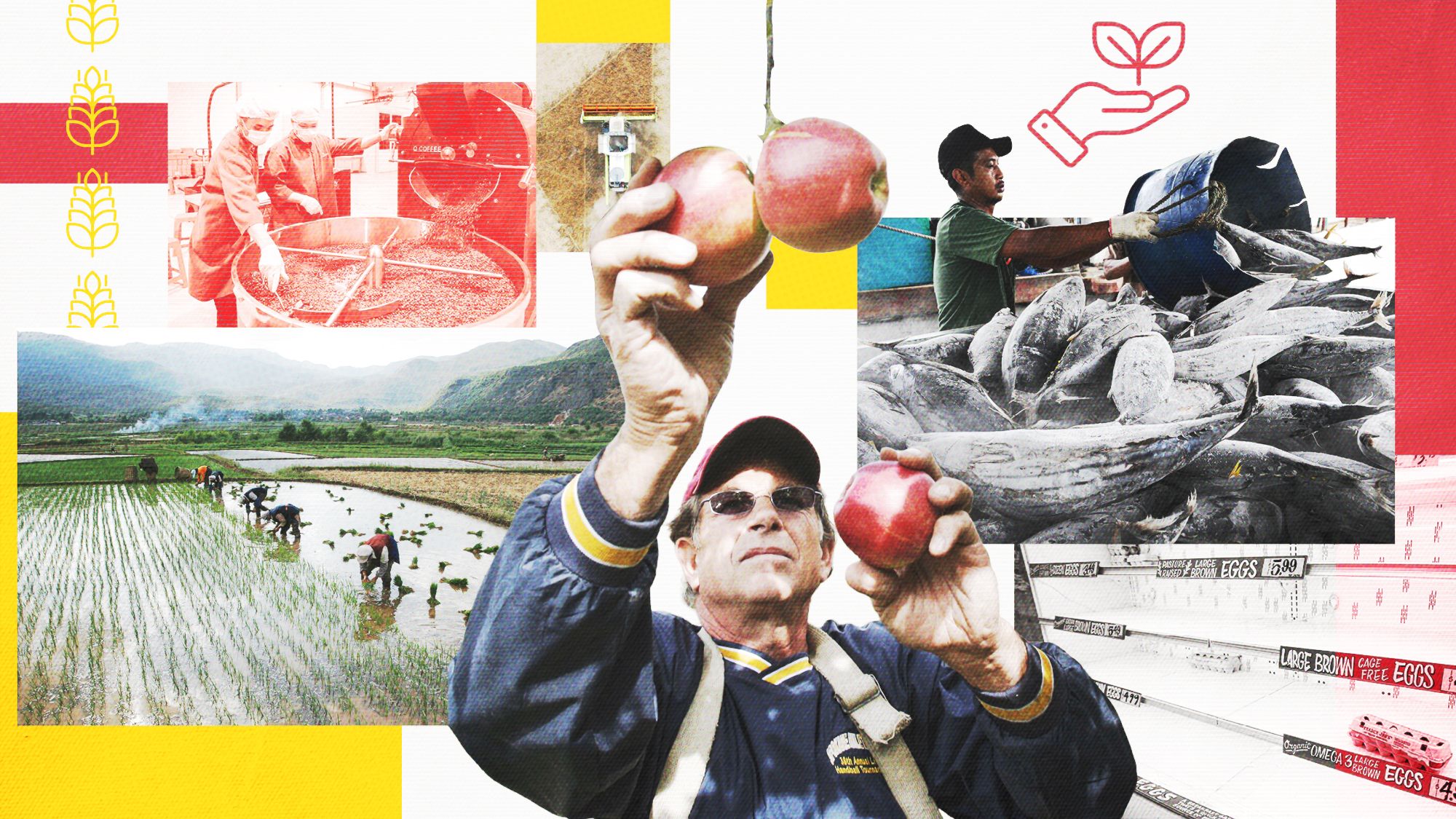
Climate change is threatening farming around the globe.
(Image credit: Jason Edwards/Getty Images)
But the U.S. is facing big changes to its food systems too, and no one is immune. Humans have overcome looming agricultural disasters before, but experts say the challenge should not be underestimated.
“There are real food security and nutrition concerns,” said Andrew Hultgren, an environmental economist at the University of Illinois, Urbana-Champaign, “especially under these high-warming futures.”
Food is becoming less nutritious
As the planet warms, food crops are expected to become less nutritious. That’s because, due to plant biology that’s not yet fully understood, crops grown under higher levels of carbon dioxide are deficient in zinc, protein, magnesium, iron and other micronutrients. Crops are already less nutritious than they were in the 1950s, but this is partly due to breeding decisions that prioritize yield over nutrition. The carbon dioxide deficiencies will exacerbate this nutrition decline.
The global monthly average concentration of carbon dioxide in the atmosphere is now over 420 parts per million (ppm), well over the preindustrial average of 280 ppm. By the end of the century, those levels will increase to at least 550 ppm in all but the most optimistic scenarios.
That will mean an additional 175 million people will be zinc deficient and an additional 122 million people will be protein deficient by 2050, a 2018 study found. Zinc deficiency has consequences for immune and skin health and may lead to poor growth in childhood; protein deficiency can also cause stunted growth as well as fatigue, muscle weakness and stress fractures. Those figures account only for the effects of carbon dioxide. A cascade of climate shifts and extreme weather may also affect the number of nutrients (and calories) available to the world.
The threats are myriad: Rising sea levels may inundate farmland and lead to saltier soil in coastal regions where, for example, rice farming is common. Soil salinity can make it impossible to grow crops in some regions. Droughts, heat waves, storms or temperature swings like those seen in Colorado this year might take out certain crops in particular places, leading to year-by-year price spikes or shortages. In the U.S., the results might look a lot like the recent egg shortages triggered by bird flu; temporarily empty shelves, price spikes, or even restrictions on the amount a customer can purchase in a visit for an affected food.

Phytoplankton blooms, like the one that grew off the Atlantic coast in April, can make seafood toxic. Such blooms will become more common as climate change worsens.
(Image credit: NASA Earth Observatory/Michala Garrison)
Climate shifts that harm pollinators and fuel the spread and introduction of plant pathogens such as harmful fungi will also likely reduce crop yields.
Areas that depend on the ocean for food are also facing steep challenges, due to both ocean acidification and the degradation of coral reef ecosystems, which are sources of food for many coastal communities and form much of the base of food chains for the larger fish people eat.
Hotter weather also affects food safety, said Christopher Golden, a professor of nutrition and public health at the Harvard T.H. Chan School of Public Health.
“Increasing sea temperature and increasing sedimentation within seas could lead to harmful algal blooms or increasing food poisoning events from temperature-related food spoilage,” Golden said. Algal blooms can contaminate shellfish like oysters or scallops with neurotoxins that can sicken and kill people who eat them. Food spoilage is a concern in regions such as Madagascar, where catches are brought ashore and readied for consumption in the open air.
Meanwhile, fish may move poleward to avoid the hottest sea temperatures, leaving the most vulnerable regions — such as Southeast Asia, the Caribbean, Africa, Central America and the Pacific — with fewer fish in their waters. How bad this looks depends on the extent of the climate swings, with research suggesting that without any mitigation, fishers could see their catches decline by 58% to 92% off small islands in the Pacific and by 70% to 86% in Southeast Asia. This would drive food insecurity and malnutrition in those regions. The U.S. will likely face impacts too, as most of its seafood is imported from subtropical or tropical waters elsewhere.
Climate change is bad in that it’s a slow-moving wave. You don’t really notice that it’s shifting underneath you and that the apple you eat isn’t the apple your granddaughter will eat.
Elizabeth Wolkovich, professor of forestry at the University of British Columbia
There may be shifts in trade networks that lessen the blow for U.S. consumers, Golden said, but it’s hard to predict. Some possibilities include “price shifts or trade shifts that lead to changing dietary patterns or more shelf-stable and heavily processed items that we know aren’t good for your health,” he said. In other words, less fresh-caught snapper and more potted meats.
Changing foods on the table
Individual producers are adapting, sometimes in ways that may not be immediately obvious to consumers. “Climate change is bad in that it’s a slow-moving wave,” said Elizabeth Wolkovich, a professor of forestry at the University of British Columbia. “You don’t really notice that it’s shifting underneath you and that the apple you eat isn’t the apple your granddaughter will eat.”
On that note, growers in the Pacific Northwest and U.S. Northeast will face challenges getting apples to lunch boxes around the world. Fewer cold days and more extreme-heat days will likely reduce apple yields by affecting how and when trees go dormant and bloom. Because it takes five or more years to establish fruiting trees in new regions, this could mean a reduced apple supply and higher prices.
Today’s smooth arabica coffee (Coffea arabica) varieties may get harder to find and more expensive as climate change forces coffee growers out of many of the places they used to farm and droughts reduce supply. Earthier, more bitter robusta coffee beans (Coffea canephora) do better in warming temperatures, but even those beans could struggle with increasing seasonal variability caused by climate change.
Climate has already shifted wines in favor of less-acidic and higher-alcohol varieties, Wolkovich said, but it’s happened slowly enough that, unless you’re a connoisseur, you may not have noticed. Wine lovers can expect more changes: Wolkovich has found that the varieties of wine grapes that growers can produce will shift with climate change. Wildfires in grape-growing regions like California can also produce an unpleasant acrid and smoky flavor in wine.

Wildfires, which will become more common, can lend a smoky, acrid flavor to wines.
(Image credit: George Rose via Getty Images)
And it’s not just flavors that will be affected. U.S. dairy cattle breeds originated in cool and cloudy Northern Europe, and their milk output goes down as temperatures climb. Such heat stress reduced annual milk yield by an average of 1% a year between 2012 and 2016 alone, and heat-related losses are expected to balloon by 30% by 2050.
Americans have long been drinking less milk from the glass, but their demand for yogurt and cheese is rising, said Jared Hutchins, an assistant professor of agricultural and consumer economics at the University of Illinois Urbana-Champaign and first author of the study on milk yield. Those products depend heavily on the fat and protein content in milk, which is the first thing to drop when cattle are hot. “Fat and protein are what deliver the cultured dairy products that are in high demand,” Hutchins told Live Science.

For many of the European cattle breeds currently used in dairy production, overall yield, as well as the protein and fat content, decrease in hotter conditions.
(Image credit: Pierre Crom via Getty Images)
The story repeats itself across agricultural products, Hultgren said. “For each degree of that global temperature rise, caloric output [from crops] drops by 120 kilocalories or U.S. calories per person per day,” he said, “which is about 4.5% of a person’s daily recommended caloric intake.”
That calculation, published by Hultgren and his colleagues in the journal Nature in 2025, already accounted for adaptations that farmers can make to reduce crop losses. Without those adaptations, the number would be over 30% higher, he said.
Reductions in available calories will translate to food shortages in vulnerable places, such as the Horn of Africa or India, said Marina Romanello, executive director of a multinational research project that tracks the impacts of climate on health at University College London. In North America, “it would feel like inflation,” Hultgren said — yet another factor driving up grocery prices.
Worst-case scenarios
For farmers, the year-by-year uncertainty of climate change is a problem. Will this year bring drought? Will there be a sudden storm or flood that will wash away the spring crop? Should they take a risk on a new heat-resistant plant or agricultural technique?
Similar uncertainty haunts the long-term forecast. Climate tipping points can lead to sudden, irreversible changes in the system. For agriculture, one of the scariest tipping points is the potential collapse of the Atlantic Meridional Overturning Circulation (AMOC). This pattern of ocean currents brings warm surface water north from the equator and circulates cold water south, warming Northern Europe and the northern parts of North America and cooling the Southern Hemisphere.
If this current were to collapse, northwestern Europe would cool dramatically, with studies suggesting that London could see temperature lows of minus 4 F (minus 20 C) — colder than the city’s lowest temperatures on record. Precipitation would decline across Europe, leading to drought. Meanwhile, in the Amazon, the wet season could become the dry season and vice versa, said René van Westen, a climate researcher at Utrecht University in the Netherlands who has studied the impacts of an AMOC collapse.
On the other hand, if the AMOC doesn’t collapse, London is expected to warm by 4.9 F (2.7 C) and see 15% to 18% more precipitation, depending on the season. The uncertainty in these predictions makes preparations difficult. There is still a lot of controversy over whether the AMOC will collapse and, if so, when. Should farmers plan for England to become increasingly toasty, or should they expect it to be plunged into a little ice age?
AMOC-related changes will take decades to centuries to unfold, even with a total collapse, van Westen told Live Science. But even so, they would require a total rewriting of agriculture in Europe and the northeastern U.S. “It will be very challenging to adapt to such a scenario,” he said.
That doesn’t mean a collapse of the world food system is inevitable. Farmers are already adapting to the early impacts of climate change by scaling back water-hungry crops in drought years and, in some places, testing new, heat-resistant varieties of crops in an attempt to stem the losses.

The apples we eat now, like honeycrisps, may not fare well under climate change.
(Image credit: Bloomberg via Getty Images)
Exclusive to Live Science Pro
And humans have overcome looming disaster in agriculture before: In the 1950s and 1960s, new varieties of rice and wheat, along with the availability of synthetic nitrogen fertilizers, spurred the “Green Revolution,” tripling the world’s yield of cereal crops while expanding farmland by only 30%. Similar innovations could limit hunger even as the world warms.
But the biggest way to mitigate these impacts is the most obvious one. While Hultgren and his colleagues found that adaptation could cut caloric losses under climate change by 30%, mitigating warming by reducing emissions today could slash them by half. Similarly, the AMOC is on a path toward weakening, van Westen said, but as long as humans slow the pace of climate change, the current can recover.
“If you are cutting your emissions,” van Westen said, “you can lower your risk.”
Do you know where pumpkins and blueberries come from? Find out with our fruits and vegetables quiz!