




NEWYou can now listen to articles!
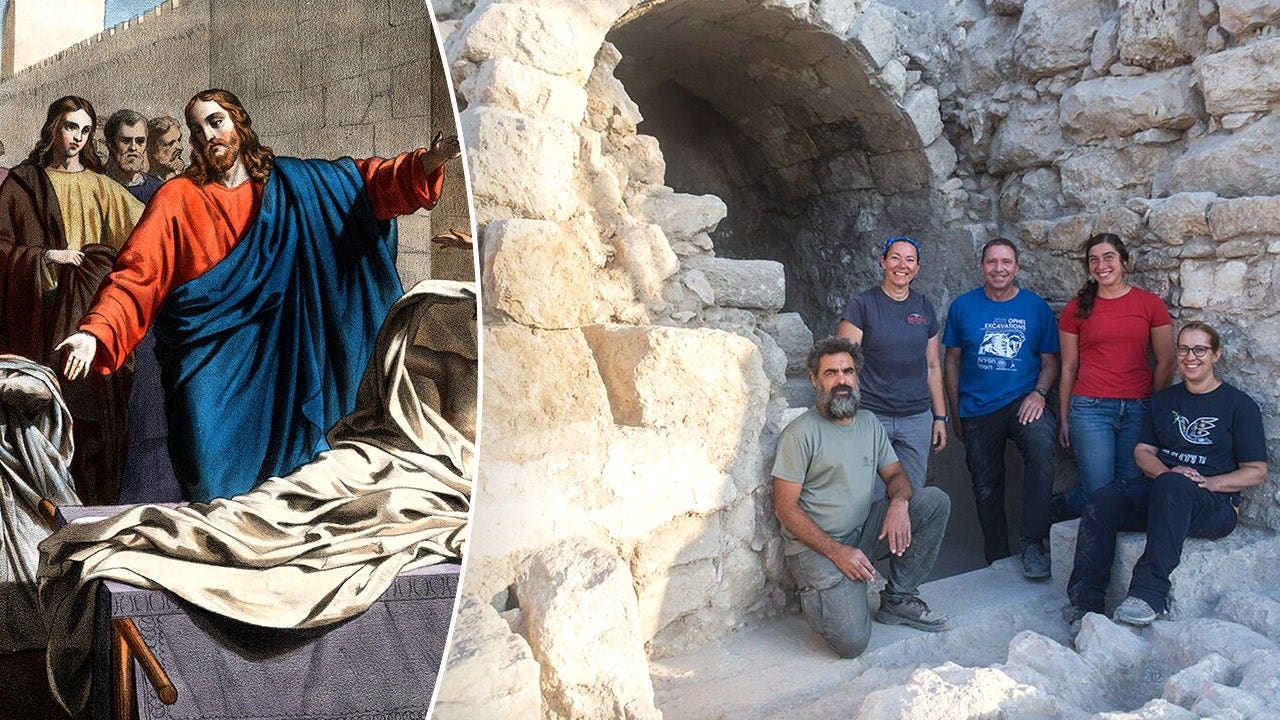
Archaeologists have uncovered a remarkably well-preserved 2,000-year-old ritual bathing complex near Jerusalem’s Temple Mount that dates back to the time of Jesus. It was likely used by Jewish pilgrims visiting the ancient holy site, with an expert noting the discovery helps highlight the broader significance of baptism.
The excavation, announced earlier this fall, was carried out by archaeologists from the Hebrew University of Jerusalem.
The discovery was made in the Ophel, an archaeological area immediately south of Jerusalem’s Temple Mount, near an ancient entrance known as the Triple Gate.
JESUS’ CRUCIFIXION ACCOUNT GETS FRESH LOOK AFTER ANCIENT RING TIED TO PILATE IS REINTERPRETED
The complex was built in the early first century A.D. It features three large ritual baths, a plastered pool and a paved plaza, along with an extensive water system.
Located near the Triple Gate, one of the main entrances to the Temple Mount, the complex likely served pilgrims who underwent ritual purification before visiting the Second Temple, researchers said.
Archaeologists have uncovered a remarkably well-preserved 2,000-year-old ritual bathing complex near Jerusalem’s Temple Mount, dating back to the time of Jesus. (Stefano Bianchetti/Corbis via Getty Images; Aubrey Mercado/Hebrew University of Jerusalem)
Officials described one of the baths as “exceptionally well-preserved,” noting that it stands nearly 14 feet tall and retains its original vaulted stone ceiling and a shaft that once supplied it with water.
“The preservation of a Second Temple-period structure from floor to ceiling is exceedingly rare in Jerusalem, particularly in such a central and historically significant location,” the Hebrew University of Jerusalem said in a statement.
HOLY LAND DISCOVERY REVEALS ANCIENT CHARRED RELICS FROM ONE OF JERUSALEM’S DARKEST CHAPTERS
Excavation directors professor Uzi Leibner and professor Orit Peleg-Barkat described the monumental stone structure devoted entirely to ritual purification as “a truly unparalleled phenomenon.”
The archaeologists added, “The complex goes to the heart of our research into the archaeology of Second Temple-period pilgrimage: how the area immediately south of the Temple Mount was designed to accommodate the many pilgrims who came to Jerusalem to visit the Temple, and what activities and rituals took place near its gates.”

The 2,000-year-old complex likely accommodated Jewish pilgrims who underwent ritual purification before visiting Jerusalem’s Second Temple, according to researchers. (Emil Sadikov/Hebrew University of Jerusalem)
The complex also bears evidence of Jerusalem’s destruction by Roman forces in 70 A.D.
Archaeologists found dozens of coins dating to the First Jewish Revolt against Rome on the complex’s floors and among the debris.
ARCHAEOLOGISTS UNEARTH SECRET CHURCH TIED TO COUNCIL OF NICAEA, CHRISTIANITY’S DEFINING MOMENT
Excavations also revealed an even older public purification facility beneath the complex, including another large ritual bath believed to date to the first century B.C.
The earlier structure suggests the site had been used for ritual purification long before the Roman destruction of Jerusalem.
“Baptism, a ritual that many people think of as exclusively Christian, emerged out of broader ancient Jewish bathing and purification rituals.”
While Jesus and his disciples could theoretically have visited the bathing complex, there is no evidence in the New Testament that they did, said Candida Moss, the Edward Cadbury professor of theology at the University of Birmingham.
CLICK HERE TO SIGN UP FOR OUR LIFESTYLE NEWSLETTER
Moss, who specializes in early Christianity, told Digital the discovery offers insight into the ancient Jewish purification practices that helped shape Christian baptism.
Between the first century B.C. and the first century A.D., ritual bathing became increasingly popular among Jews in Judea and Galilee, as evidenced by the growing number of immersion facilities built during that period, Moss said.

Archaeologists discovered dozens of ancient coins — two sides are seen above — on the bathing complex’s floors and among debris left by Jerusalem’s destruction. (Tal Rogovski/Hebrew University of Jerusalem)
She pointed to the Qumran community, associated with the Dead Sea Scrolls, whose residents used ritual baths known as mikva’ot for daily bathing.
CLICK HERE FOR MORE LIFESTYLE NEWS
Moss said the broader interest in ritual bathing also helps explain the popularity of John the Baptist and the adoption of baptism by Jesus’ followers.
“What it does show is that baptism, a ritual that many people think of as exclusively Christian, emerged out of broader ancient Jewish bathing and purification rituals,” Moss said.
“That, in turn, can help explain the popularity of John the Baptist and the use of baptism by Jesus’ followers.”
TEST YOURSELF WITH OUR LATEST LIFESTYLE QUIZ
The discovery comes amid a series of recent archaeological finds in Israel dating to the time of Jesus.

The discovery sheds light on Jewish ritual purification practices that helped shape the development of Christian baptism, according to theologian Candida Moss. (Emil Sadikov/Hebrew University of Jerusalem; Heritage Art/Heritage Images via Getty Images)
Earlier this fall, Israeli officials announced the recovery of a remarkably intact 2,000-year-old Jewish ritual bath in Kiryat Gat, about 35 miles southwest of Jerusalem.
CLICK HERE TO DOWNLOAD THE APP
Around the same time, archaeologists uncovered a 2,000-year-old aqueduct near Jerusalem that once supplied water to the Second Temple complex.