



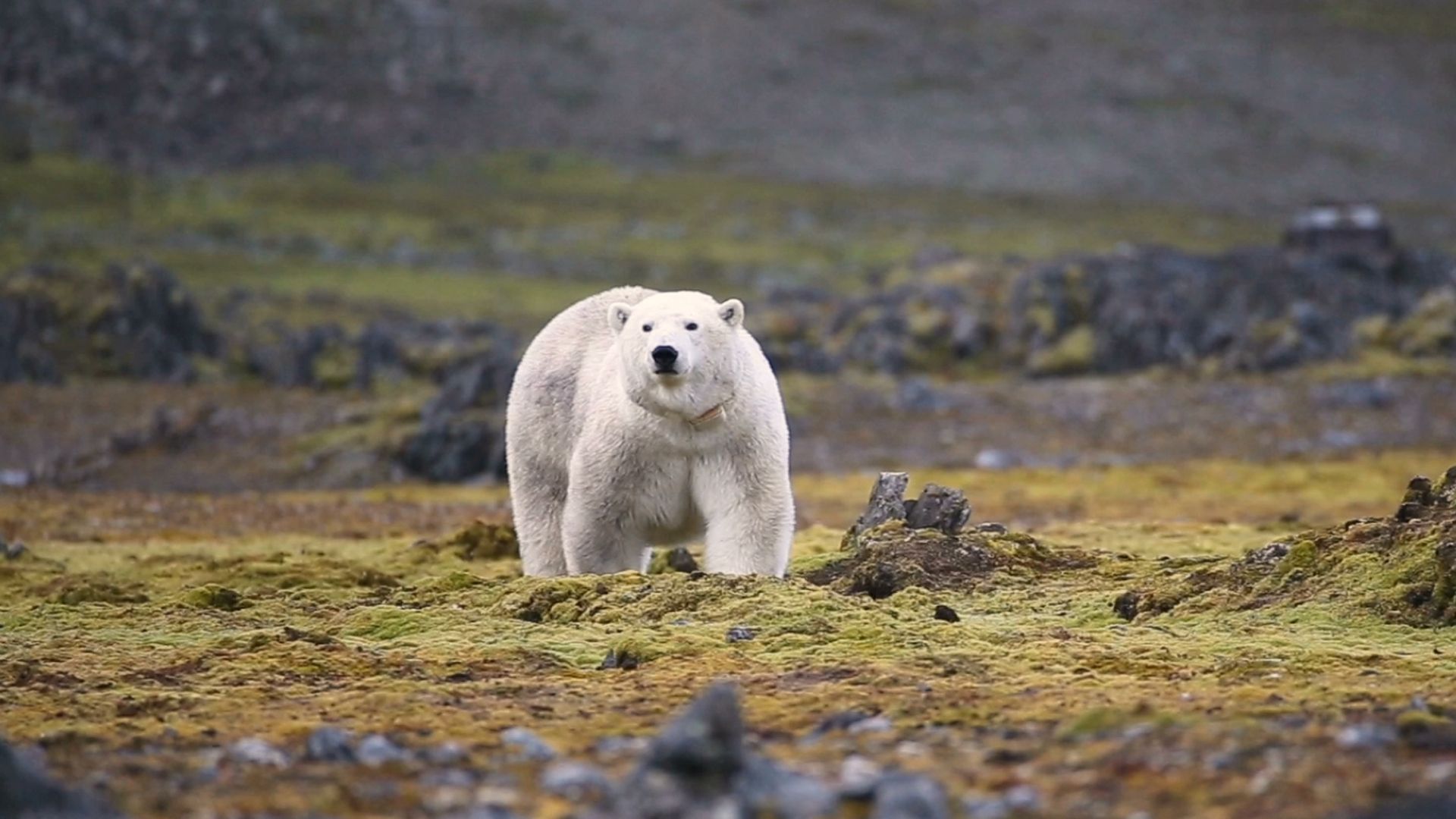

Something surprising has been happening to polar bears. Those living in Svalbard, a Norwegian archipelago, have been gobbling up hundreds of birds’ eggs and looking healthier than they have in the past. And in warmer parts of Greenland, the bears are showing signs of genetically adapting to climate change.
The discoveries seem to be unexpected bright spots for the beleaguered species, which for decades has been photographed clinging to vanishing sea ice and has become a “poster animal” for the effects of climate change. So what do the promising signs mean for polar bears? Could they actually survive the rapid melting of Arctic sea ice?
Experts told Live Science that the new findings show there may be unexpected refuges where some polar bear populations cling on or even do well for longer than models suggest. Alone, these discoveries won’t be enough to save polar bears from extinction, but they might buy these iconic creatures a little more time as the world attempts to do the one thing that could save them — cutting emissions.
An icebound creature
The future for polar bears (Ursus maritimus) has looked precarious for a long time. The animals depend on sea ice, on which they hunt ring seals (Pusa hispida) and bearded seals (Erignathus barbatus), which can outswim the bears in the water. As the climate warms, sea ice is melting, shrinking this key hunting ground. A 2020 study projected that if greenhouse gas emissions continue as usual, all but a few polar bear populations will collapse by 2100, with the remaining ones clinging on for longer in a handful of “last refuges” such as the Queen Elizabeth Islands, Canada’s northernmost Arctic archipelago.
Yet the recent positive findings raise the tantalizing prospect that polar bears might be able to survive climate change after all.
A January study in the journal Scientific Reports looked at the body condition of 770 adult polar bears in Svalbard between 1995 and 2019. They found that, on average, the bears became thinner until 2000 but grew fatter afterward, despite a rapid loss of sea ice there.
That was a surprise, because a fat polar bear is a healthy one, lead researcher Jon Aars, a research scientist at the Norwegian Polar Institute in Tromsø, told Live Science. “We expected to see a decline in body condition because of the rapid loss of sea ice.”
And a study published in the journal Mobile DNA in December 2025 revealed that polar bears in southern Greenland are using “jumping genes” to rapidly rewrite their own DNA, potentially allowing them to more readily adapt to warmer habitats by changing how they handle heat and process fats.
Mixed picture
So do these findings really mean the picture is looking less bleak for polar bears?
Andrew Derocher, a biologist at the University of Alberta who worked with Aars on the Svalbard bear study, told Live Science that there are 20 unique polar bear populations around the Arctic, and each lives in a slightly different environment and faces a different level of sea ice loss.
“The basic premise is that if you lose the sea ice, the bears are losing habitat,” he said. “They’re forced on land for longer. They use up more energy, and then they get in poorer condition, with knock-on effects on survival and reproduction.” But there is an incredibly productive ecosystem between the islands in the Svalbard area and those in the Russian Arctic near Franz Josef Land.
Because the area is on a continental shelf, the water off Svalbard is relatively shallow and warm, with nutrient-rich water flowing in from the North Atlantic, he said. This means polar bears have lots of prey options. They are eating walruses, birds and even birds’ eggs, and they’re staying in good shape.
“In dense colonies of ground-nesting birds like ducks and geese, bears have been seen taking a couple of hundred eggs during a single day,” Aars said. “They just raid quite a lot of the nests, eating absolutely everything.”
And although seal numbers in Svalbard are down, where there is ice, the seals sit on it in higher density, which may make them easier to catch, Derocher said. Sometimes the Svalbard bears have even been spotted catching reindeer (Rangifer tarandus platyrhynchus).

Unfortunately, there are not enough reindeer to sustain a population of polar bears, he said. “So, no matter how wonderful those pictures look when they’re scarfing down a reindeer, it’s not going to help them.”
The new insights highlight polar bears’ resourcefulness, said Louise Archer, a polar bear scientist at the University of Toronto Scarborough.
“What we’re seeing happening in Svalbard is really interesting in terms of all the different behaviors that polar bears can employ to deal with their changing environment,” Archer told Live Science.
But their shift to hunting birds’ eggs, walruses and reindeer doesn’t mean they are developing evolutionary adaptations to an ice-free world.
“They’ve always done that,” Derocher said. “They’re just being forced to do it more.”
It’s clear that a permanent land relocation is unlikely, because they move onto the ice as soon as it reappears, he added. “Sea ice is what makes a polar bear possible,” Derocher said. “It’s the high fat diet from the abundance of seals that allows them to exist in an incredibly cold environment.”
Body condition also isn’t the whole story, he said. Svalbard’s polar bears may be in good shape, but they reproduce on ice. Because large areas of Svalbard’s west coast are now free of sea ice, key areas in which they build dens have disappeared. A December 2025 modeling study estimated that reproduction and cub survival will decline around Svalbard in low-ice years. “The ice just doesn’t come in time,” Derocher said.
Genetic adaptation?
But is there hope in the news that some polar bears seem to be genetically adapting to warmer climes? Alice Godden, a bioscientist at the University of East Anglia, and her colleagues looked at genetic elements that can copy and paste and jump around the genome, causing mutations, in subpopulations of polar bears in northern and southern Greenland. They found more of this genetic activity in the southern population, where it is warmer.
Many of the changes in gene expression were in metabolic pathways that govern fat processing, so they could be reactions to warmer weather and a changing diet. It’s a promising sign that the bears are adapting, Godden said, but the time scale required for such changes to make a meaningful difference is longer than the time polar bears are thought to have left.

The majority of the Arctic Ocean could be ice-free during summer by 2050, but as the length of a polar bear generation is about 11.5 years, genetic adaptations to an ice-free ecosystem will likely take many hundreds or thousands of years, Godden said.
“They’re adapting as best they can, but without human intervention, the odds aren’t looking great,” she said.
Derocher, for his part, suspects the genetic changes may not be adaptations at all but rather a sign the bears are more stressed, which can lead to DNA damage and thus more mutations, essentially causing faster biological aging.
Patches of hope in an overall bleak picture
Ultimately, some polar bear populations may do better than others, depending on local geography, food availability and sea ice dynamics. “We suspect that it’s going to be 20 different subpopulations, 20 different scenarios, all kind of following the same trajectory but at different sort of time scales,” Derocher said.
Aars agreed. “I think the likely thing is that polar bears will disappear from much of the Arctic as sea ice recedes further and further north, but it’s very, very difficult to say how fast it goes,” he said.
Archer expects populations to plummet earlier in regions like Western Hudson Bay, Southern Hudson Bay and western Canada, which lacks a rich ecosystem and where bears already spend several months without sea ice.

But as the Svalbard news shows, there are potential refuges where the bears could hold out for longer. In other parts of the High Arctic, such as around the Canadian Arctic Archipelago, there is still very thick sea ice, which allows little light to penetrate to the water and therefore little energy to support a food chain. As this ice starts to thin, more algae will grow, supporting communities of invertebrates, fish and seals that can feed polar bears, which may allow them to remain in these areas beyond the end of the century, Archer said.
How long Svalbard could sustain a viable population of bears isn’t certain. “Are the Svalbard bears going to get hit by a devastating warm year next year, the year after, or can they go like this for 20 more years before things get really bad?” Derocher said.
Ultimately, the odds of these iconic bears surviving beyond the end of the century will depend mainly on reducing emissions. “There are some changes that are already baked into the system, but there’s a lot that we can do to alter what the future looks like for them.”
For example, if we limit global warming to 3.7 degrees Fahrenheit (2 degrees Celsius) above pre-industrial levels then adult polar bears could survive to 2100, even at the southern end of their range in Hudson Bay, Archer said.
“We are not on an unstoppable trajectory towards a tipping point where sea ice disappears for good,” Archer said. “It’s absolutely in our hands how the future plays out.”