


Close Menu
  • Home
  • United States
  • World
  • Politics
  • Business
  • Lifestyle
  • Entertainment
  • Health
  • Science
  • Tech
  • Sports
  • More
    • Web Stories
    • Editor’s Picks
    • Press Release

Subscribe to Updates

Get the latest USA news and updates directly to your inbox.

What's On
Oliver Tree’s Body Is Recovered After Deadly Helicopter Crash, Returned to United States

Oliver Tree’s Body Is Recovered After Deadly Helicopter Crash, Returned to United States

June 22, 2026
Liberty receive surprise pregame visit, message from franchise legends: ‘Do things the New York way’

Liberty receive surprise pregame visit, message from franchise legends: ‘Do things the New York way’

June 22, 2026
Media, tech and advertising elite return to Cannes Lions Festival

Media, tech and advertising elite return to Cannes Lions Festival

June 22, 2026
Facebook X (Twitter) Instagram
Trending
  • Oliver Tree’s Body Is Recovered After Deadly Helicopter Crash, Returned to United States
  • Liberty receive surprise pregame visit, message from franchise legends: ‘Do things the New York way’
  • Media, tech and advertising elite return to Cannes Lions Festival
  • Southwest Airlines plane struck by ground vehicle at Memphis airport
  • When Do Love Island USA’s Infamous Casa Amor Episodes Air During Season 8?
  • Scottie Scheffler couldn’t break his US Open struggles in failed attempt at career Grand Slam
  • Missing NYC boy found on the roof of his apartment playing hooky — by a CBS news chopper
  • NYPD officer shoots stolen car driver who struck cops in the Bronx
  • Privacy
  • Terms
  • Advertise
  • Contact Us
Join Us
USA TimesUSA Times
Newsletter Login
  • Home
  • United States
  • World
  • Politics
  • Business
  • Lifestyle
  • Entertainment
  • Health
  • Science
  • Tech
  • Sports
  • More
    • Web Stories
    • Editor’s Picks
    • Press Release
USA TimesUSA Times
Home » Scientists found the optimal robot body, and it has 20 legs ‪—‬ watch it scale walls and move through trees
Scientists found the optimal robot body, and it has 20 legs ‪—‬ watch it scale walls and move through trees
Science

Scientists found the optimal robot body, and it has 20 legs ‪—‬ watch it scale walls and move through trees

News RoomBy News RoomMay 28, 20261 ViewsNo Comments

A weird 20-legged machine could change how scientists think about the ideal robot form.

For decades, roboticists have been inspired by the natural world, building machines that resemble humans, dogs, insects and even horses. But new research suggests that the most useful robot body may look less like a human and more like a sea urchin.

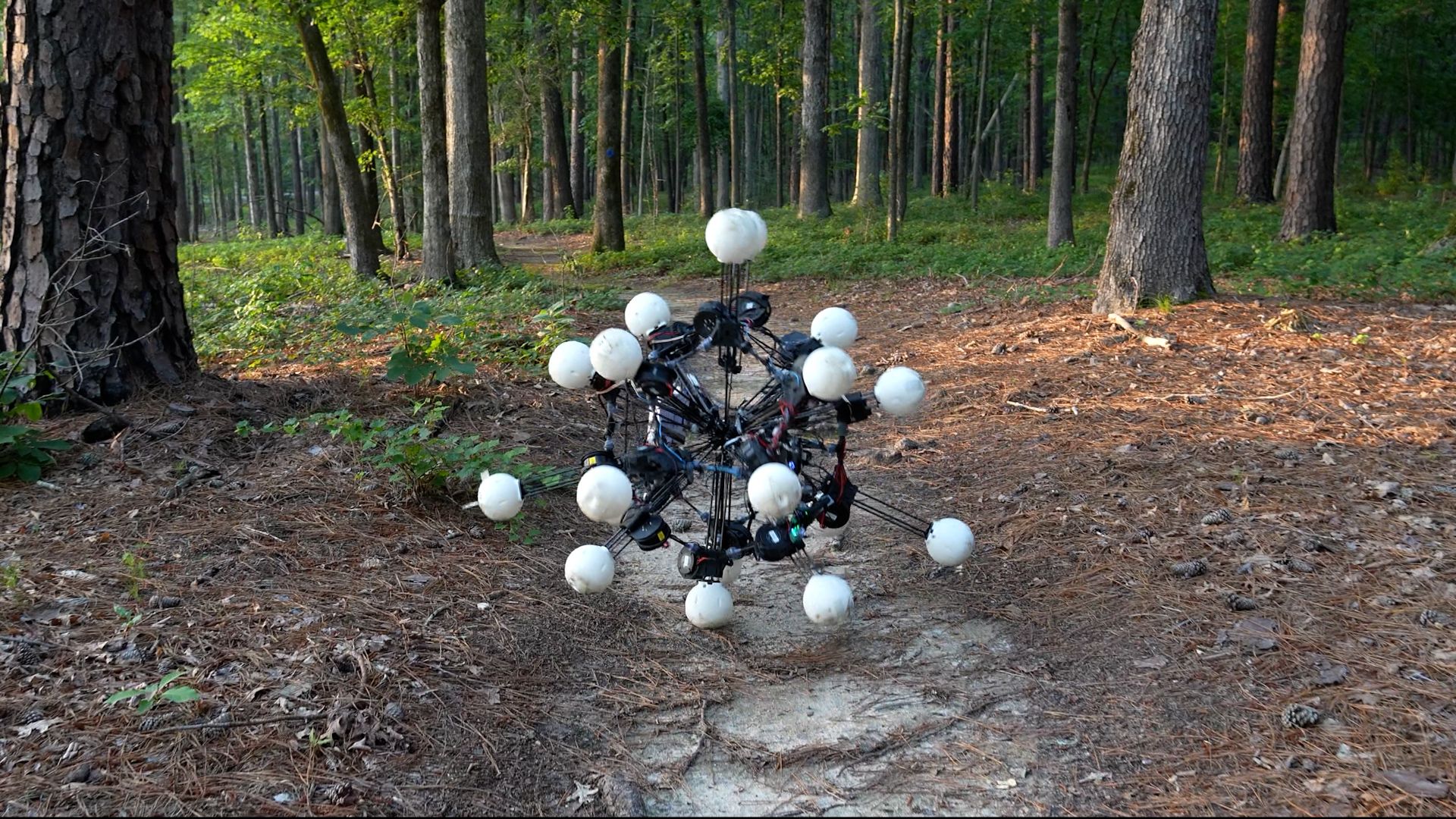
The robot has no front or back. Its 20 telescoping legs, each costing $300, radiate from a central body, with a depth camera at each leg tip, leading the researchers to name it Argus, after the all-seeing monster of Greek mythology. This design results in a machine that can move in any direction, stabilize itself after being pushed, cross rough terrain, carry a 10-pound (4.5 kilograms) payload and even climb up walls.


You may like

The Duke University scientists who created the robot published their findings May 27 in the journal Science Robotics.

“Watching Argus move is unlike watching any other robot we’ve worked with,” Jiaxun Liu, a doctoral student in Duke’s General Robotics Lab and co-author of the study, said in a statement. “The first time we saw it navigate among trees and rough terrain, even under heavy collisions [when someone pushed it], we knew this was something different.”

Simulating symmetry

The team arrived at Argus’ design after running more than 1,500 simulations of different robot shapes. Instead of asking what animal the robot should resemble, the researchers focused on how symmetrical a machine could be in all directions ‪—‬ a mathematical concept called dynamic isotropy.

The dynamic isotropy score ranges from 0 to 1 and measures how evenly a robot can accelerate its body, or center of mass, in every direction. A score of 1 means a robot can react or move nearly identically in all directions.

Get the world’s most fascinating discoveries delivered straight to your inbox.

“When a robot can accelerate equally well in every direction, it stops needing to face the world in any particular way,” Boyuan Chen, director of Duke’s General Robotics Lab and co-author of the study, said in the statement. “Forward and backward become the same. Left and right become the same. The whole problem of robot control changes character.”

According to the researchers, most robots today — including advanced four-legged robots, humanoids and conventional drones — score below 0.6, meaning they’re better at moving or reacting in some directions than others. With its 20 legs, Argus scored a 0.91, close to the theoretical maximum.

To achieve this high score, the team arranged Argus’ body around a shape called a regular dodecahedron, a three-dimensional form with 12 pentagonal faces. The arrangement gives the robot a nearly uniform field of view and allows it to move without needing to orient itself the way a conventional robot would.


What to read next

Chen said that based on these findings, robots don’t need to imitate humans or dogs to boost their agility, and instead are designed from deeper mathematical principles.

Releasing the robot

To test whether Argus’ design was truly optimal, the team took the robot out on the Duke campus, where it rolled across concrete, grass, dense foliage, soft sand, wet surfaces and bark. It handled obstacles up to 5 inches (12.7 centimeters) tall, kept moving even after three of its legs were broken, and pushed a 3-foot (1 meter) cube while rolling.

Argus, the 20-legged robot, rolls across a sandy beach.

(Image credit: Duke University)

Argus is a proof of concept and not the final answer on the optimal robot design, the researchers wrote in the study. Its broader importance may be in how it was designed rather than where or how it can be used in real-world scenarios ‪—‬ it could be a mathematical way to compare different robot bodies and design new form factors from scratch.

“It shows that designing for dynamic symmetry isn’t just a theoretical curiosity,” Boxi Xia, a postdoctoral researcher at Duke’s General Robotics Lab and co-author of the study, said in the statement. “It produces a robot you can deploy in the wild, on uneven ground and in clutter, even in low-gravity settings. It changes what’s possible.”


Share. Facebook Twitter LinkedIn Telegram WhatsApp Email

Keep Reading

The US just approved bemotrizinol, a sunscreen ingredient long used in Asia and Europe. Here’s how it works.

The US just approved bemotrizinol, a sunscreen ingredient long used in Asia and Europe. Here’s how it works.

James Webb telescope finds a cosmic cloud of creation buried in the Sword of Orion — Space photo of the week

James Webb telescope finds a cosmic cloud of creation buried in the Sword of Orion — Space photo of the week

What will the Amazon rainforest look like in 100 years?

What will the Amazon rainforest look like in 100 years?

‘You kill the bacteria and heal the wound at the same time’: Emerging nanotech could be the future of wound healing

‘You kill the bacteria and heal the wound at the same time’: Emerging nanotech could be the future of wound healing

Outdoor cats can be exposed to dangerous germs — here’s how to protect you and your pets, according to more than 400 studies

Outdoor cats can be exposed to dangerous germs — here’s how to protect you and your pets, according to more than 400 studies

Science news this week: Goblin shark filmed for first time, California close to a major quake, physicists split photon, and inside China’s plans to ‘tame nature’

Science news this week: Goblin shark filmed for first time, California close to a major quake, physicists split photon, and inside China’s plans to ‘tame nature’

Diagnostic dilemma: A fish stabs a man through the throat and the base of the skull

Diagnostic dilemma: A fish stabs a man through the throat and the base of the skull

Why does it take our eyes so long to adjust to the dark?

Why does it take our eyes so long to adjust to the dark?

Watch bison herd defend a newborn calf from wolf attack in a primeval Polish forest

Watch bison herd defend a newborn calf from wolf attack in a primeval Polish forest

Add A Comment
Leave A Reply Cancel Reply

Editors Picks

Liberty receive surprise pregame visit, message from franchise legends: ‘Do things the New York way’

Liberty receive surprise pregame visit, message from franchise legends: ‘Do things the New York way’

June 22, 2026
Media, tech and advertising elite return to Cannes Lions Festival

Media, tech and advertising elite return to Cannes Lions Festival

June 22, 2026
Southwest Airlines plane struck by ground vehicle at Memphis airport

Southwest Airlines plane struck by ground vehicle at Memphis airport

June 22, 2026
When Do Love Island USA’s Infamous Casa Amor Episodes Air During Season 8?

When Do Love Island USA’s Infamous Casa Amor Episodes Air During Season 8?

June 22, 2026

Subscribe to News

Get the latest USA news and updates directly to your inbox.

Latest News
Scottie Scheffler couldn’t break his US Open struggles in failed attempt at career Grand Slam

Scottie Scheffler couldn’t break his US Open struggles in failed attempt at career Grand Slam

June 22, 2026
Missing NYC boy found on the roof of his apartment playing hooky — by a CBS news chopper

Missing NYC boy found on the roof of his apartment playing hooky — by a CBS news chopper

June 22, 2026
NYPD officer shoots stolen car driver who struck cops in the Bronx

NYPD officer shoots stolen car driver who struck cops in the Bronx

June 22, 2026
Facebook X (Twitter) Pinterest WhatsApp TikTok Instagram
© 2026 USA Times. All Rights Reserved.
  • Privacy Policy
  • Terms
  • Advertise
  • Contact

Type above and press Enter to search. Press Esc to cancel.