


Traces of two “ghost lineages” of extinct human populations lie hidden within our genome, a new study reveals.
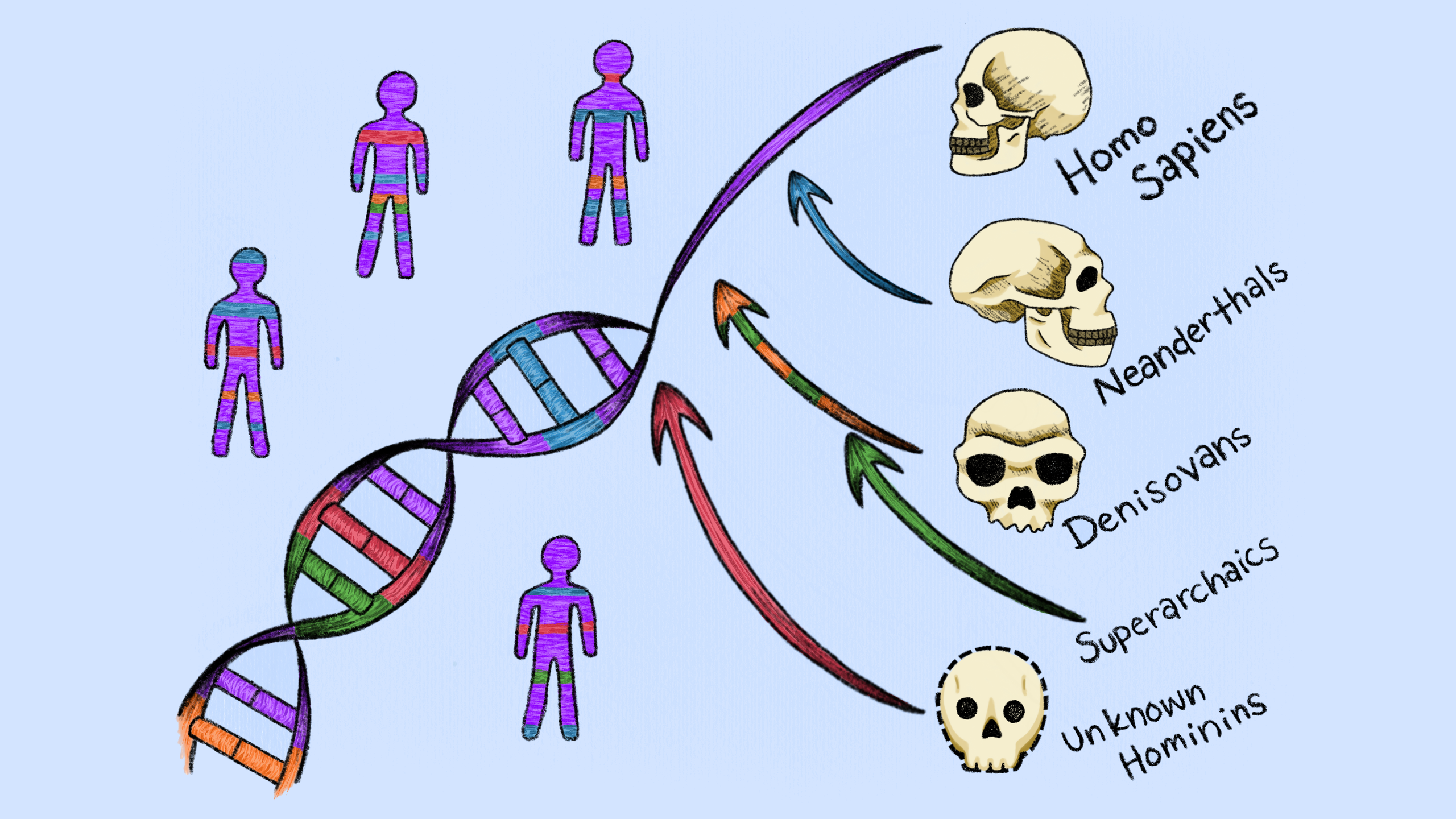
One of these ghost lineages left its DNA scattered in all present-day people. The other, a “super-archaic” lineage, dates back nearly 2 million years, researchers reported Thursday (July 30) in the journal Science.
“These extinct populations may have lived hundreds of thousands — or even more than a million — years ago, yet traces of their genetic legacy remain preserved in our genomes today,” study co-author Priya Moorjani, a human evolutionary geneticist at the University of California, Berkeley, told Live Science.
Latest Videos FromLive Science
For decades, experts have found DNA evidence that our species, Homo sapiens, once mated with now-extinct relatives such as Neanderthals and Denisovans. Most people not of sub-Saharan ancestry living today possess about 1% to 2.4% Neanderthal ancestry, and Asians and Oceanians (people from the island nations of the Pacific Ocean) harbor about 0.1% to 6% Denisovan ancestry.
But scientists have suspected that modern humans may have interbred with other now-extinct human groups that have not been identified yet. However, the scarcity of ancient DNA samples makes it challenging to identify what these unidentified groups, often called ghost lineages, might have contributed to our species.
“Ancient DNA has transformed our understanding of human evolution, but it can only tell us about populations for which DNA has been preserved,” Moorjani said. “DNA survives only under very specific conditions — typically in cold, dry environments — which means that much of our evolutionary history, particularly in Africa, other tropical regions, and at very deep timescales, remains inaccessible.”
Looking for “long-extinct ancestors”
In the new study, Moorjani and her colleagues reasoned that everyone’s genome contains a record of their ancestry. They investigated whether it was possible to uncover signs of “long-extinct ancestors preserved within the genomes of present-day people,” Moorjani said.
The researchers developed a new technique to scan and compare more than 500 complete genomes of present-day humans from around the world. Using this data, they reconstructed the complete genealogies of each spot in each person’s genome, developing family trees of the people’s ancestors that mapped out every time genetic lineages diverged and merged. They focused on ancestors who had profound genetic differences from modern humans — a sign they evolutionarily split from the modern human lineage a long time ago.
Get the world’s most fascinating discoveries delivered straight to your inbox.
“Most regions of our genome share a common ancestor relatively recently in our evolutionary history,” Moorjani said. “Occasionally, however, we find stretches of DNA whose common ancestor lies much farther back in time, indicating they originated from a long-separated human lineage.”
Unlike previous approaches, this new method does not require DNA samples from fossils in order to spot ancient genetic sequences in the modern-human genome. “We no longer have to wait for extraordinary fossil preservation to learn about extinct human populations,” Moorjani said. “Instead, the genomes of living people contain traces of these ancient ancestors, and genealogical methods allow us to recover some of that hidden history.”
The researchers experimentally tested the new method, which correctly identified Neanderthal and Denisovan ancestors in modern-human genomes. However, it also uncovered previously unknown instances of interbreeding with now-extinct groups.
The researchers said one ghost lineage’s DNA was found in all modern humans. This finding suggested that the lineage interbred with modern humans in Africa more than 50,000 years ago, before the most recent migration of H. sapiens out of Africa and into the rest of the world.
“Previous publications suggested that there might be ghost ancestry — ancestry from unknown archaic lineages in modern humans — but they hadn’t concluded whether this unknown ancestry is present only in Africans or not, and when this introgression event happened,” study co-author Yulin Zhang, a computational biologist at UC Berkeley, said in a statement. “We were actually able to find and map genomic locations in modern humans that are from this ghost lineage and show that this ghost ancestry is in all modern humans, not only in Africans.”
This newfound lineage’s DNA constitutes about 0.5% to 1% of the genomes of modern humans, comparable to the amount of Neanderthal DNA in many people living today. The scientists estimated that this ghost lineage diverged from the ancestors of modern humans about the same time Neanderthals and Denisovans did, about 800,000 years ago.
Ghost candidates
One possible candidate for the ghost lineage is Homo heidelbergensis, the researchers wrote in the study. This human species lived from about 700,000 to 200,000 years ago in Africa and Europe.
“I agree with their speculation that this ghost could have been the species Homo heidelbergensis, which was present in Africa as recently as 300,000 years ago,” Chris Stringer, a paleoanthropologist at the Natural History Museum in London who was not involved in the study, told Live Science.
The scientists also found evidence that people from Oceania inherited traces of a “super-archaic” human lineage that diverged from the ancestors of modern humans about 1.8 million years ago, before the emergence of the common ancestor of modern humans, Neanderthals and Denisovans. This super-archaic DNA, on average, made up about 0.002% of the Oceanian genomes investigated and appeared within regions of Denisovan DNA, suggesting that the super-archaic DNA got into modern humans through interbreeding with Denisovans.
The age of this super-archaic DNA suggests it may have come into Denisovans, and then modern humans, from Homo erectus, the longest surviving human species to date, Fernando Villanea, a population geneticist at the University of Colorado Boulder who was not involved in the study, told Live Science. That could make sense, because H. erectus skulls found in Yunxian, China, share some features with Denisovan fossils, Villanea added. But to date, only a limited amount of H. erectus genetic material has been analyzed.
The study’s findings highlight that modern humans are the product of multiple species and that “hybridization is the norm and not the exception,” Villanea said. “We see hybridization being a common trait in the evolution of many other species, and these findings help us reframe our scientific thinking away from a mentality of human exceptionalism.”
The DNA segments from these newfound lineages are spread throughout the human genome, but they are most numerous in parts of the genome associated with the immune system and metabolic function. Moorjani said this makes sense, as the need to adapt to new germs and sources of food has been one of the strongest drives in human evolution. Interbreeding with other now-extinct human groups allowed modern humans to acquire potentially beneficial DNA.
“This work reinforces a fundamental shift in how we think about human evolution,” Moorjani said. “Rather than a simple branching tree, human history is increasingly emerging as a complex web of populations connected by repeated episodes of divergence, migration and mixing.”
Stringer agreed, adding that this new technique provides “indirect ways of reconstructing parts of the genomes of more primitive species like H. erectus and H. heidelbergensis.”
In the future, the scientists hope to use their new method to detect signs of more ghost lineages, “particularly those from regions such as Africa and South Asia that remain underrepresented in ancient-DNA studies,” Moorjani said. The new technique can also help researchers “study evolutionary history in other species where fossil DNA is scarce or absent,” she added.
See how much you know about early humans with our human evolution quiz!