




Scientists have built a DNA-powered computer that can perform calculations using billions of molecules in a tiny drop of water.
The system taps into the laws of physics to create what the scientists describe as a computing system that’s more efficient than the conventional computers that are widely used today.
Rather than continuously using energy to force a calculation through a series of processing steps, the DNA computer is designed so that its more “energetically favorable” state is the correct answer. In other words, the computer is built to use less energy than other biological computers, which integrate living cells with traditional hardware, would take to calculate the answer.
Latest Videos FromLive Science
“The clever part is that the binding process is competitive: the DNA molecules compete with each other to select a winner, which succeeds in binding to the scaffold; all of the jostling and competition process information and execute a computation,” Damien Woods, a professor of computer science at Maynooth University in Ireland and a co-author of the study, told Live Science in an email. “Eventually, the system settles down into its energetically-preferred state which encodes the answer to the computation.”
The researchers described their system, called the Scaffolded DNA Computer (SDC), in a study published Sept. 16 in the journal Nature. They tested the SDC on 10 programs, including 100-bit computations. Some calculations, like 10 + 3, took around 30 seconds for the SDC to compute.
There are several possible long-term applications for the SDC, but these are currently speculative, the researchers noted in the study.
DNA-based systems could potentially contribute to molecular data storage, energy-efficient forms of computation, or even devices capable of running inside living cells.
Get the world’s most fascinating discoveries delivered straight to your inbox.
“Molecular computers like this are not trying to replace electronic ones, but they could be used in biological environments, smart materials and archival DNA data storage,” Abeer Eshra, an assistant professor of computer science and a co-author of the study, told Live Science via email. “Our work is a new direction for DNA data storage, since any data stored in such a system would have natural built-in error correction properties.”
A computer made from DNA
The SDC is made from short strands of DNA that interact with a longer DNA scaffold. The strands are placed into a small amount of salt water, and then heated and cooled.
As the DNA strands interact, they assemble into structures according to a set of programmed rules that make up the “computation.” The DNA strands act like tiny molecular puzzle pieces, with their sequences determining which pieces can attach to one another and to different positions on the longer scaffold. By designing these binding rules, the researchers effectively “program” a calculation.
“Each program corresponds to a set of DNA strands: to program a different computation, or give a different input, we simply select different DNA strands from the fridge,” Woods and Eshra told Live Science in an email.
The approach also exploits thermodynamics — the tendency of physical systems to move toward more energetically favorable states. When the mixture is heated and cooled, the strands compete to form the most stable arrangements, with the correct configuration becoming energetically favored. The final structure encodes the answer, allowing the molecules to “compute” by simply interacting with each other.
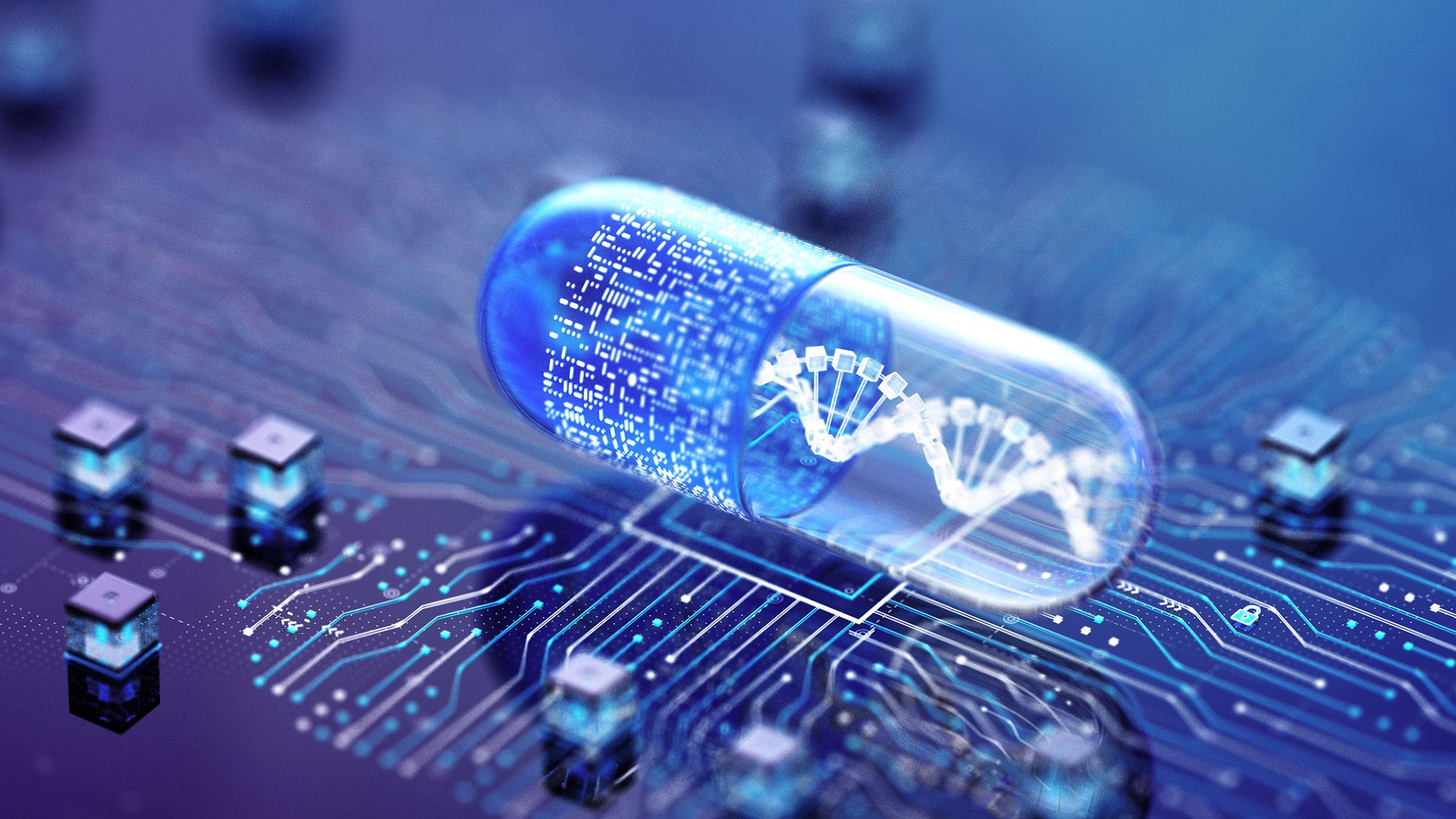
DNA molecules interact to “compute” specific calculations.
(Image credit: Design Cells via Getty Images)
While the DNA computer itself is tiny, the number of strands involved in the computing process is enormous.
“A small droplet of liquid contains billions, and sometimes trillions, of DNA strands,” Eshra said in a statement. “These strands interact with one another to produce a result.”
A reusable molecular computer
Using the SDC, the researchers demonstrated more than 700 computations across their experiments. Their programs included addition; multiplication by 3; division by 2; and eight-bit parity detection, a common type of error correction for computing. Small calculations could be completed in under a minute, which is striking given that the computing has to go through chemical reactions that take the same amount of time or longer.
“They’re trivial calculations you could easily do faster yourself, and a silicon computer would finish in an instant,” Constantine Evans, a senior research fellow at Maynooth University and a co-author of the study, told Live Science. “Our system uses just a handful of molecules, never really following an organized process of steps, never making irreversible steps, and yet ending up with the right answer. When thinking about computation at a molecular level, reliably making even those seemingly simple computations is very hard.”
Larger calculations took considerably longer. A more difficult sum in the range of about 11 million to 34 million took up to 14 hours.
“It demonstrates that the system is programmable, reusable and although slow compared to silicon, it is fast compared to other DNA computers,” Woods and Eshra wrote in a joint email to Live Science.
In addition to being fast, the SDC is reusable. Whereas many earlier molecular computers were intended as one-time experiments, the SDC was designed so the molecules could be used repeatedly.
“Many molecular computers to date relied on specially prepared components, or molecular fuels to drive the system forward, or carefully timed reactions,” Eshra said. “Our DNA computer instead works by throwing the molecules together and letting it relax towards equilibrium.”
Three of the programs were successfully redone up to 24 times. The team even repeated one experiment 1.5 years after the original experiment. The SDC had partially dried out, but the researchers were able to rerun the calculations by adding water.
For now, however, the work is mainly a demonstration that thermodynamics can be used to perform useful calculations.
“There is still a lot more theory to do!” Eshra said. Broader future directions include “designing scaffolds that are better suited to computation, improving the system’s read-out, and investigating potential applications in DNA data storage. We are already working on some of these questions.”
Stérin, T., Eshra, A., Evans, C. G., Adio, J., & Woods, D. (2026). A thermodynamically favoured molecular computer. Nature, 657(8132), 646–652. https://doi.org/10.1038/s41586-026-10996-5
Can you match these ancient devices to their pictures? Find out with our computing quiz!