



Close Menu
  • Home
  • United States
  • World
  • Politics
  • Business
  • Lifestyle
  • Entertainment
  • Health
  • Science
  • Tech
  • Sports
  • More
    • Web Stories
    • Editor’s Picks
    • Press Release

Subscribe to Updates

Get the latest USA news and updates directly to your inbox.

What's On
Cory Booker says he has ‘concerns’ over Maine Democrat Graham Platner

Cory Booker says he has ‘concerns’ over Maine Democrat Graham Platner

May 31, 2026
Influencer Estee Williams Mourns 8-Month-Old Daughter After Baby Was Denied Heart Transplant

Influencer Estee Williams Mourns 8-Month-Old Daughter After Baby Was Denied Heart Transplant

May 31, 2026
Frederik Andersen pens heartfelt Claude Lemieux tribute after fighting back tears as Hurricanes reached Stanley Cup Final

Frederik Andersen pens heartfelt Claude Lemieux tribute after fighting back tears as Hurricanes reached Stanley Cup Final

May 31, 2026
Facebook X (Twitter) Instagram
Trending
  • Cory Booker says he has ‘concerns’ over Maine Democrat Graham Platner
  • Influencer Estee Williams Mourns 8-Month-Old Daughter After Baby Was Denied Heart Transplant
  • Frederik Andersen pens heartfelt Claude Lemieux tribute after fighting back tears as Hurricanes reached Stanley Cup Final
  • Dem congressional candidate charged with terrorist threats after pulling gun on government officials
  • Commodores bassist Ronald LaPread who played on ‘Brick House’ dies at 75
  • New on Prime Video in June 2026 — All the Top Movies and TV Shows You Need to Watch
  • Mets need Nolan McLean, rest of top starters to add missing piece necessary to save season
  • Berkshire Hathaway to acquire homebuilder Taylor Morrison in massive $8.5B deal
  • Privacy
  • Terms
  • Advertise
  • Contact Us
Join Us
USA TimesUSA Times
Newsletter Login
  • Home
  • United States
  • World
  • Politics
  • Business
  • Lifestyle
  • Entertainment
  • Health
  • Science
  • Tech
  • Sports
  • More
    • Web Stories
    • Editor’s Picks
    • Press Release
USA TimesUSA Times
Home » Science history: Chernobyl nuclear power plant melts down, bringing the world to the brink of disaster — April 26, 1986
Science history: Chernobyl nuclear power plant melts down, bringing the world to the brink of disaster — April 26, 1986
Science

Science history: Chernobyl nuclear power plant melts down, bringing the world to the brink of disaster — April 26, 1986

News RoomBy News RoomApril 25, 20261 ViewsNo Comments

QUICK FACTS

Milestone: Chernobyl partially melts down

Date: April 26, 1986

Where: Chernobyl, Ukraine

On April 26, 1986, operators at the Chernobyl Nuclear Power Plant were running a test to see what would happen to its nuclear reactors in a power outage — and they triggered the worst nuclear accident in human history.

The plant generated fission power using several nuclear cores, where uranium atoms were split. The process generates successively more heat and free neutrons as atoms split into progressively lighter ones, eventually turning feedwater into steam that powers turbines. Separate cooling water that circulated around the plant’s nuclear cores and a “moderator” material was meant to keep the reaction stable.

Reactor 4 was scheduled to be shut down for regular maintenance, so the operators decided to test whether, during a power outage, the turbines could keep the coolant water circulating long enough for the emergency diesel generators to kick in.


You may like

The operators started reducing power to the reactor around 1 a.m. on April 25. However, a Kyiv-based operator that controlled the electricity grid wouldn’t allow for a complete shutdown, as the grid needed power. So contrary to the prescribed test protocol, the reactor was kept at half-power levels from 2 p.m. to around 11 p.m. local time. (This decision led to a buildup of xenon that made the reactor unstable.)

By the time the test resumed, a less-experienced night crew was on duty. Ideally, the team should have raised power to a higher level to stabilize the reactor before restarting the shutdown test. Instead of bringing the power back up, the operators accidentally lowered it further.

By about 12:30 a.m. on April 26, they realized the power had dropped too rapidly. They tried to raise it by removing almost all of the control rods, which are designed to slow the atom-splitting reaction by absorbing neutrons. The power levels then fluctuated rapidly, and the operators took multiple measures to control the reaction, including temporarily lowering feedwater levels.

A power surge 100 times larger than normal was detected. The operators then tried to get the reaction under control by lowering all 211 control rods into the core, but they jammed. At 1:23 a.m., two back-to-back steam explosions occurred, blew the roof off the building, and spewed radioactive material high into the atmosphere. The debris triggered a massive fire. The core had partially melted down.

Get the world’s most fascinating discoveries delivered straight to your inbox.

Hundreds of thousands of people were forced to evacuate nearby towns. Two workers died immediately in the disaster, and some of the emergency firefighters and “liquidators” who raced to contain the fire and prevent further melt down ultimately died of radiation sickness or cancer down the line. The cancers were likely caused by the radioactive iodine, strontium and cesium that permeated the area after the explosions.

Just after the Chernobyl plant melted down, this mass of molten concrete, uranium and other nuclear debris, nicknamed “The Elephant’s Foot,” was extremely radioactive. It is now part of the Chernobyl exclusion zone. (Image credit: Photo 12 via Getty Images)

The former Soviet Union tried to keep the meltdown a secret, but elevated radiation levels were detected across Europe, particularly in Scandinavia, in the weeks following the disaster.

In the years after, children in nearby regions experienced higher levels of thyroid cancer than had been typical in the past. But a United Nations report from 2000 found “no increases in overall cancer incidence or mortality that could be associated with radiation exposure.” That said, the report acknowledged that some upticks in cancer rates would be expected to take decades to show up in the data.


What to read next

Today, the 1,000-square-mile (2,700 square kilometers) Chernobyl exclusion zone around the plant is one of the most radioactive places on the planet and a nature preserve. It is also a natural test bed to see what happens when animals and plants are exposed to high levels of radiation, as well as a direct example of “evolution in action.”

Experts have spent decades dissecting the missteps that led to the catastrophe, including the poor training of the nuclear plant operators and their subsequent failure to follow safety protocols. Keeping the reactors at half power for hours didn’t help, either.
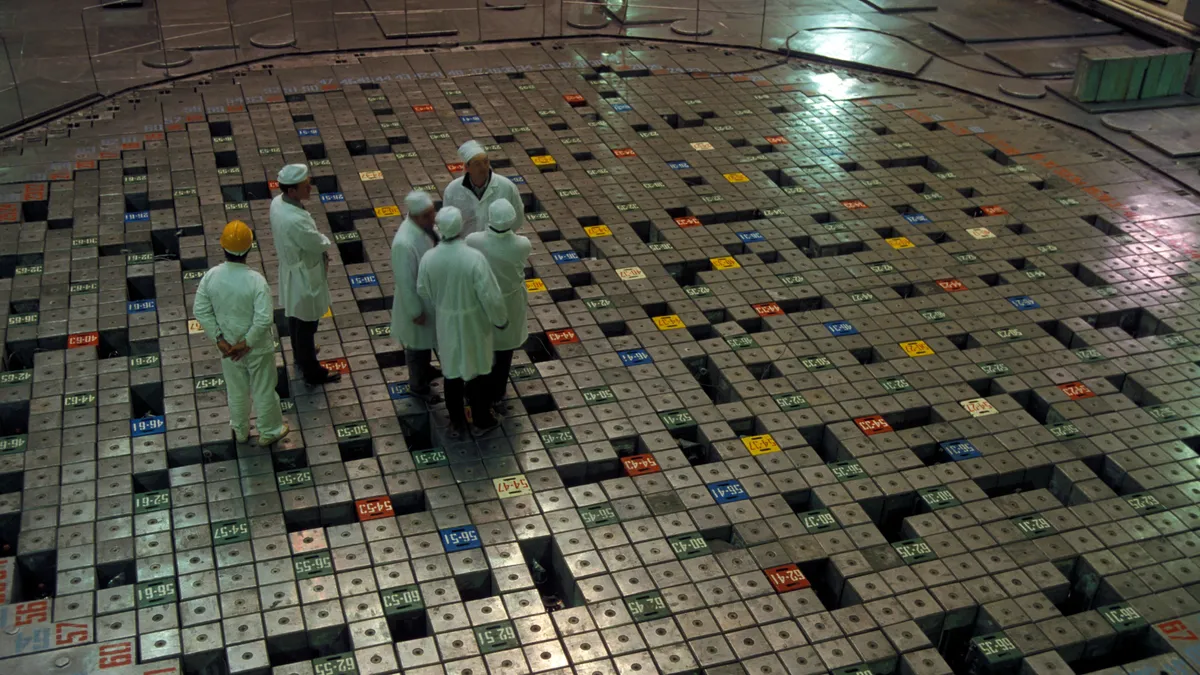
A group of people wearing white laboratory coats stand on a patterned floor in a large circular room.

Scientists stand in the reactor hall for reactor 1 at the Chernobyl Nuclear Power Plant more than a decade after the explosion. RBMK reactors like this one have a fatal design flaw that makes melt down more likely, scientists now know (Image credit: Patrick Landmann via Getty Images)

But at heart of the meltdown was a critical design flaw in the Reaktor Bolshoy Moshchnosti Kanalnyy (RBMK) reactors used at Chernobyl and elsewhere in the Soviet Union. All reactors use a “moderator” material to slow fission-produced neutrons so they can stay in the core and fuel further reactions, while water is used as a coolant to keep the cores from overheating and triggering a runaway reaction.

In the “light water” nuclear reactors typically used in the U.S. and Europe, water is both a moderator and a coolant. This means that, as the reaction gets hotter, more and more water turns to steam, leaving less water to act as a moderator, Live Science previously reported. The reaction has a built-in negative feedback loop in which the more heat and steam is produced, the less efficiently fission occurs.

At Chernobyl, however, graphite served as the moderator. In such a system, as steam forms, the graphite heats up, and the fission reaction speeds up as well. This creates the potential for a runaway positive feedback loop, because steam creates voids where the reaction speeds up, which can quickly boil all the coolant water. This is called a “high positive void coefficient.”

It didn’t help that the control rods were tipped with graphite, which temporarily sped up the fission reaction just as the operators were trying to slow it down. British officials had warned the Soviets that RBMK reactors had serious defects at least nine years prior to the Chernobyl accident, but most of those issues were not corrected, The New York Times reported at the time.

There are several RBMK reactors still operating in Russia, but most of those have undergone extensive safety retrofitting so that such a runaway reaction is, in theory, much less likely.


Share. Facebook Twitter LinkedIn Telegram WhatsApp Email

Keep Reading

‘We were being bullied in our own home’: How ‘authoritarian’ HOAs are contributing to the insect apocalypse

‘We were being bullied in our own home’: How ‘authoritarian’ HOAs are contributing to the insect apocalypse

Bronze Age 5-year-old’s skull found in Uzbekistan is the oldest known evidence of surgery in Central Asia

Bronze Age 5-year-old’s skull found in Uzbekistan is the oldest known evidence of surgery in Central Asia

‘Astonishing’: James Webb telescope spots the most chemically primitive galaxy in the ancient universe

‘Astonishing’: James Webb telescope spots the most chemically primitive galaxy in the ancient universe

Astronomers gaze into the ‘Crystal Ball Nebula’ and see a vision of our dying sun — Space photo of the week

Astronomers gaze into the ‘Crystal Ball Nebula’ and see a vision of our dying sun — Space photo of the week

How many generations of humans have there been?

How many generations of humans have there been?

Are some people wired to see ghosts? A psychologist explains what makes paranormal experiences more likely

Are some people wired to see ghosts? A psychologist explains what makes paranormal experiences more likely

Scientists got mouse eyes to perform photosynthesis ‪—‬ and no, they didn’t turn green

Scientists got mouse eyes to perform photosynthesis ‪—‬ and no, they didn’t turn green

New device could make processors run 1,000 times faster without additional waste heat — scientists say it could reduce data center energy demands

New device could make processors run 1,000 times faster without additional waste heat — scientists say it could reduce data center energy demands

Science news this week: Exploding rocket overshadows NASA’s next steps to the moon, ‘Doomsday Glacier’ faces big loss, quantum computer AI hybrid shows impressive results, and war deepens Iran’s water crisis

Science news this week: Exploding rocket overshadows NASA’s next steps to the moon, ‘Doomsday Glacier’ faces big loss, quantum computer AI hybrid shows impressive results, and war deepens Iran’s water crisis

Add A Comment
Leave A Reply Cancel Reply

Editors Picks

Influencer Estee Williams Mourns 8-Month-Old Daughter After Baby Was Denied Heart Transplant

Influencer Estee Williams Mourns 8-Month-Old Daughter After Baby Was Denied Heart Transplant

May 31, 2026
Frederik Andersen pens heartfelt Claude Lemieux tribute after fighting back tears as Hurricanes reached Stanley Cup Final

Frederik Andersen pens heartfelt Claude Lemieux tribute after fighting back tears as Hurricanes reached Stanley Cup Final

May 31, 2026
Dem congressional candidate charged with terrorist threats after pulling gun on government officials

Dem congressional candidate charged with terrorist threats after pulling gun on government officials

May 31, 2026
Commodores bassist Ronald LaPread who played on ‘Brick House’ dies at 75

Commodores bassist Ronald LaPread who played on ‘Brick House’ dies at 75

May 31, 2026

Subscribe to News

Get the latest USA news and updates directly to your inbox.

Latest News
New on Prime Video in June 2026 — All the Top Movies and TV Shows You Need to Watch

New on Prime Video in June 2026 — All the Top Movies and TV Shows You Need to Watch

May 31, 2026
Mets need Nolan McLean, rest of top starters to add missing piece necessary to save season

Mets need Nolan McLean, rest of top starters to add missing piece necessary to save season

May 31, 2026
Berkshire Hathaway to acquire homebuilder Taylor Morrison in massive .5B deal

Berkshire Hathaway to acquire homebuilder Taylor Morrison in massive $8.5B deal

May 31, 2026
Facebook X (Twitter) Pinterest WhatsApp TikTok Instagram
© 2026 USA Times. All Rights Reserved.
  • Privacy Policy
  • Terms
  • Advertise
  • Contact

Type above and press Enter to search. Press Esc to cancel.