






QUICK FACTS
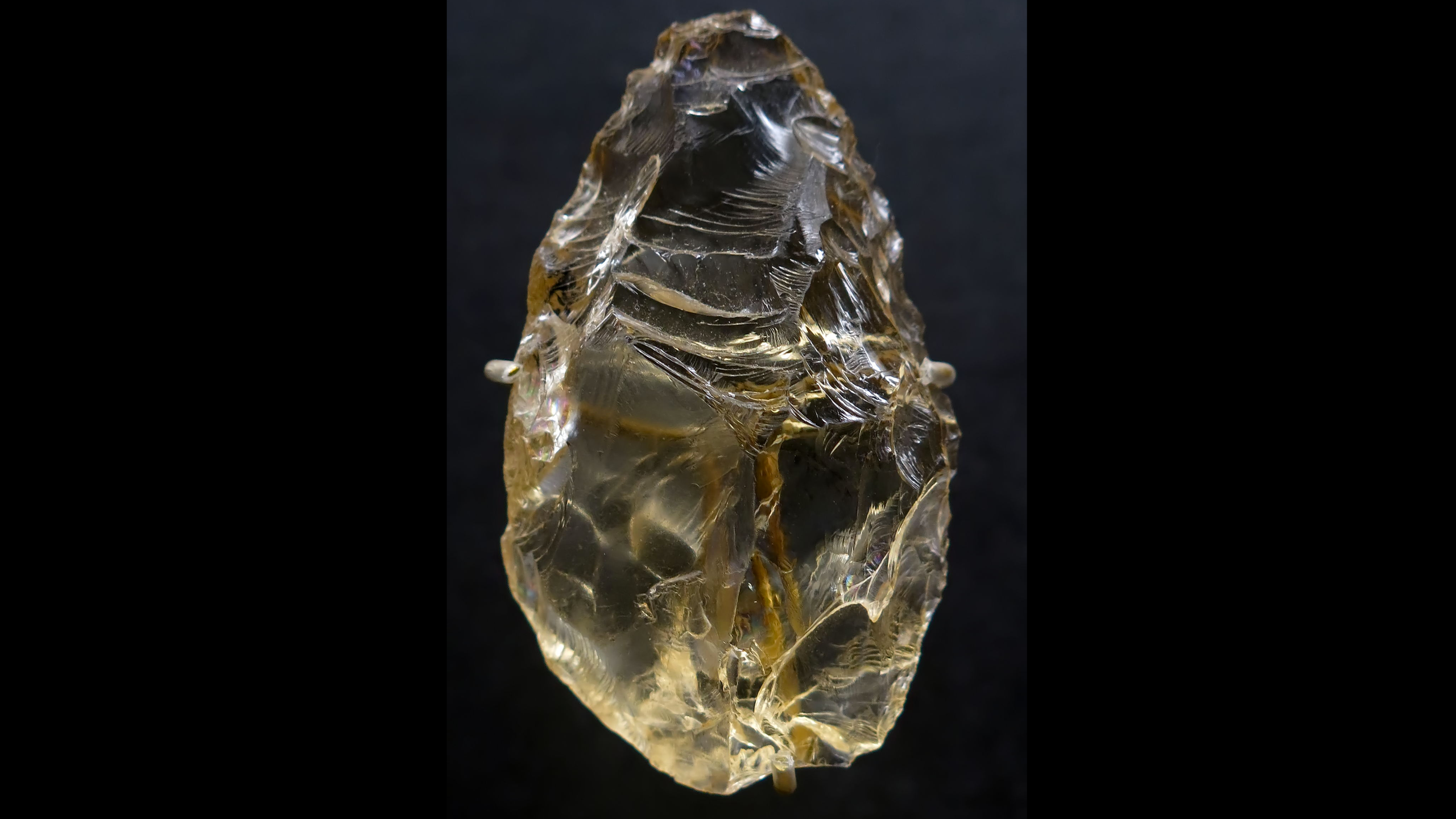
Name: Rock crystal scraper
What it is: A stone tool made from microcrystalline quartz
Where it is from: Dordogne, southwestern France
When it was made: Between 45,000 and 80,000 years ago
A century ago, American archaeologists excavating at a cave site in France unearthed a cache of seven rock crystal tools made by Neanderthals. The discovery was one of the first to prove that Neanderthals were not the unintelligent brutes that many scientists of the time believed they were.
This rare quartz scraper was found at the archaeological site of Abri Des Merveilles in the Dordogne region of France in 1924 by a team from the American School of Prehistoric Research (now a department at Harvard University) led by George MacCurdy. The unique tool is now in the collection of France’s National Archaeological Museum.
Neanderthals typically crafted their stone tools from flint or chert because these rocks would predictably fracture into sharp edges. But a small handful of Neanderthal sites in Europe have yielded tools made from microcrystalline quartz, also known as rock crystal, resulting in stunningly clear scrapers and points.
Latest Videos FromLive Science
According to MacCurdy’s April 1931 excavation report, this was the first rock crystal tool the team discovered. It is transparent but yellow-tinged, and it may have been used as a combination scraper and point. In addition to six other rock crystal tools, MacCurdy found tiny rock crystal chips that meant the tools were likely fashioned on-site in the cave. The rocks may have tumbled downstream from the headwaters of the Vézère, a tributary of the Dordogne River that runs near the site. Abri des Merveilles has never been precisely dated. However, based on stratigraphy, tool types and the presence of a Neanderthal molar, the rock crystal tools were likely made between 45,000 and 80,000 years ago.
MacCurdy’s discovery proved that Neanderthals, not modern humans (Homo sapiens), were the first to create innovative tools from rock crystal — a conclusion that surprised many scientists of the time.
A century ago, most experts believed that Neanderthals were ape-like and unintelligent, thanks in large part to paleoanthropologist Marcellin Boule’s 1909 analysis of a Neanderthal skeleton from the site of La Chapelle-aux-Saints in France. The skeleton of an older male Neanderthal with osteoarthritis influenced Boule’s incorrect characterization of Neanderthals as knuckle-dragging cavemen. This perception of Neanderthals lasted well into the 21st century, when paleogeneticists finally proved that Neanderthals and modern humans mated.
MacCurdy, however, saw the rock crystal tools as an indication that Neanderthals had a sense of aesthetics. “We are accustomed to think of Neandertal man as devoid of the artistic sense,” he wrote, because, a century ago, archaeologists had not yet found evidence of Neanderthal rock art, carved artifacts, engravings or use of pigments.
Get the world’s most fascinating discoveries delivered straight to your inbox.
The Neanderthal “was not an artist in the strict sense; that he had an eye for beauty of form and color is evident from even the limited use he made of rock crystal,” MacCurdy wrote in the journal PNAS in November 1931. “Neandertal man must also be given credit for discernment of beauty and quality of the material employed in his industry.”
According to France’s National Archaeological Museum, which profiled this tool as their Object of the Month in September 2025, MacCurdy drew highly innovative conclusions about Neanderthals from the rock crystal tools, which helped pave the way for our modern understanding of our enigmatic extinct cousins.
For more stunning archaeological discoveries, check out our Astonishing Artifacts archives.
Can you put together last week’s Astonishing Artifact?
TOPICS