


Quick facts
What it is: Mars
Where it is: 2.2 astronomical units (Earth-sun distances)
When it was shared: May 18, 2026
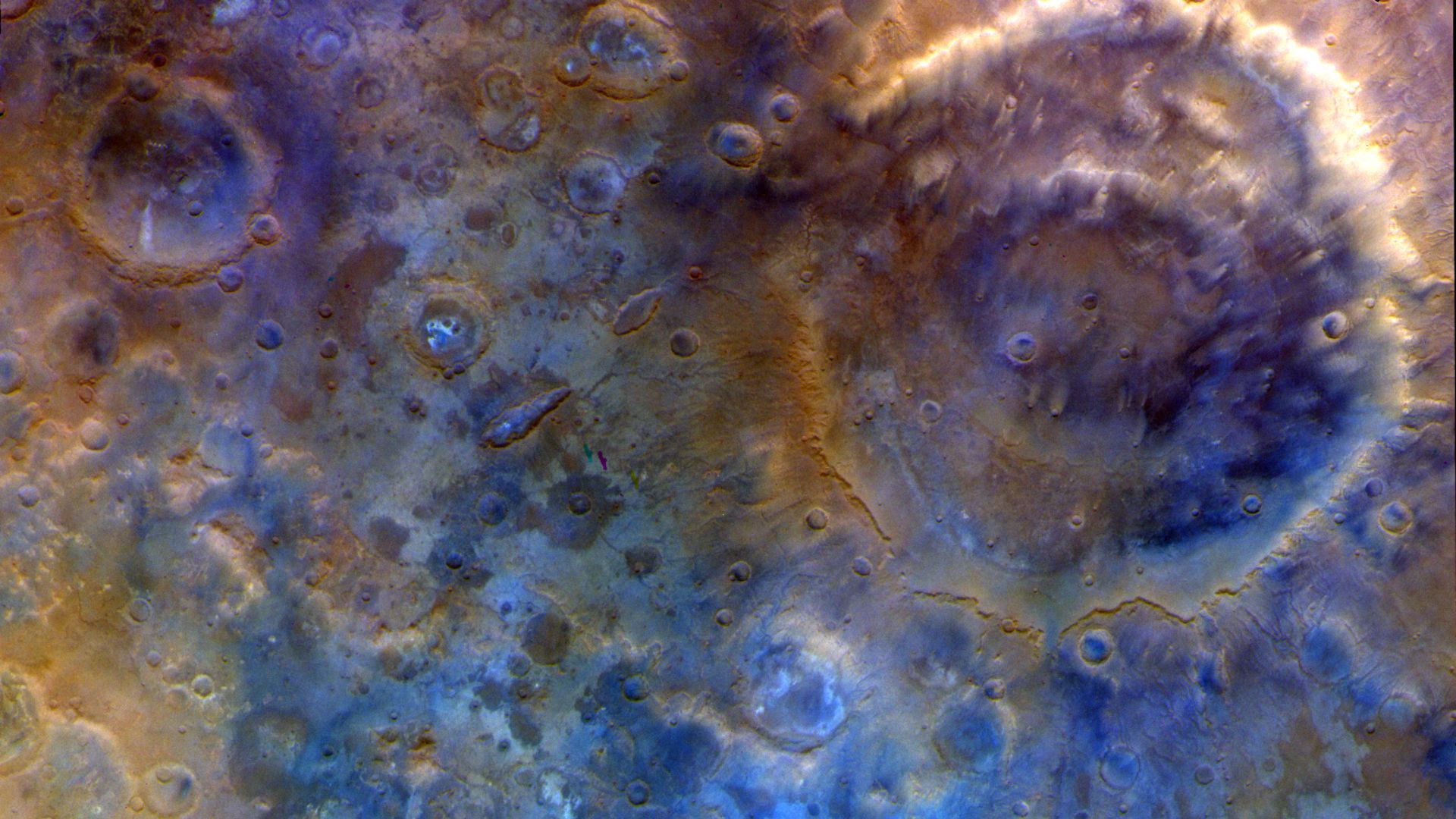
Is it just us, or is the Red Planet looking a lot bluer than usual?
NASA’s Psyche spacecraft returned this colorful snapshot of Mars after completing a close flyby of the planet last week, marking a major milestone in the probe’s long journey to the metal-rich asteroid 16 Psyche. The spacecraft passed within 2,864 miles (4,609 kilometers) of the Martian surface on May 15, taking a suite of color images, including this close-up of the double-ringed Huygens crater and the heavily cratered southern highlands surrounding it.
Aside from the image of Huygens crater, Psyche obtained close-ups of wind blowing over craters in the Syrtis Major region and a high-resolution view of the water-ice-rich south polar cap of Mars.
In other spectacular images taken as Psyche approached and departed the planet, Mars appears as a thin crescent — a rare perspective afforded by Psyche’s high angle of approach. Researchers also observed sunlight scattering through Mars’ dusty atmosphere, creating a brighter-than-expected glow around the edge of the planet. As it left the vicinity of the Red Planet, Psyche got an image of an almost fully lit Mars, which included its south polar cap and the Valles Marineris canyon.
Psyche sees streaks on Mars where wind has blown material off of impact craters.
(Image credit: NASA/JPL-Caltech/ASU)
“We’ve captured thousands of images of the approach to Mars and of the planet’s surface and atmosphere,” Jim Bell, the Psyche imager instrument lead and a planetary scientist at Arizona State University, said in a NASA statement. It was part of an effort to calibrate Psyche’s multispectral cameras well in advance of its arrival at asteroid 16 Psyche. “As the spacecraft continues its journey after the flyby, we’ll continue calibration imaging of Mars for the rest of the month as it recedes into the distance,” Bell added.
NASA’s solar-powered Psyche mission launched Oct. 13, 2023, on a complex route to the asteroid belt. The quickest way to get somewhere in the solar system isn’t to use propellant to fly directly but to slingshot around a moon or planet, effectively using gravity and orbital motion to accelerate a spacecraft. 16 Psyche is in the main asteroid belt between Mars and Jupiter, where it orbits the sun about three times farther away than Earth does.
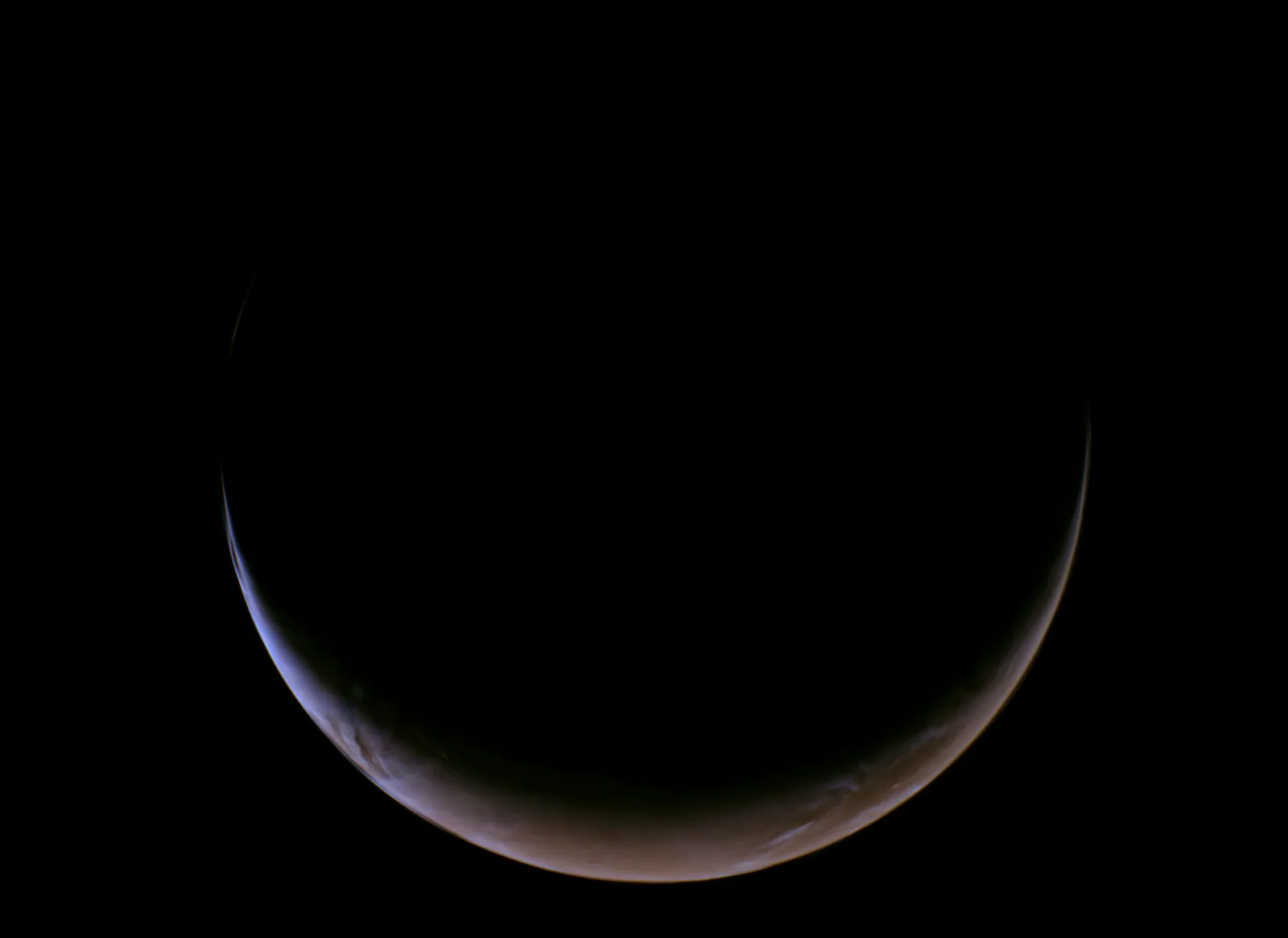
Psyche sees a crescent Mars as the spacecraft approached for a gravity assist on the way to the asteroid belt.
(Image credit: NASA/JPL-Caltech/ASU)
According to NASA’s Jet Propulsion Laboratory, the recent Martian flyby increased Psyche’s speed by approximately 1,000 mph (1,600 km/h) and shifted its orbital plane by about 1 degree relative to the sun.
Get the world’s most fascinating discoveries delivered straight to your inbox.
Following the maneuver, NASA engineers used the agency’s Deep Space Network to confirm that the spacecraft remains on the correct trajectory for its scheduled arrival at asteroid Psyche in August 2029, where it will go into orbit and conduct detailed mapping and scientific observations. The asteroid is thought to be the exposed core of a planetesimal, a building block of an early planet.
The abundant metals on the asteroid are thought to be worth many quadrillions of dollars — though, at the moment, there is no feasible plan for extracting them.
What do you know about the Red Planet? Test your knowledge with our Mars quiz!
TOPICS