



Follow us
Add us as a preferred source on Google
Subscribe to our newsletter
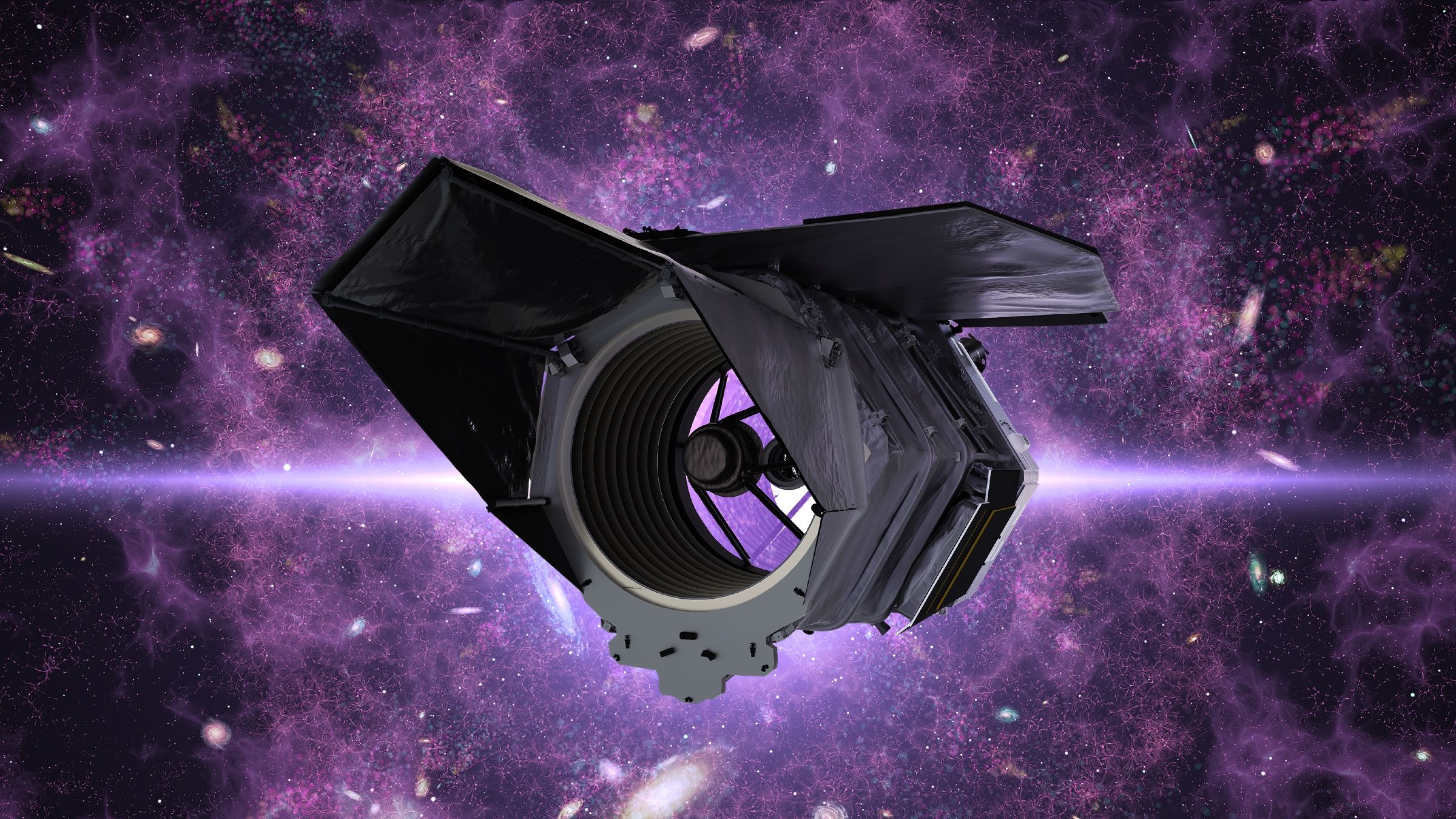
NASA’s Nancy Grace Roman Space Telescope is nearing its final destination more than 1 million miles (1.6 million kilometers) from Earth, where it will soon scour the universe for a host of cosmological treasures, including an estimated 100,000 new alien worlds.
But even before its mission truly begins, recent developments suggest the state-of-the-art spacecraft could take better images than — and remain operational for more than twice as long as — initially expected, further delighting already-excited astronomers.
“It is fantastic to learn that Roman is not just reaching its design goals but exceeding them,” Eamonn Kerins, an astronomer at the University of Manchester in the U.K. who will help lead one of Roman’s major surveys, told Live Science.
Latest Videos FromLive Science
Roman is NASA’s latest flagship space telescope, following in the footsteps of iconic observatories like the Hubble Space Telescope and the James Webb Space Telescope (JWST). The $4 billion machine — which is over 42 feet (12.7 meters) long and weighs around the same as a fully grown Tyrannosaurus rex — successfully launched into space on Aug. 30, more than a decade after scientists started building it.
The telescope is now en route to Lagrange point 2 (L2), a fixed point relative to our planet where Earth’s gravity and the sun’s gravity cancel each other out. There, Roman will join several other important spacecraft, including JWST and the European Space Agency’s Euclid telescope.
Roman was launched into space on board one of SpaceX’s Falcon heavy rockets. It lifted off Aug. 30 from NASA’s Kennedy Space Center in Florida.
(Image credit: SpaceX via NASA)
During Roman’s journey to L2, which is currently around 85% complete, mission scientists have remotely switched on the telescope’s various instruments to test whether they function as expected. So far, this “commissioning process” has gone off without a hitch, and by the time Roman arrives in less than two weeks, it should be ready to snap its first in-depth images of the cosmos.
Researchers were already pumped to see what Roman will be able to do once it is in place and fully switched on. However, that excitement has further intensified in recent weeks, thanks to two postlaunch developments.
Get the world’s most fascinating discoveries delivered straight to your inbox.
First, a series of near-perfect rocket burns, executed during and shortly after launch, saved more than a decade’s worth of fuel that can now be used to extend Roman’s mission. Second, after remotely adjusting the telescope’s mirror, researchers discovered it should be capable of snapping images with around 30% greater detail than engineers predicted.
The team that designed, launched and remotely commissioned the orbital observatory has “done an amazing job” and “their work has ensured that Roman is more than up to the task,” Kerins said.
Extended lifespan
Shortly after Roman arrived in space on board a SpaceX Falcon Heavy rocket that lifted off from NASA’s Kennedy Space Center in Florida, mission scientists conducted two major burns, or engine firings, which gave the spacecraft enough momentum to escape Earth’s orbit and make the journey to L2.

Roman is around the same size as a small truck and was packed into the nose cone of the Falcon Heavy rocket prior to launch.
(Image credit: SpaceX via NASA)
Thanks to a combination of “exquisite planning by our orbital dynamics team” and “brilliant execution by the operations team,” these burns were so precise that each one saved up to four years’ worth of fuel, Jamie Dunn, director of NASA’s Goddard Space Flight Center in Greenbelt, Maryland, said in a Sept. 14 statement.
On top of this, Roman ended up being much lighter than initially planned, which allowed engineers to pack another four years’ worth of fuel into the spacecraft before launch. “Since Roman’s [weight] was lower than we budgeted for, we were able to fill the propellant tanks to their capacity rather than only filling them as much as we needed,” Alison Rao, the Roman propulsion lead at NASA Goddard, said in the statement.
In total, these savings could give Roman an additional 12 years of fuel, which could more than double the mission’s planned 10-year lifespan. That means Roman could still be capturing images of the cosmos in 2048.
Given that Roman can collect data up to 1,000 times faster than Hubble, this extended lifespan will greatly enhance the amount of data the new space telescope will be able to capture. “With a 20-year Roman lifetime, we could, in theory, do over 20,000 years of Hubble survey work,” Kerins said. “That’s a lot of science!”

Roman is now on its way to L2, where the gravity of Earth and the sun cancel out, allowing it to remain in one place without expending much fuel.
(Image credit: NASA/John Kraus)
This prolonged lifespan will let astronomers compare images of specific objects decades apart — such as expanding nebulas or colliding galaxies — allowing them to detect changes they otherwise might have missed.
It may also let them study objects or phenomena that we haven’t even discovered yet, which is particularly exciting, Kerins noted. “The real show-stopper results will be new things we just aren’t even thinking about right now,” he said. “The possibilities are truly breathtaking.”
There is also the chance that Roman’s mission could be extended even further, because engineers often find clever ways of making active spacecraft last longer. For example, Hubble is more than two decades past its initial mission parameters, and the recently deceased Swift Observatory lasted 10 times longer than initially predicted before falling back to Earth last week.
Improved image quality
Roman’s secret weapon is arguably its Wide Field Instrument (WFI), made up of a 288-megapixel camera attached to a 7.9-foot (2.4 m) mirror, which will capture ultra-detailed images with a field of view roughly 100 times larger than Hubble’s.

Roman’s WFI consists of a 288-megapixel camera attached to a 7.9-foot (2.4 m) mirror. It will be capable of capturing images with a field of view 100 times greater than Hubble.
(Image credit: NASA/Chris Gunn)
We have already seen the first WFI images — a series of blurry, green dots captured during a test of the instrument’s 18 different light detectors ( see below). However, those photos were nothing like what WFI will capture in the future; those images will be so detailed that you would need dozens of high-definition TVs to properly display a single snap in full resolution, Kerins said.
After Roman completes the initial WFI commissioning phase, those images will be around 30% sharper than designers predicted. “All of the images from Roman’s cosmic surveys will be even sharper than we expected,” Alden Jurling, a senior optical engineer who works on Roman at NASA Goddard, said in an Oct. 14 statement. “It’s a great outcome.”
The improvements were first noticed after the WFI’s car-sized mirror was realigned by just one-sixteenth the diameter of a human hair, demonstrating just how intricate the commissioning process has been. “Calibrating an instrument is like tuning a piano or guitar before a concert,” Maxime Rizzo, a WFI systems engineer at NASA Goddard, said in the statement. “You adjust everything until it’s just how you want it and then leave the settings alone so it performs consistently while you use it.”

NASA released Roman’s first photos on Sept. 15. Each small square represents one of the telescope’s light detectors, and each blurry green spot is a distant star. (This is just a test image and does not represent how the telescope’s proper photos will look.)
(Image credit: NASAGoddard/Tyler Desjardins (STScI) with annotations by Harry Baker)
The improved image quality could really come to the fore during Roman’s hunt for potentially habitable exoplanets, which is what Live Science’s readers are most excited about for this mission.
Kerins, who is leading the Exoplanet Demographics Working Group for the Transits in the Roman Exoplanets Survey, is particularly excited about this development, but he said it does not necessarily guarantee that Roman will find more exoplanets than initially predicted.
The rest of Roman’s commissioning phase is also proceeding as planned.
Roman’s coronagraph instrument, which will block out the light from distant stars to allow WFI to spot alien worlds, has passed its main commissioning phase and is working as intended, according to a NASA blog post.

Roman has completed around 85% of its journey to L2 and should arrive at its final destination in the next few weeks. (The timeline in this image is a screenshot from Roman’s commissioning process website, captured on Nov. 11.)
(Image credit: NASA)
Meanwhile, a global network of ground stations, which will receive up to 1.4 terabytes of data from Roman every day, has established contact with the spacecraft and is receiving signals as expected, another blog post revealed.
All of these early wins raise hopes that Roman can have a long and successful career, and are a testament to the years of work that went into designing the spacecraft and planning the mission.
“What we’re seeing now with the actual optical performance and estimated lifetime of Roman is just how good that design process has been,” Kerins said. “It’s a remarkable achievement. I can’t wait to see what Roman is going to give us.”
TOPICS