


Close Menu
  • Home
  • United States
  • World
  • Politics
  • Business
  • Lifestyle
  • Entertainment
  • Health
  • Science
  • Tech
  • Sports
  • More
    • Web Stories
    • Editor’s Picks
    • Press Release

Subscribe to Updates

Get the latest USA news and updates directly to your inbox.

What's On
Colonel Sanders hated KFC gravy so much it sparked a franchise lawsuit

Colonel Sanders hated KFC gravy so much it sparked a franchise lawsuit

May 31, 2026
13 Expensive-Looking Linen Dresses That Give Effortless Hamptons Rich Mom Energy

13 Expensive-Looking Linen Dresses That Give Effortless Hamptons Rich Mom Energy

May 31, 2026
Here’s how to watch USMNT pre-World Cup friendly vs. Senegal live for free

Here’s how to watch USMNT pre-World Cup friendly vs. Senegal live for free

May 31, 2026
Facebook X (Twitter) Instagram
Trending
  • Colonel Sanders hated KFC gravy so much it sparked a franchise lawsuit
  • 13 Expensive-Looking Linen Dresses That Give Effortless Hamptons Rich Mom Energy
  • Here’s how to watch USMNT pre-World Cup friendly vs. Senegal live for free
  • Exclusive | Ex-NYC Mayor Mike Bloomberg set to march in Israel Day Parade: ‘Sticking it to Mamdani’
  • Agitators stockpile masks, protective gear outside Newark’s Delaney Hall
  • I Spent a Weekend in Amsterdam — All the Cool Girls Wear These Laid-Back Dress Styles
  • Karl-Anthony Towns envisioned his Knicks future with call back to first New York pregame outfit
  • Bronze Age 5-year-old’s skull found in Uzbekistan is the oldest known evidence of surgery in Central Asia
  • Privacy
  • Terms
  • Advertise
  • Contact Us
Join Us
USA TimesUSA Times
Newsletter Login
  • Home
  • United States
  • World
  • Politics
  • Business
  • Lifestyle
  • Entertainment
  • Health
  • Science
  • Tech
  • Sports
  • More
    • Web Stories
    • Editor’s Picks
    • Press Release
USA TimesUSA Times
Home » Live quantum network test in New York overcomes 2 key hurdles in creating an ‘unhackable’ internet
Live quantum network test in New York overcomes 2 key hurdles in creating an ‘unhackable’ internet
Science

Live quantum network test in New York overcomes 2 key hurdles in creating an ‘unhackable’ internet

News RoomBy News RoomMay 8, 20260 ViewsNo Comments

Researchers have created a network that they say demonstrates the real-world feasibility of a quantum internet that’s physically impossible to hack, at least without detection.

Working with quantum startup Qunnect and networking company Cisco, the team connected a trio of nodes across New York’s existing fiber-optic cables with quantum signals in the form of photons (packets of light) where quantum states are used to carry information through entangled qubits. By distributing and swapping entanglement between the signals, the scientists effectively connected them into a small quantum network.

The demonstration builds on work in 2023, in which the same team connected a pair of nodes between Brooklyn and Manhattan. The addition of a third node shows that it’s possible to use existing physical infrastructure to create something approaching a true quantum network, the scientists say. They outlined their findings in a study uploaded Feb. 17 to the arXiv preprint database.


You may like

This third node acts as an intermediate hub where the team could perform entanglement swapping and routing, turning two links into a small multi‑node quantum network that can distribute entanglement across different pairs on demand. This would act more like a true network rather than a single line.

“Manhattan is a very compact place,” said Javad Shabani, director of NYU’s Center for Quantum Information Physics and the NYU Quantum Institute. “Everything is within five or six miles, and you can find hundreds of financial institutions in a very small radius. That density — of infrastructure, institutions, and potential users — may make the city one of the first places where a quantum internet begins to take shape. Having this network right now is important. It’s a huge investment that will pay off probably in the next decade or so.”

A blueprint for future quantum networks

A quantum internet is deemed “unhackable” due to device-independent quantum key distribution (DI-QKD), a method by which cryptography keys are encoded in the quantum state of particles such as photons. It’s not possible to copy quantum states, and measuring them disturbs them — meaning that eavesdropping is difficult and simple to detect.

Information travels via photons, but they can get easily lost in fiber. In addition, “noise” — disturbances caused by the environment or other stimuli — scrambles their states, thus limiting data transfers to very short distances.

Get the world’s most fascinating discoveries delivered straight to your inbox.

To extend this range, the team created a “hub-and-spoke” network — an intermediary hub for swapping and routing with two outlying spokes. To accomplish this, they created simple nodes at Qunnect’s Brooklyn facility and generated pairs of photons that are entangled — meaning their quantum states are linked so they share information over space and time. These flowed across 5 to 6 miles (8 to 10 kilometers) of deployed commercial fiber to a central hub at a QTD Systems facility, a commercial data center and network facility in Lower Manhattan.

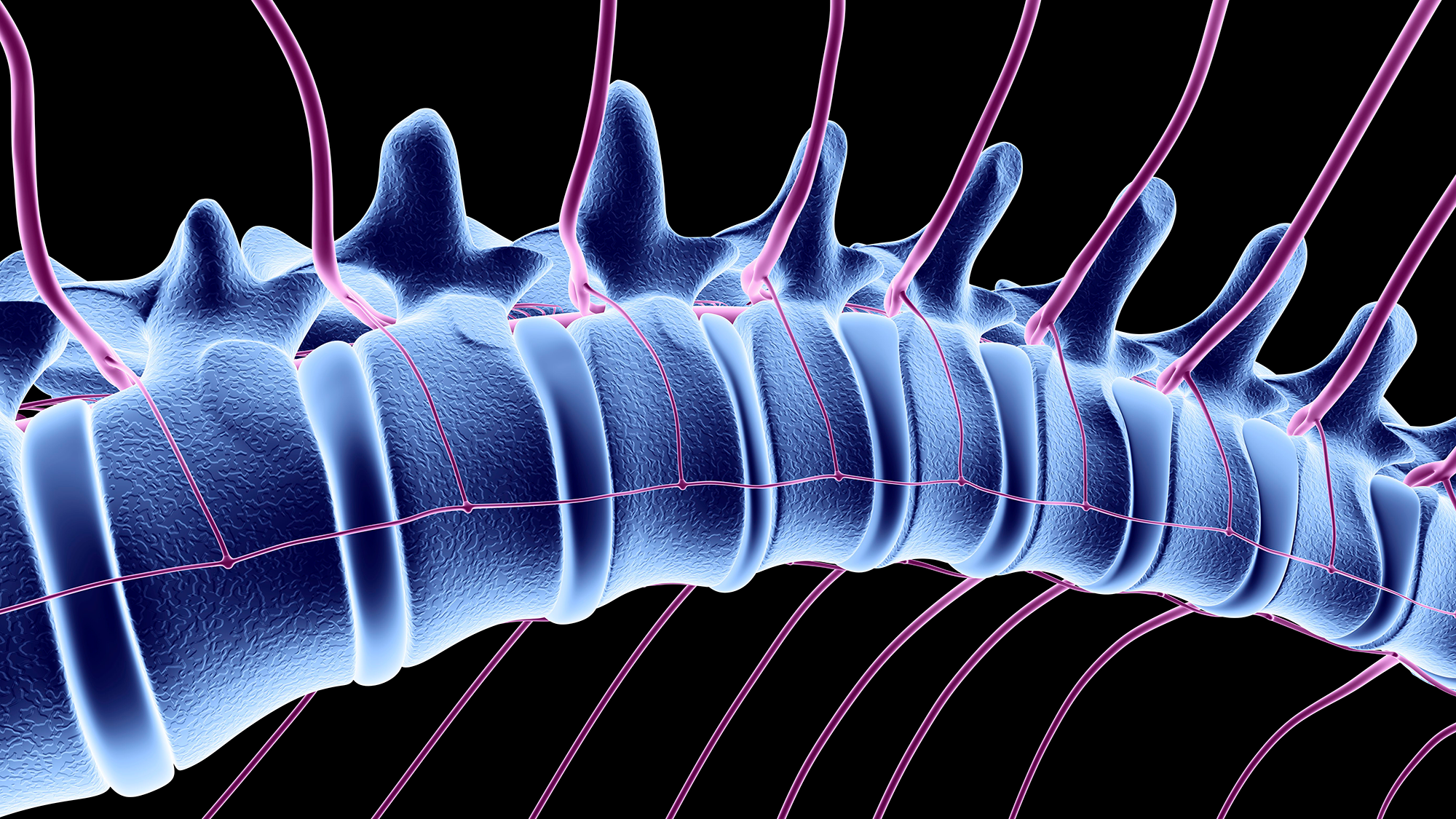
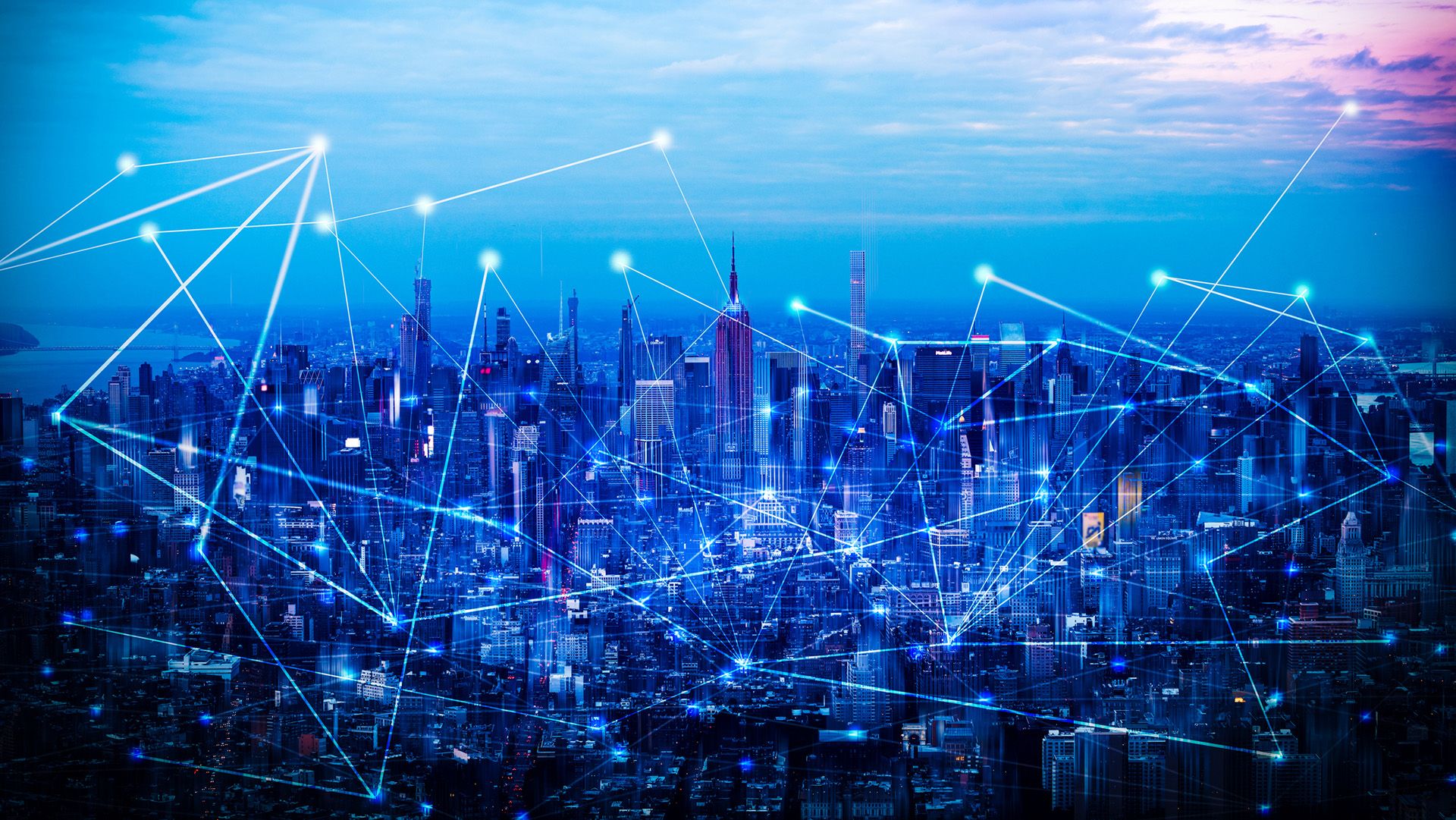
The success of the quantum internet relies on entanglement, where particles’ internal quantum states are interdependent on each other.

(Image credit: koto_feja via Getty Images)

One vital advance came in the form of “entanglement swapping” — a process by which particles that have never previously interacted can become entangled. This is key for building short connections into a larger network, the scientists said.

This relies on measurements that “transfer” entanglement from initial pairs to distant ones. It relies on quantum teleportation — the phenomenon where two or more particles share linked quantum states — so measuring one instantaneously determines correlated properties of the others. However, instead of teleporting data between two entangled qubits, it teleports the state of entanglement itself.


What to read next

The swapping happened at the QTD center, where cryogenic detectors ‪—‬ ultra-sensitive photon detectors cooled to extremely low temperatures to reliably detect single photons carrying quantum information ‪—‬ measured the photons and linked pairs that had never interacted. The result was city-spanning entanglement between the original outer sources.

Addressing the internet’s Achilles’ heel

Conventional data transfers are highly susceptible to eavesdropping. Scientists say the quantum internet would solve this issue because any interception disturbs the photons, making the tampering immediately apparent.

This experiment proves metropolitan-scale quantum links work with live telecom fibers, solving the issues of weakening or loss of photons as they travel through optical fiber cables, alongside temperature extremes and vibration that can wreck fragile entanglement.

The hub-and-spoke design addresses scalability by centralizing complex cryogenic gear at one hub. This sidesteps the issue of every node requiring pricey, power-hungry cooling, meaning the network can be expanded without ballooning costs.

In the short term, this demonstration paves the way for QKD, the sharing of unhackable encryption keys to protect sensitive data from sources like banks, the government or the healthcare industry.

In the longer term, it’s a step toward true distributed quantum computing, which could link multiple devices to address highly sophisticated problems, like drug discovery or climate modeling, that no single operator could handle.

Entangled networks could also be deployed to boost quantum sensing, which could lead to ultraprecise clocks, navigation without GPS and other high-precision sensor arrays.

Among the key challenges are that fiber-optic cables absorb and scatter photons exponentially with length — about 0.2 decibels per kilometer at telecom wavelengths — dropping entanglement success to near zero beyond 62 miles (100 km) without boosting. The new experiment transmitted information over a mere 5 to 6 miles (8 to 10 km) per leg; spanning longer distances will require quantum repeaters, which lack the quantum memories required to function effectively.

However, the experiment was important in proving the viability of quantum networks outside a strictly controlled laboratory environment. The scientists showed that the effects of noise and loss can be adequately managed to sustain entanglement across a dense metropolis like New York.

A. N. Craddock, T. Cowan, N. Bigagli, S. Robinson, D. Herrington, I. Luciano, J. Nguyen, A. B. B. de Oliveira, V. V. Ramasesh, & M. G. Raymer, High-rate Scalable Entanglement Swapping Between Remote Entanglement Sources on Deployed New York Fiber, arXiv:2602.15653v2 [quant-ph], https://doi.org/10.48550/arXiv.2602.15653 (2026).


Can you match these ancient devices to their pictures? Find out with our computing quiz!

Share. Facebook Twitter LinkedIn Telegram WhatsApp Email

Keep Reading

Bronze Age 5-year-old’s skull found in Uzbekistan is the oldest known evidence of surgery in Central Asia

Bronze Age 5-year-old’s skull found in Uzbekistan is the oldest known evidence of surgery in Central Asia

‘Astonishing’: James Webb telescope spots the most chemically primitive galaxy in the ancient universe

‘Astonishing’: James Webb telescope spots the most chemically primitive galaxy in the ancient universe

Astronomers gaze into the ‘Crystal Ball Nebula’ and see a vision of our dying sun — Space photo of the week

Astronomers gaze into the ‘Crystal Ball Nebula’ and see a vision of our dying sun — Space photo of the week

How many generations of humans have there been?

How many generations of humans have there been?

Are some people wired to see ghosts? A psychologist explains what makes paranormal experiences more likely

Are some people wired to see ghosts? A psychologist explains what makes paranormal experiences more likely

Scientists got mouse eyes to perform photosynthesis ‪—‬ and no, they didn’t turn green

Scientists got mouse eyes to perform photosynthesis ‪—‬ and no, they didn’t turn green

New device could make processors run 1,000 times faster without additional waste heat — scientists say it could reduce data center energy demands

New device could make processors run 1,000 times faster without additional waste heat — scientists say it could reduce data center energy demands

Science news this week: Exploding rocket overshadows NASA’s next steps to the moon, ‘Doomsday Glacier’ faces big loss, quantum computer AI hybrid shows impressive results, and war deepens Iran’s water crisis

Science news this week: Exploding rocket overshadows NASA’s next steps to the moon, ‘Doomsday Glacier’ faces big loss, quantum computer AI hybrid shows impressive results, and war deepens Iran’s water crisis

What is jetlag, and how can you avoid it?

What is jetlag, and how can you avoid it?

Add A Comment
Leave A Reply Cancel Reply

Editors Picks

13 Expensive-Looking Linen Dresses That Give Effortless Hamptons Rich Mom Energy

13 Expensive-Looking Linen Dresses That Give Effortless Hamptons Rich Mom Energy

May 31, 2026
Here’s how to watch USMNT pre-World Cup friendly vs. Senegal live for free

Here’s how to watch USMNT pre-World Cup friendly vs. Senegal live for free

May 31, 2026
Exclusive | Ex-NYC Mayor Mike Bloomberg set to march in Israel Day Parade: ‘Sticking it to Mamdani’

Exclusive | Ex-NYC Mayor Mike Bloomberg set to march in Israel Day Parade: ‘Sticking it to Mamdani’

May 31, 2026
Agitators stockpile masks, protective gear outside Newark’s Delaney Hall

Agitators stockpile masks, protective gear outside Newark’s Delaney Hall

May 31, 2026

Subscribe to News

Get the latest USA news and updates directly to your inbox.

Latest News
I Spent a Weekend in Amsterdam — All the Cool Girls Wear These Laid-Back Dress Styles

I Spent a Weekend in Amsterdam — All the Cool Girls Wear These Laid-Back Dress Styles

May 31, 2026
Karl-Anthony Towns envisioned his Knicks future with call back to first New York pregame outfit

Karl-Anthony Towns envisioned his Knicks future with call back to first New York pregame outfit

May 31, 2026
Bronze Age 5-year-old’s skull found in Uzbekistan is the oldest known evidence of surgery in Central Asia

Bronze Age 5-year-old’s skull found in Uzbekistan is the oldest known evidence of surgery in Central Asia

May 31, 2026
Facebook X (Twitter) Pinterest WhatsApp TikTok Instagram
© 2026 USA Times. All Rights Reserved.
  • Privacy Policy
  • Terms
  • Advertise
  • Contact

Type above and press Enter to search. Press Esc to cancel.