





Scientists in Japan have discovered a way to transmit data at a speed of 112 gigabits per second (Gbps) at a specific spectrum band that’s vital for the build-out of next-generation 6G wireless networks.
To achieve this breakthrough, the researchers developed a new kind of terahertz wireless communication system driven by microcombs — special photonic devices fitted onto microchips that generate optical frequencies for wireless networks. When used with high-order modulation techniques — advanced ways to enable higher data-transfer rates in limited bandwidth — the team delivered these blistering wireless communication speeds in the 560 gigahertz spectrum band.
Achieving such speeds — at a frequency above 420 GHz for the first time — showed how this system can overcome the limitations of signal power and noise that plague conventional electronics at these ultrahigh frequencies, thereby limiting them to much slower data rates. The researchers outlined their findings May 16 in the journal Communications Engineering.
“This result represents a major step toward practical 6G wireless systems and ultra-high-speed mobile backhaul,” said Takeshi Yasui, a professor in Tokushima University’s Institute of Post-LED Photonics and co-author of the study, said in a statement.
Let there be light
Although 5G wireless speeds are notably fast, with average speeds of approximately 300 megabits per second (Mbps) in the U.S., work is already underway to engineer and roll out 6G networks across the world. In the future, scientists predict speeds to reach a theoretical maximum of 1 terabit per second — more than 3,000 times faster than today’s average 5G speeds and 50 times faster than 5G’s theoretical limit.
Commercial 6G networks are expected to launch by 2030 or beyond, but significant work is still needed to build out these networks. But to ultimately support the delivery of 6G, a fast backhaul wireless network that taps into super-high-frequency terahertz waves is needed. These sit in the spectrum band that goes beyond 350 GHz. Below that frequency, the electronic spectrum is already congested with 5G signals and lacks the frequency to deliver large amounts of data at next-generation speeds.
When conventional electronics are used to push into the terahertz spectrum, their electronic signals get blighted by a lack of power or “phase noise” — essentially, fluctuations in a signal — that make it hard to separate desired signals from unwanted ones. This leads to limitations in signal stability and the amount of data electronic signals can carry at frequencies above 350 GHz.
Get the world’s most fascinating discoveries delivered straight to your inbox.
6G promises speeds 3,000 times current 5G speeds.
(Image credit: Black_Kira via Getty Images)
Photonics — the use of light to carry data — is therefore seen as a way to forge a path to 6G networks. But conventional photonic systems have required bulky laser systems that need precise optical alignment to work well, and they are still hindered by phase noise.
To address these challenges, scientists are exploring optical microcombs as a way to generate a series of precise lines of light. Their optical stability minimizes phase noise. However, they need precise optical alignment; in a real-world network deployment, vibrations could disrupt such alignments and thus interfere with established connections.
In the new study, the researchers noted that these microcombs didn’t “simultaneously achieve stable signal generation and high-order modulation for high-speed data transmission.”
Building bonds
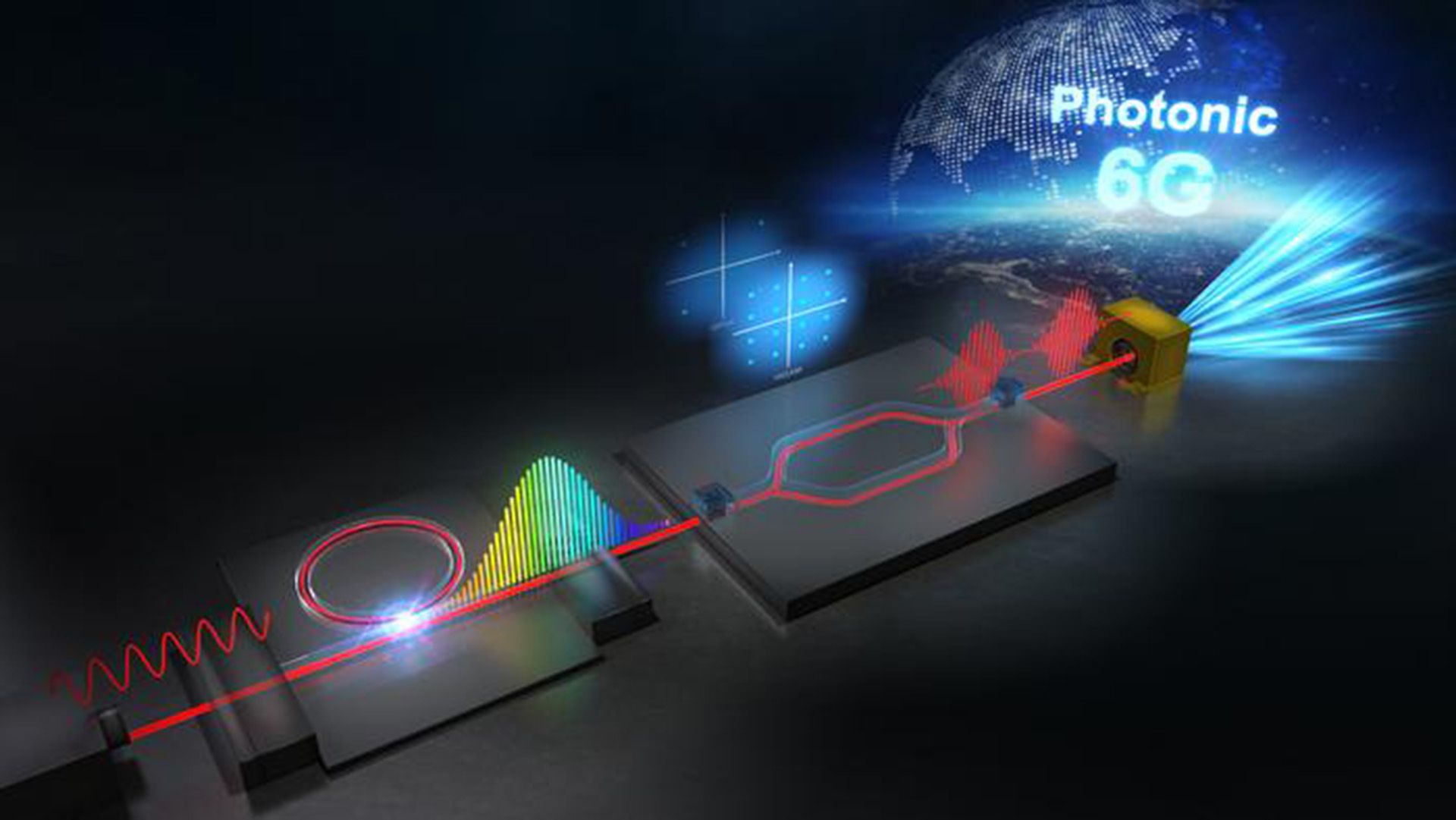
The breakthrough comes from directly bonding an optical fiber to a silicon nitride microresonator – a microcomb photonic structure used to convert laser light into millions of precise laser lines. Combining fiber optics with microcombs bypasses the challenge of precise optical alignment, whereas in more conventional photonic systems, laser light needs to be carefully aligned across multiple axes and stages through the use of optical microscopes so it can be directed into microchips.
To send data using the microcomb system, the researchers generated two optical signal carriers — with high stability and a high signal-to-noise ratio — by injection locking the microcomb with lasers. They coded data into these signals using the QPSK and 16QAM high-order modulation formats — essentially, a way to squeeze as much data as possible into a single wave transmission. Then, they converted the optical signals into the 560 Ghz terahertz wave through a technique called photomixing, before transmitting them to a receiver.
In experiments, they achieved 84 Gbps speeds with QPSK and 112 Gbps speeds with 16QAM. The results mean the team researchers made a compact and stable terahertz signal source capable of data transmission speeds exceeding 100Gbps via a transmitter that’s just 0.2 inches (5 millimeters) across. For comparison, a conventional microcomb system is 17.7 inches (450 mm).
They also integrated a temperature control function into the microresonator so it could withstand temperature fluctuations, therefore more reliably reproducing the required optical resonance characteristics.
The researchers plan to find ways to further curtail phase noise and boost the output power of their systems to deliver even faster data-transfer speeds. But the study opens a way to create a technological foundation for an ultra-high-speed wireless backhaul network. Such a network could bypass the need for underground fiber-optic cabling as the backbone for high-speed networks and lead the way to practical 6G deployments.