




Follow us
Add us as a preferred source on Google
Subscribe to our newsletter
A Euclid space telescope image of the newfound quasar (red dot in the center), which is further away than any known active galactic nucleus found yet.
(Image credit: ESA/Euclid/Euclid Consortium/NASA, Wolf et al. 2026)
Astronomers have just discovered the earliest-known quasar — and it’s 40 million years older than the previous record holder. The finding, which observed the object at just 630 million years after the Big Bang, could help researchers to better understand how black holes developed in the early universe.
“Finding quasars at ever-increasing distances, at the edge of the observable universe, teaches us something about how the black holes in their centres grew,” study co-author Julien Wolf, a researcher at the Max Planck Institute for Astronomy, said in a statement. “The closer to the Big Bang we find them, the faster their black holes must have grown or the more massive they must have been at birth — or both.”
The object — estimated to have the mass of 360 million suns — was described in a new study published Tuesday (Nov. 24) in the journal Astronomy and Astrophysics.
Latest Videos FromLive Science
A quasar, short for “quasi-stellar radio source,” is an incredibly bright core at the center of some galaxies —a region known as the active galactic nucleus (AGN). They form when supermassive black holes, which lurk at the hearts of most galaxies, start to binge on nearby matter. Once enough swirling material accumulates around these black holes, it heats up and glows intensely before falling into the object. What sets quasars apart from other AGNs is their sheer luminosity; they can be brighter than all the stars in a galaxy combined.
Quasars were much more common early in the universe than they are today. They are thought to have peaked in number about 10 billion years ago. Observing them can give scientists important clues as to how galaxies evolve — and how their supermassive black holes develop.

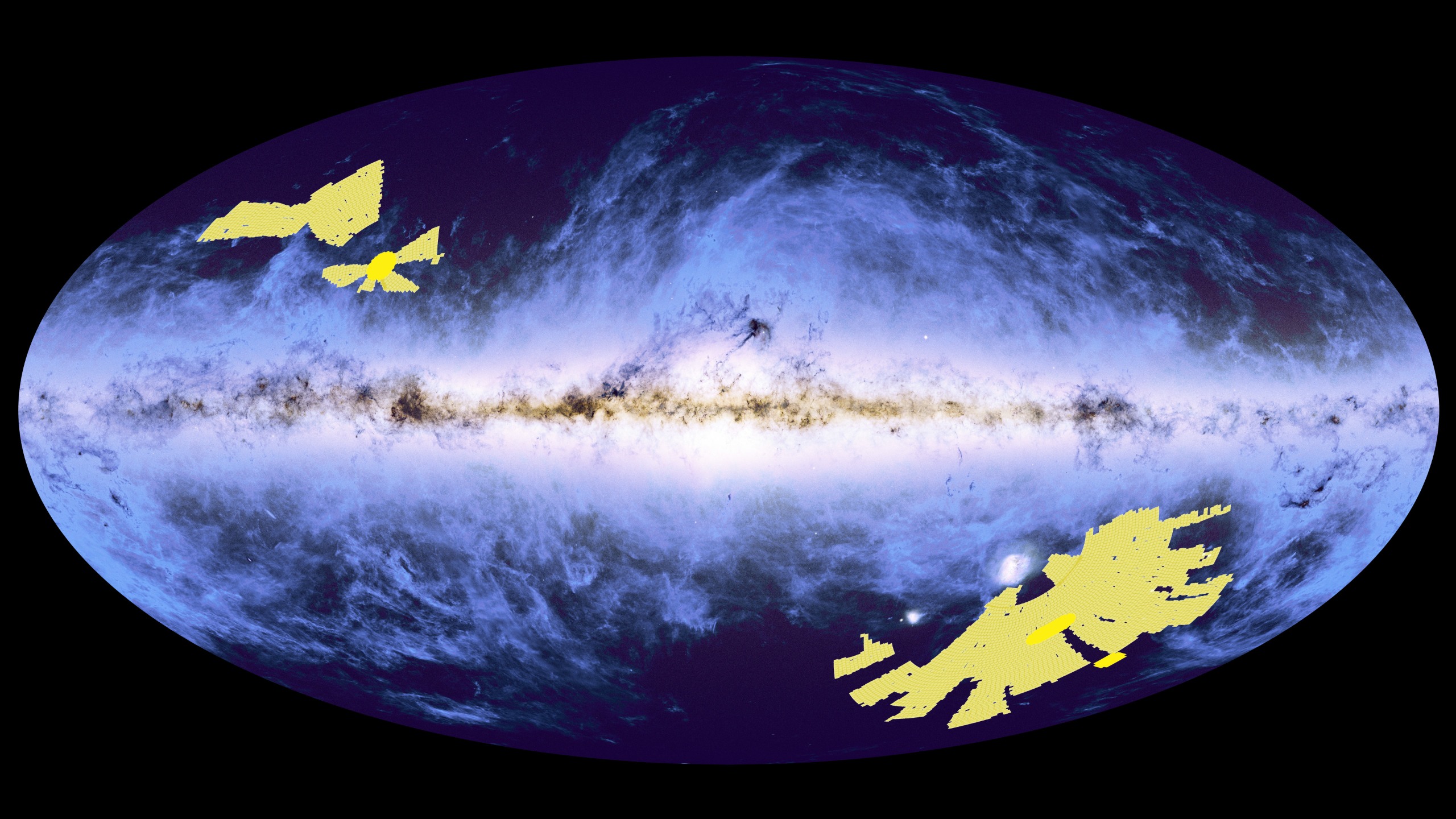
The quasar was discovered during the Euclid Wide Survey’s scan of the sky — marked here in light yellow. Dark yellow patches show the target areas of Euclid’s Deep Survey, which will repeatedly view smaller parts of the sky.
(Image credit: ESA/Euclid/Euclid Consortium/NASA; ESA/Gaia/DPAC; ESA/Planck Collaboration)
Because it takes time for light to travel, observing celestial objects that are very far away is tantamount to peering back in time. We see galaxies very near to Earth as they were only a few thousand years ago; conversely, we see galaxies very far away from us as they were billions of years ago, because their light is only now reaching our telescopes. The older the galaxy, the more red its light becomes as it stretches across the universe — a phenomenon called “redshift.”
Using data from NASA’s James Webb Space Telescope (JWST) and the European Space Agency’s Euclid Wide Survey, the researchers behind the new study identified a quasar with a redshift of 8.13 — the first such object ever found with a redshift beyond 8. This makes it the oldest quasar yet observed, at approximately 13.1 billion years old. For reference, the universe itself is thought to be 13.8 billion years old.
Sign up for the Live Science daily newsletter now
Get the world’s most fascinating discoveries delivered straight to your inbox.
The scientists named the object Dún Aonghasa, after a prehistoric cliff fort on the Atlantic-facing edge of Inis Mór, an island off the coast of Ireland. The name is meant to reflect the quasar’s position at the very edge of our current observational frontier for the cosmos.
According to the researchers, Dún Aonghasa also appears to be growing more slowly than astronomers previously thought possible, given its size. This suggests that its supermassive black hole may have gone through a massive growth spurt, followed by a period of much slower growth in the distant past. The discovery could put new constraints on black hole growth models, which are already being challenged by previous JWST detections of supermassive monsters that seem to have grown too big for their early place in cosmic history.
Future observations from Euclid and JWST could help researchers test this hypothesis and see if it holds for other ancient quasars, the researchers said.
See how much you know about black holes with our black hole quiz!
TOPICS