





Follow us
Add us as a preferred source on Google
Subscribe to our newsletter
In a cave in southern China, archaeologists have discovered an unusual 100,000-year-old tooth that may add a brand-new branch to the human family tree. A genetic analysis of the enamel revealed that the tooth is distinct from all other examples discovered in the area and may have come from an individual who belonged to a previously unknown ancient human lineage.
In a study published Wednesday (Nov. 25) in the journal Nature, researchers described four isolated teeth recovered from two cave sites in southern China that date to around 100,000 years ago, when our extinct cousins the Denisovans roamed Asia. Teeth from one cave site are similar to Denisovans’, but a tooth from the second site has a unique shape and genetic variants in the tooth enamel, suggesting it is from an “unresolved archaic Homo” group, the researchers wrote.
The teeth were recovered from archaeological cave sites named Longchuandong and Chuanshandong in the Guangxi region. Based on uranium-series dating, the two teeth from Longchuandong — a molar and a bicuspid (the teeth between the canines and molars) — date to about 104,500 to 42,600 years ago, while the two teeth from Chuanshandong — which are both bicuspids — are at least 100,800 years old.
Latest Videos FromLive Science
To try to figure out which ancient human group these teeth belonged to, the researchers studied the shape and characteristics of the teeth and extracted proteins from the tooth enamel. The heritable traits of the two Longchuandong teeth lined up well with Denisovan teeth that had previously been identified, revealing that a Denisovan-related group was living in southern China in the Late Pleistocene (129,000 to 11,700 years ago), according to the study. But the Chuanshandong teeth — which the team thinks may be from the same individual — were very different.
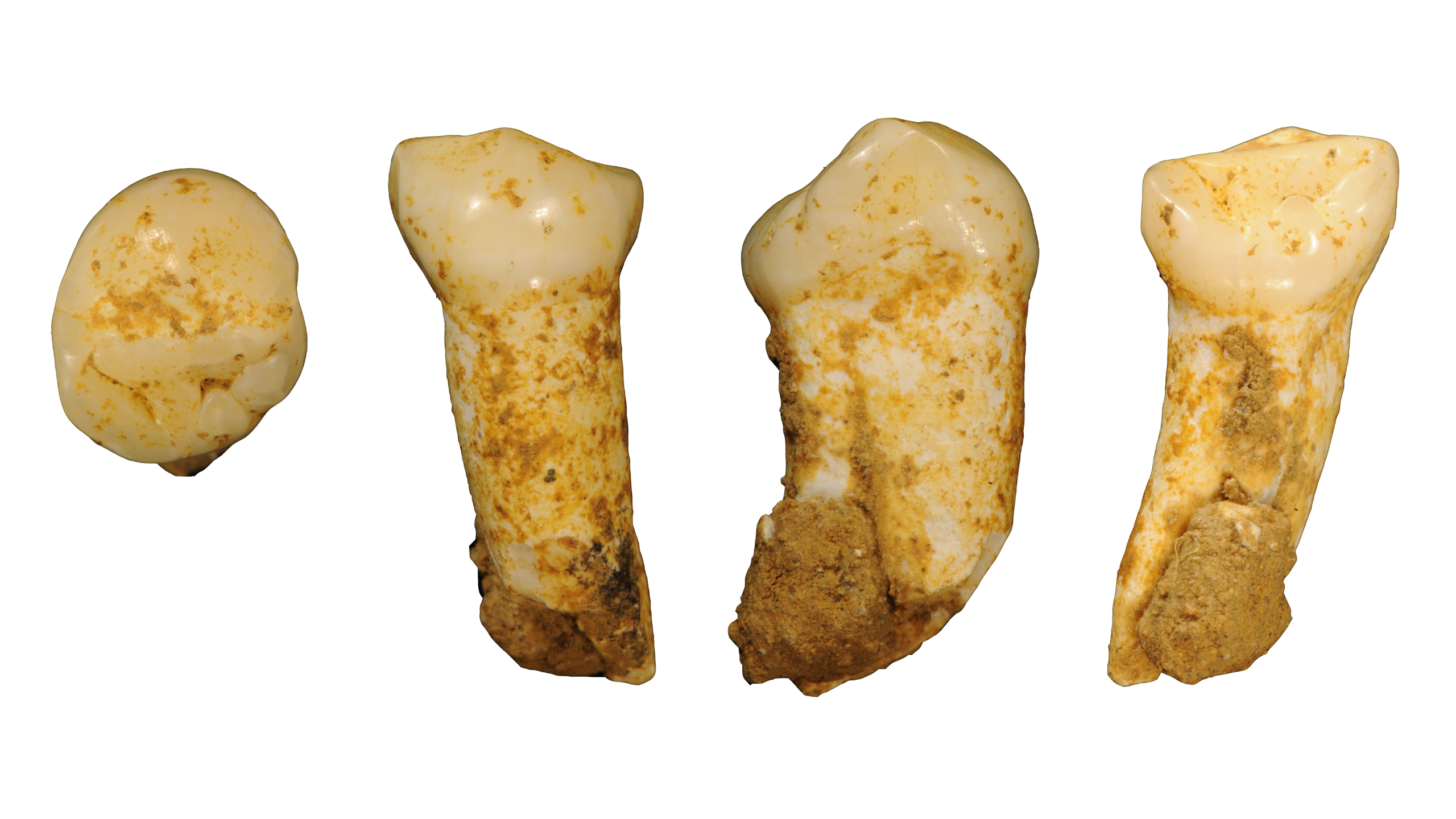
The shape of the Chuanshandong bicuspids “did not align well with any established East Asian Homo member,” the researchers wrote. For example, the Chuanshandong teeth had a complex tooth root system typically seen in Homo erectus, but they also had traits more aligned with Homo sapiens, including a more symmetrically shaped tooth crown.
The root system of the Chuanshandong tooth was complex and similar to what experts see in Homo erectus.
(Image credit: Qiaomei Fu / Institute of Vertebrate Paleontology and Paleoanthropology)
The researchers extracted proteins from the Longchuandong teeth and one of the Chuanshandong bicuspids and discovered they were all from chromosomally male individuals. But while the Longchuandong proteins matched those from Denisovan remains that were unearthed elsewhere in China, several of the Chuanshandong protein variants have only been identified in H. erectus and Homo antecessor, an ancient human distantly related to Neanderthals and modern humans.
The protein analysis “showed that Chuanshandong formed a sister group to the common ancestors of Neanderthals, Denisovans and H. sapiens,” the researchers wrote in the study. This means that “at least two non-sapiens Homo populations may have existed in southern China’s subtropics during the Middle and Late Pleistocene,” they wrote.
Sign up for the Live Science daily newsletter now
Get the world’s most fascinating discoveries delivered straight to your inbox.
A new branch?
Given the small number of 100,000-year-old fossils from China that have been analyzed to date, it is unclear what the morphology and genetics of the Chuanshandong teeth mean for our understanding of human evolution, researchers say.
Denisovans were first identified in 2010, when DNA analysis of a tiny pinkie finger bone found in a Siberian cave revealed that the group was distinct from Neanderthals and modern humans. Since then, paleoanthropologists have discovered fossils all across Asia from our extinct cousins and learned that Denisovans, Neanderthals and modern humans all interbred when they had the chance. But Denisovans’ and Neanderthals’ genetics are known from full genomes — the complete set of their genetic material — while due to preservation issues, most of the fossils from China have only produced proteomes, a more limited set of genetic data that provides information on the body’s proteins.
The Chuanshandong proteome included an ancestral genetic variant linking them to H. erectus and H. antecessor, two groups that lived before H. sapiens arrived on the scene. The presence of these variants suggests that the Chuanshandong teeth were from someone who belonged to a primitive Homo lineage, the researchers wrote. Their unique ancient proteins could also be explained by interbreeding with H. erectus.
It’s not clear whether they are our cousins.
Qiaomei Fu, director of the Ancient DNA Laboratory at the Institute of Vertebrate Paleontology and Paleoanthropology in China
It’s too early, though, to call this a new human group, study co-author Qiaomei Fu, director of the Ancient DNA Laboratory at the Institute of Vertebrate Paleontology and Paleoanthropology, part of the Chinese Academy of Sciences, told Live Science in an email.
“We could call it the Chuanshandong group temporarily, but we need more fossil and molecular evidence to determine its affinity with other archaic Homo,” Fu said. “It’s not clear whether they are our cousins.”


The Guangxi region of China is known for its caves, many of which have Pleistocene mammal fossils.
(Image credit: Getty Images)
“There is more to learn”
The new Chuanshandong proteome is extremely interesting, said John Hawks, an anthropologist at the University of Wisconsin-Madison who was not involved in the study. But “the paper characterizes this as an ‘unknown Homo‘. I wouldn’t put it that way. The question is which group has variation of the proteome,” he told Live Science in an email.
Hawks noted that it is currently unclear whether H. erectus or Denisovans had the specific variant identified in the Chuanshandong tooth, as paleoproteomic analysis is still a relatively new technique. If the genetic variant existed in H. erectus, then the Chuanshandong teeth, which are more similar to H. erectus in shape than they are to Neanderthals, may actually be from an H. erectus individual rather than a brand-new human group. But the comparison is further complicated by the fact that no one has yet found other Denisovan bicuspids — the type of tooth found in the Chuanshandong cave.
“I have a feeling that a comprehensive analysis with all the teeth together would be stronger than these separate papers” that Fu’s research team has published recently, Hawks said. “I think there is more to learn from compiling more complete analyses.”
The researchers noted in the study that excavations have been ongoing in Guangxi caves for a decade, revealing a rich variety of Pleistocene mammal fossils, including ancient human relatives. This may mean that the pace of discoveries about our species’ past will soon accelerate.
“We have some new findings from this region, and we are conducting analyses on them,” Fu said.
Xing, S., Rao, H., Xie, G., Bai, F., Ge, J., Bennett, E.A., Wu, Z., Shao, Q., Li, X., Viola, B., Sun, Q., Zhou, K., Li, Z., Jiangzuo, Q., Zhao, Y., Liu, F., Liu, Y., Feng, X., Lin, Q., Fu, Q. (2026). Middle-Late Pleistocene Denisovans and unresolved Homo in southern China. Nature. https://www.nature.com/articles/s41586-026-11341-6
Human evolution quiz: What do you know about Homo sapiens?
TOPICS