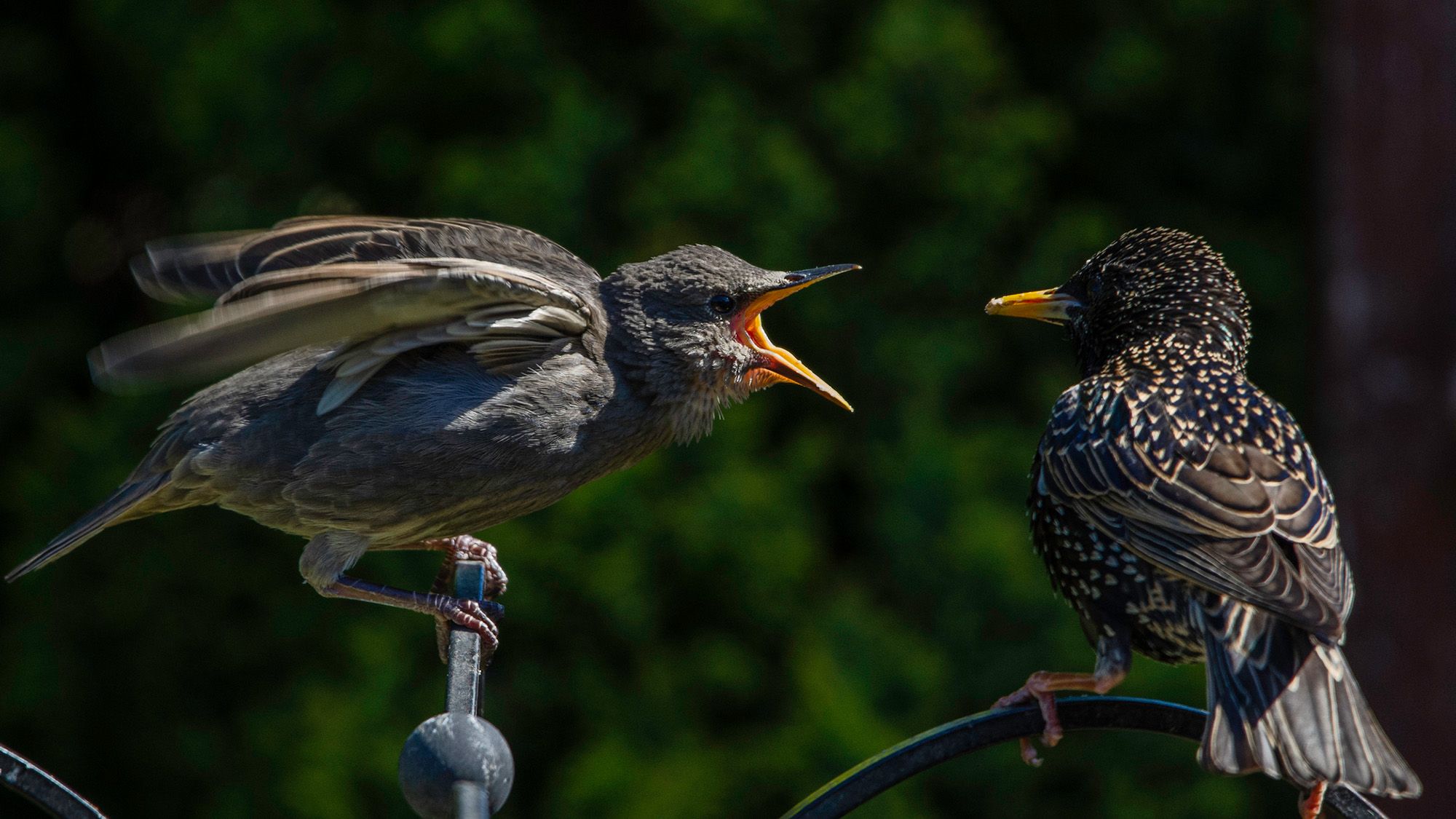
In the late 19th century, Eugene Schieffelin, an amateur ornithologist, released around 100 European starlings (Sturnus vulgaris) in New York City’s Central Park. He was chairman of the American Acclimatization Society, a group dedicated to introducing the flora and fauna of Europe to North America. The result was a disaster. Within decades, the birds had established themselves in this new habitat and moved across the country, and by 1970 — less than a century after their introduction — there were 200 million of them.
But this rapid expansion revealed something remarkable about one of the world’s most invasive bird species: its ability to evolve. In this excerpt from “Bird on the Street: The Unnatural History of Starlings” (Columbia University Press, 2026), author and evolutionary biologist Julia M. Zichello recounts a point in her research when she was starting to figure out these birds’ incredible adaptability: when she received a box of dead starlings.
Wildlife control agencies in the United States cull starling populations annually, at airports and on farms, to prevent damage to crops, interference with livestock, and collisions with aircraft. These birds are killed creatively: trapped, gassed, poisoned; their cervical vertebrae dislocated.
Technically, it is not illegal in the United States for someone without a permit to end the life of a starling (as it is for most other birds). In 2014, I sent an email to the U.S. Department of Agriculture (USDA) Animal Control Unit requesting starling specimens for my research project.
I remember speaking to a wildlife specialist on the phone who cautiously (but professionally) sounded as though they didn’t understand why anyone would want these birds. The starlings were, quite literally, trash. But they graciously sent me the birds anyway (in a box labeled Honey Baked Ham).
Approximately two million starlings are killed every year in the United States by the USDA. And now I had five of them. Intraspecific diversity in anatomy — that is, slight differences between individuals of the same species — can arise from various developmental or evolutionary mechanisms. For example, clear differences emerge throughout development: an old person’s anatomy is different from a young person’s. There are also anatomical differences between sexes, which are activated by signaling molecules we call hormones.
But other differences between individuals of the same species, controlling for age and sex, can also tell us something important about evolution. In fact, this is where evolution begins. This is microevolution — where variation within a given species is shaped by the constant flux and reciprocal action of mutation, natural selection, the founder effect, migration, and genetic drift.
These evolutionary forces drumbeat through time, with varying speeds, intensities, and moments of confluence and opposition. Determining the strength and contribution of each of these evolutionary forces to the genetic and physical variation we observe within a species is one of the most longstanding and fundamental questions in all of evolutionary biology. Certain evolutionary processes generate differences between individuals, while others homogenize these differences.
For example, mutation is a creative force, which — despite its mostly negative press — can generate new versions of a gene that could turn out to be advantageous in a specific environmental context. Each time a new offspring is born, a few novel mutations arise; these may be advantageous, disadvantageous, or (most often) totally neutral. So mutation creates new variation in a population and makes you a little bit different from each of your parents. Enough reason to celebrate it, really.
The founder effect — a process whereby a new population is established by a small subset of individuals from a larger original population — often reduces genetic variation in the new population. And because genetic diversity is reduced, certain versions of genes (or alleles) can quickly rise in frequency in the new population.
Starlings are capable of rapidly adapting to local climates, which contributes to their success as a species.
(Image credit: Douglas Sacha via Getty Images)
But this is not because the allele is advantageous; it’s just because it is the only game in town. This statistical sampling process — called “genetic drift” — is stronger in small populations. The impact that the founder effect has on genetic variation is fairly well understood, but how it shapes physical traits is substantially messier and more mysterious.
This is partly because a single physical (or phenotypic) trait, like wing length, is under the action of many genes at once. Gregor Mendel, the Austrian monk, did some pioneering work in the 1860s with pea plants and discovered how a single gene controlled a single trait, such as flower color or pea texture. But we now know that this elegant one-gene model does not represent how the majority of complex physical traits are genetically programmed.
This non-Mendelian mayhem only added to my interest in how starlings may have changed phenotypically over time due to the founder effect. Patterns of variation — or lack thereof — are evolutionary clues: they can signal that something happened in the past. But figuring out exactly what that something was is part of the inherent challenge of practicing a historical science like evolutionary biology.
Exclusive to Live Science Pro
In starlings, we know from historical records that the U.S. population started out small (around 100 birds) and expanded rapidly to today’s population of 93 million. For me, the big question was: do starlings lack genetic and phenotypic diversity because of a dramatic population history forged by human interference?
If you casually look from bird to bird in a starling flock, they look very similar to one another — like glossy little soldiers, sometimes even pecking in the grass and marching forward in unison. But I needed to quantify their differences (or similarities), because there is more to science than just noticing something in the grass.
This approach — looking across a living species as a way of looking backwards in time — is why I was so excited about my five dead starlings. And I could do anything I wanted with them. I could dissect them, take tissue samples for DNA extraction, or turn them into a research specimen for the future. It was evolution in a garbage bag.
Help us improve Live Science Pro: We’re always trying to make our content better. Leave us feedback about Pro here.
Columbia University Press
Bird on the Street: The Unnatural History of Starlings
Blending natural history with science memoir, Bird on the Street traces how starlings illuminate the mechanisms of evolution and the relationship between humans and wildlife. Following starlings from the streets and skies into museums and laboratories, Julia M. Zichello invites readers into the daily practice of science: the small discoveries and frequent setbacks, moments of doubt as well as wonder. If we set aside our hostility and see starlings for what they are, Zichello argues, we gain new insight into not only evolution and ecology but also ourselves.