

Close Menu
  • Home
  • United States
  • World
  • Politics
  • Business
  • Lifestyle
  • Entertainment
  • Health
  • Science
  • Tech
  • Sports
  • More
    • Web Stories
    • Editor’s Picks
    • Press Release

Subscribe to Updates

Get the latest USA news and updates directly to your inbox.

What's On
1,000-mile-long cloud that forms and vanishes on Mars every day obeys ‘exotic physics’ never seen on Earth

1,000-mile-long cloud that forms and vanishes on Mars every day obeys ‘exotic physics’ never seen on Earth

October 7, 2026
The surprising brain benefits linked to holding your breath for minutes: study

The surprising brain benefits linked to holding your breath for minutes: study

October 7, 2026
Jaguar reveals 0K electric vehicle two years after failed ‘woke’ rebrand video

Jaguar reveals $130K electric vehicle two years after failed ‘woke’ rebrand video

October 7, 2026
Facebook X (Twitter) Instagram
Trending
  • 1,000-mile-long cloud that forms and vanishes on Mars every day obeys ‘exotic physics’ never seen on Earth
  • The surprising brain benefits linked to holding your breath for minutes: study
  • Jaguar reveals $130K electric vehicle two years after failed ‘woke’ rebrand video
  • Trump celebrates all kids under 18 having a Trump Account — but parents must claim it for financial benefits
  • US military lost or damaged 81 aircraft in war with Iran, report finds
  • We’re Sold! Maura Higgins Is the Latest Cool Girl To Rock the Striped Rugby Shirt This Fall
  • Meet the woman behind Alex Cora’s decision to spurn the Phillies
  • ‘It looks like a chimera’ — 168 million years ago, a strange platypus-like mammal relative lived in China alongside dinosaurs
  • Privacy
  • Terms
  • Advertise
  • Contact Us
Join Us
USA TimesUSA Times
Newsletter Login
  • Home
  • United States
  • World
  • Politics
  • Business
  • Lifestyle
  • Entertainment
  • Health
  • Science
  • Tech
  • Sports
  • More
    • Web Stories
    • Editor’s Picks
    • Press Release
USA TimesUSA Times
Home » ‘It looks like a chimera’ — 168 million years ago, a strange platypus-like mammal relative lived in China alongside dinosaurs
‘It looks like a chimera’ — 168 million years ago, a strange platypus-like mammal relative lived in China alongside dinosaurs
Science

‘It looks like a chimera’ — 168 million years ago, a strange platypus-like mammal relative lived in China alongside dinosaurs

News RoomBy News RoomOctober 7, 20263 ViewsNo Comments

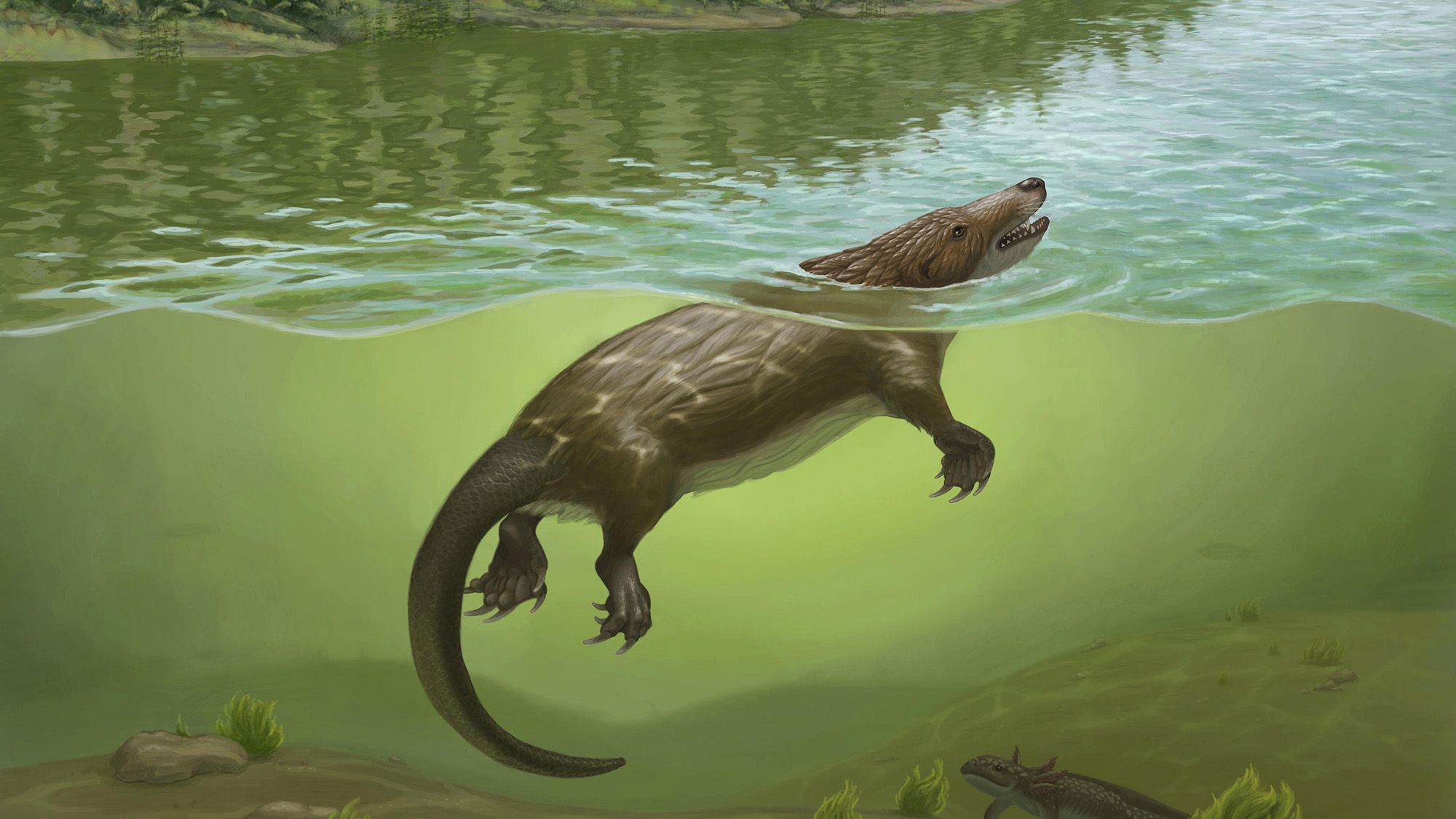
A newly discovered platypus-like creature is the largest-known mammal relative from the entire Jurassic period, a new study finds — although it still only weighed as much as a Chihuahua.

The critter, which hunted salamanders in the freshwater lakes and rivers of what is now Inner Mongolia, China, lived during the mid-Jurassic between 168 million and 163 million years ago. It seems to be the earliest known mammal-type animal that lived a semiaquatic life.

Researchers unearthed the delicate and detailed fossil in 2016, which revealed that the animal likely weighed about 2.2 to 4.4 pounds (1 to 2 kilograms). It was large for a mammal relative during the Jurassic, but its name, Megacauda sungei, was inspired by its tail: Megacauda means “big tail.” The discovery was detailed in a study published on Wednesday (Oct. 7) in the journal Nature.

Latest Videos FromLive Science

The furry predator had a mix of features seen in modern-day animals, with a broad, flattened tail that marks it as a powerful swimmer, and short hind legs with relatively long feet.

“It’s like a chimera,” study co-author Zhe-Xi Luo, a paleontologist at the University of Chicago, told Live Science. “The back half of this animal is very much like a platypus. As are the limbs, which would be capable of swimming or digging tunnels in river banks.”


You may like

But the teeth “are definitely not like a platypus,” Luo said. It possessed robust canines and shearing cheek-teeth that would cut and chew meat in a different way from modern carnivorous mammals. “It’s a predator with gigantic and very specialized canines,” Luo said. “So, it’s partly otter-like and partly platypus-like.”

A revealing fossil

The fossil of Megacauda sungei, highlighting its bones and soft tissue.

(Image credit: Luo et al., Nature (2026))

Tiny bits of vertebrate bones found in what would have been the animal’s stomach and the surrounding fossil beds hint that M. sungei dined on salamanders, Luo said.

He added that M. sungei may have sheltered in burrows on land in the temperate plant-filled climate, and hunted in lakes and rivers for fish and invertebrates.

Another notable aspect of the fossil is its throat. Modern mammals, including humans, have hyoid bones in the throat arranged in a “U”-shaped saddle. These help us use throat muscles to swallow chewed food one chunk at a time, instead of gulping down huge bites or whole prey. The structures also enable babies to suckle their mother’s milk.

M. sungei seems to have had the apparatus needed to do this, study co-author Thomas Martin, a paleontologist at the University of Bonn in Germany, told Live Science.


What to read next

“This is an incredibly important evolutionary innovation,” Luo said, adding that this capability is one of the things that helped early mammals diversify into carnivores, insectivores, herbivores or omnivores to take advantage of all sorts of foods.

Finding this in M. sungei suggests that the apparatus needed for suckling milk and swallowing had already evolved by the Middle Jurassic (around 174 million to 164 million years ago), Martin said.

This is before marsupials like kangaroos and placental mammals like primates and bears are thought to have diverged from each other 160 million years ago, after descending from an egg-laying common ancestor that lived approximately 180 million years ago.

“Now we push the history of it back to before the split of modern marsupials and modern eutherian [placental] mammals,” Luo said.

“Neonatal suckling behaviour was previously thought of as being a hallmark of advanced mammals, but it now appears to have evolved well before then, in the common ancestor of docodontans and mammals at least 165 million years ago,” said Sue Hand, a vertebrate paleontologist at the University of New South Wales in Australia who wasn’t involved in the study.

M. sungei is from an extinct lineage of docodonts, which are relatives of mammals from the dinosaur-dominated Jurassic and Cretaceous periods, living between about 200 million and 120 million years ago.

Docodonts adapted to a wide variety of habitats. For example, there was the Jurassic tree-dwelling shrew-like docodont called Microdocodon gracilis, and Docofossor brachydactylus, a tunnel-digger with shovel-like paws. Luo was also part of the team that described a semiaquatic “Jurassic beaver”, Castorocauda lutrasimilis, which lived 164 million years ago.

“It seems that an aquatic lifestyle arose often in early mammal-like species,” said Tim Flannery, a mammalogist at the Australian Museum Research institute who wasn’t involved in the work.

If anything, the newly described “spectacular fossil” shows that docodonts were wide-ranging during the dinosaur age, Hand told Live Science in an email.

“This very detailed study adds to accumulating evidence that mammaliaforms occupied a wide range of ecological niches long before the evolution of living mammals,” Hand said.

Li, Y., Li, P., Neander, A., I., Zhang, H., Zhou, C., Martin, T., & Luo, Z. (2026a). A Jurassic mammaliaform swimmer and transformation of the mammalian pharynx. Nature. https://doi.org/10.1038/s41586-026-11107-0


Share. Facebook Twitter LinkedIn Telegram WhatsApp Email

Keep Reading

1,000-mile-long cloud that forms and vanishes on Mars every day obeys ‘exotic physics’ never seen on Earth

1,000-mile-long cloud that forms and vanishes on Mars every day obeys ‘exotic physics’ never seen on Earth

‘We stocked an RV as an emergency bugout vehicle’: Readers share how prepared they are for a disaster

‘We stocked an RV as an emergency bugout vehicle’: Readers share how prepared they are for a disaster

‘Completely unexpected’: Astronomers spy never-before-seen ‘phoenix planet’ rising from the ashes of a dead star

‘Completely unexpected’: Astronomers spy never-before-seen ‘phoenix planet’ rising from the ashes of a dead star

Diagnostic dilemma: Woman ‘saw dead people’ and fired a gun at them after taking too many aspirin

Diagnostic dilemma: Woman ‘saw dead people’ and fired a gun at them after taking too many aspirin

Draconids 2026: The year’s most unpredictable meteor shower has begun, with fierce ‘meteor storms’ possible

Draconids 2026: The year’s most unpredictable meteor shower has begun, with fierce ‘meteor storms’ possible

Zombified cells may drive aging, and scientists are devising new ways to get rid of them

Zombified cells may drive aging, and scientists are devising new ways to get rid of them

Roboticists showcase tiny, frog-like robot that can hop across wet surfaces and swim

Roboticists showcase tiny, frog-like robot that can hop across wet surfaces and swim

Archaeologists discover a child’s skull built into the floor of a 2,500-year-old Scandinavian house

Archaeologists discover a child’s skull built into the floor of a 2,500-year-old Scandinavian house

Strange object firing a powerful beam of energy toward Earth could be the first known ‘microblazar’

Strange object firing a powerful beam of energy toward Earth could be the first known ‘microblazar’

Add A Comment
Leave A Reply Cancel Reply

Editors Picks

The surprising brain benefits linked to holding your breath for minutes: study

The surprising brain benefits linked to holding your breath for minutes: study

October 7, 2026
Jaguar reveals 0K electric vehicle two years after failed ‘woke’ rebrand video

Jaguar reveals $130K electric vehicle two years after failed ‘woke’ rebrand video

October 7, 2026
Trump celebrates all kids under 18 having a Trump Account — but parents must claim it for financial benefits

Trump celebrates all kids under 18 having a Trump Account — but parents must claim it for financial benefits

October 7, 2026
US military lost or damaged 81 aircraft in war with Iran, report finds

US military lost or damaged 81 aircraft in war with Iran, report finds

October 7, 2026

Subscribe to News

Get the latest USA news and updates directly to your inbox.

Latest News
We’re Sold! Maura Higgins Is the Latest Cool Girl To Rock the Striped Rugby Shirt This Fall

We’re Sold! Maura Higgins Is the Latest Cool Girl To Rock the Striped Rugby Shirt This Fall

October 7, 2026
Meet the woman behind Alex Cora’s decision to spurn the Phillies

Meet the woman behind Alex Cora’s decision to spurn the Phillies

October 7, 2026
‘It looks like a chimera’ — 168 million years ago, a strange platypus-like mammal relative lived in China alongside dinosaurs

‘It looks like a chimera’ — 168 million years ago, a strange platypus-like mammal relative lived in China alongside dinosaurs

October 7, 2026
Facebook X (Twitter) Pinterest WhatsApp TikTok Instagram
© 2026 USA Times. All Rights Reserved.
  • Privacy Policy
  • Terms
  • Advertise
  • Contact

Type above and press Enter to search. Press Esc to cancel.