




IBM has revealed a new modular, ultracold system designed to link hundreds of quantum computer chips together to solve one of the field’s biggest infrastructure bottlenecks.
The company says its new “quantum fridges” will let it deliver the world’s first fault-tolerant quantum computer in 2029. These stable systems use quantum error correction techniques to fix noise in real time and run quantum operations without interruption.
Achieving fault tolerance would allow computer scientists to carry out new research across a wide array of fields. Whether in chemistry, materials science or theoretical physics, researchers could conduct quantum operations well beyond the scope of modern supercomputers, without worrying about excessive errors rendering computations worthless.
Until now, one of the biggest hurdles standing between today’s error-prone systems and fault-tolerant superconducting quantum computers capable of performing a hundred million operations flawlessly has been the infrastructure. IBM representatives say they have solved this problem with its modular, interconnected quantum fridges.
Watch On
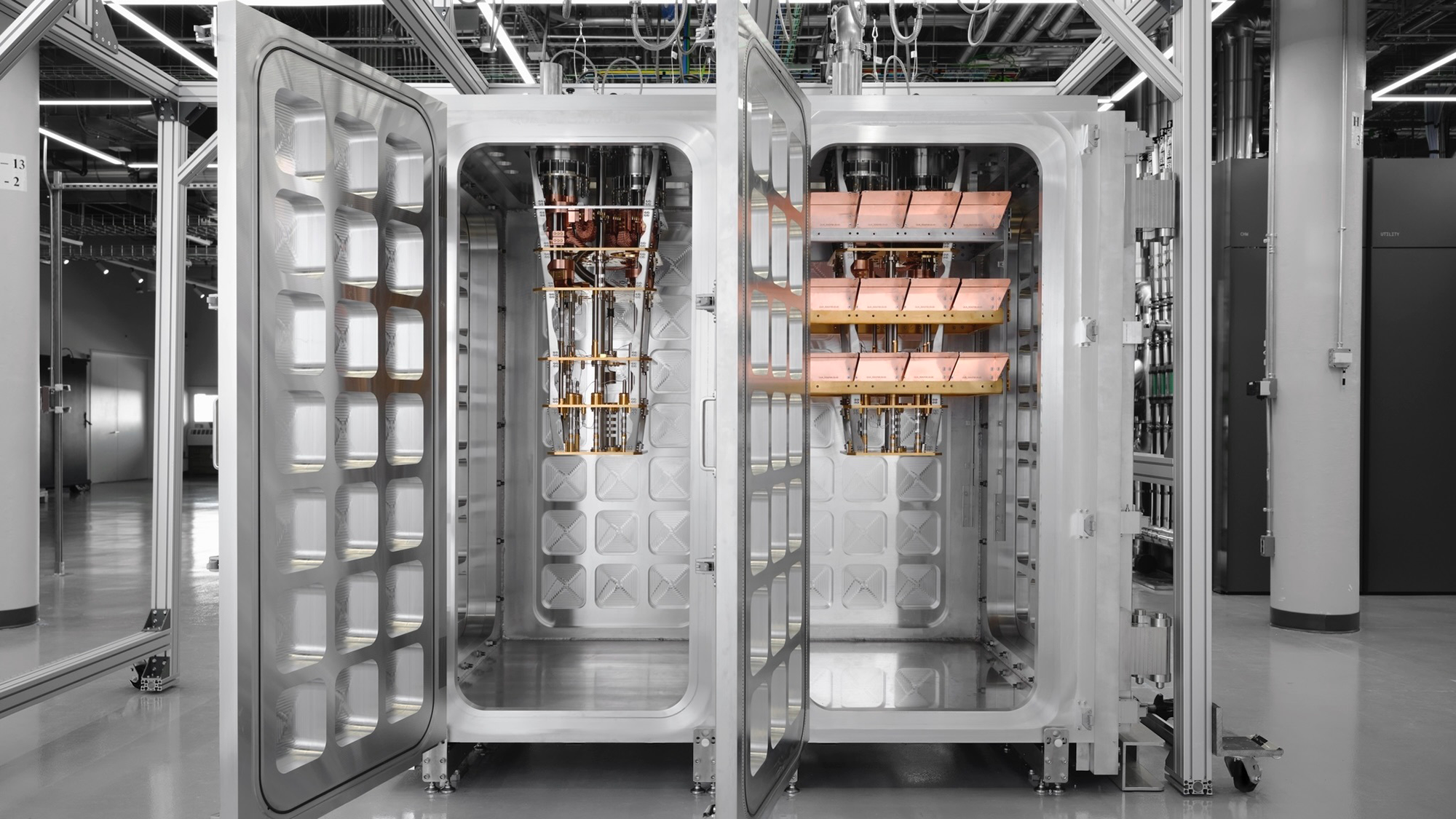
The new cryogenic system comprises individual units measuring 8 feet (2.4 m) tall by 8 feet wide, with an internal capacity of about 9 cubic feet (0.25 cubic m).
It looks like a household refrigerator and works similarly, but it can reach temperatures as low as 10 millikelvins (minus 459.65 degrees Fahrenheit, or minus 273.14 degrees Celsius) — close to absolute zero, the coldest theoretical temperature possible — which is more than 180 times colder than deep space.
These extremely low temperatures are necessary for IBM’s superconducting quantum processing units (QPUs) to operate properly, and the modular design allows engineers to expand a system’s capabilities and power one stage at a time.
Get the world’s most fascinating discoveries delivered straight to your inbox.
According to IBM representatives, this milestone represents the first time that scientists have demonstrated interconnectivity among QPUs between separate cryogenic modules.
Modular quantum computing
Just like their classical computing counterparts, superconducting quantum computers use built-in circuits, or “gates,” to conduct processing operations. Engineers can squeeze a finite number of qubits per chip, however, and each chip needs to be cooled to below 15 mK (minus 459.64 F, or minus 273.14 C) to function properly in IBM’s architecture.
That’s because qubits are inherently noisy — meaning they are naturally far more error-prone than conventional computing components. To tap into the quantum mechanical properties of the superconducting metals in the qubits without calculations failing, scientists must minimize interference from heat alongside other stimuli, like electromagnetic waves.
To achieve these temperatures in the new refrigerators, engineers use third-party cryogenic hardware that relies on helium cryo compressors paired with commercial dilution refrigeration engines for cooling. They maintain thermal protection using vacuum-sealed enclosures, electromagnetic interference gaskets, and multilayered Mylar super-insulation heat shields.
It takes more than four days for the modules to reach a temperature of about 4 K (minus 452.47 F, or minus 269.15 C), with the final push to sub-15-mK temperatures occurring shortly thereafter, IBM representatives said in a statement.
Expanding beyond a few hundred or thousand gates requires more chips and more space. But engineers can’t just build a giant, ultracold building and fill it with QPUs. This would require enormous amounts of infrastructure and leave the system brittle. Every time an engineer needed to upgrade the system, troubleshoot a hardware fault, or inspect the chips, they’d have to break the temperature seal, potentially interrupting operations.

Dozens of IBM’s quantum fridges can be connected together in the future to run more powerful systems.
(Image credit: IBM)
IBM’s breakthrough cryogenics system overcomes this problem by giving engineers dedicated modules that can house a limited number of chips. The key innovation is the ability to network modules together to harness the combined power of the individual quantum processors. This is achieved through the implementation of “L-couplers,” superconducting cables that are approximately 3.3 feet (1 meter) long.
“Normally when we do quantum operations between qubits, we do them on chip,” Oliver Dial, vice president of quantum operations at IBM, explained at an Aug. 18 news conference. “And so we use on-chip couplers that go very short distances to create entanglement to let us do 2-qubit gates. What the L-couplers let us do is perform the same feat, but over an aluminum superconducting cable that can be up to about a meter long. And it’s really critical to us because it forms the foundation of our modular designs.”
Ushering in the new era of fault tolerance
IBM intends to deploy its new modular cryogenic architecture in 2027, with near-term systems using two to three cells supporting around 1,000 qubits in total. The goal is to reach 100 million gates — or 100 million quantum operations in a single session — by 2029 with the debut of IBM’s “Starling” quantum computer.
But first, it will need to perform computations across modules. So far, scientists have only demonstrated that two cryogenic modules can be interconnected and simultaneously cooled to the required operating temperatures. They tested the modules for simple gate operations with the “Flamingo” processor, but they have not yet conducted complex operations with them. The team intends to install its current generation “Nighthawk” processors in the coming days.

IBM will use this technology to power its Starling quantum computer, which is set to use 10,000 physical qubits organized into 200 logical qubits.
(Image credit: IBM)
“We have nailed down the science towards fault tolerance on computing, and … a big part of what we’re doing to get there now is engineering,” Jerry Chow, IBM’s chief technology officer of quantum-centric supercomputing, said at the news conference. “It’s not about a single breakthrough to get to fault tolerance. It’s really about thousands of these little engineering feats that we’re demonstrating all across our entire ecosystem, from processors, to the software stack, to the controls, to the infrastructure, to the error correction which sits on top.”
Quantum computing labs currently use other stand-alone cryogenics systems, and other quantum computing systems are being designed to operate at room temperature, such as those that use photons (particles of light) — or even lab-made diamonds — as qubits.
During the news conference, IBM representatives claimed that “Starling” will be the world’s first fault-tolerant quantum computer one day. But whether the company actually achieves this feat, given that other quantum computing companies are chasing the same milestone, is another question.
Can you match these ancient devices to their pictures? Find out with our computing quiz!